

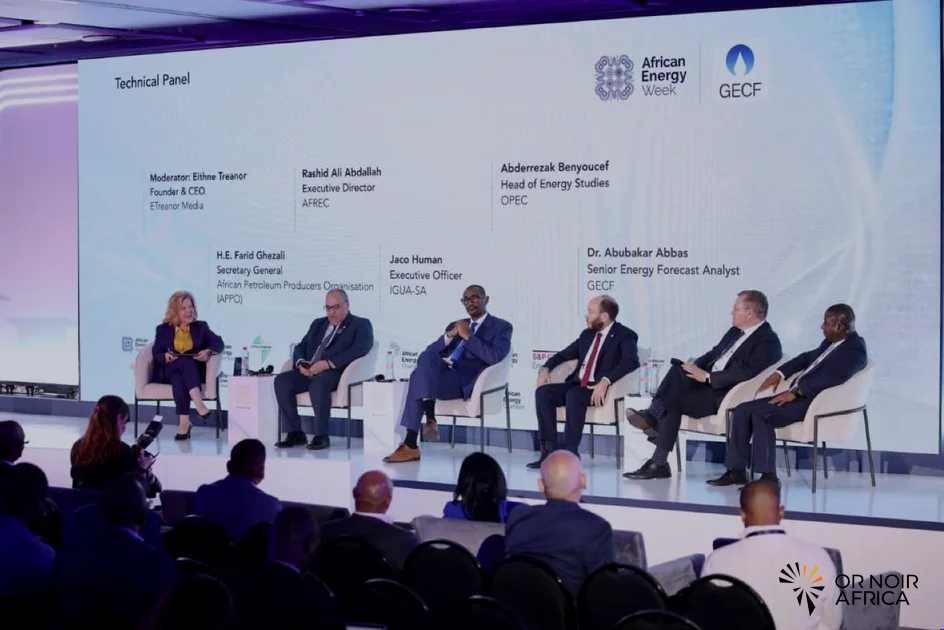
The African Energy Bank (AEB) is expected to become operational in the coming weeks and start financing projects in early 2027, said Farid Ghezali, secretary general of the African Petroleum Producers' Organization (APPO). The institution will be launched by APPO and Afreximbank and is to adopt a corridor-based approach, prioritising projects that connect several countries and create regional markets for gas.
The announcement at African Energy Week 2026 outlines a more targeted financing role than that of a bank covering all energy projects. Four pillars have been identified: export infrastructure, domestic infrastructure, clean cooking and power generation. This combination aims to reconcile resource commercialisation with local use, as many African markets lack pipelines, networks and financing to develop their own supply chains.
Corridors to connect producers and consumers
Gas corridors can bring production, transport, processing and consumption together within a single regional structure. They can include a cross-border pipeline, a power plant, industrial customers and export facilities. By expanding the number of potential buyers, they can improve a project's bankability and spread risks across several markets. Preparation nevertheless requires coordination among states on tariffs, standards, contracts and infrastructure security.
Ghezali stressed that exports and domestic supply should not compete. Exporting countries can mobilise international revenues and capital, while domestic use supplies electricity and industry. The challenge is to establish mechanisms guaranteeing volumes for local markets while allowing projects to generate enough revenue to finance infrastructure.
APPO and the Gas Exporting Countries Forum have signed an agreement to cooperate on corridors and harmonise transit tariffs and gas contracts. Harmonisation can reduce dispute risks and make trade more predictable. It also requires resolving differences among national rules, currencies, payment systems and domestic selling prices.
The regional financing gap
Rashid Ali Abdallah, executive director of the African Energy Commission, noted that recent investments have mainly supported export terminals, while regional pipelines and domestic infrastructure struggle to attract funds. This imbalance limits countries' ability to turn production into electricity and industrial activity. It also reflects the difficulty of financing cross-border projects whose revenues are shared across several jurisdictions.
Africa will need at least $1 trillion over the next thirty years to develop its gas resources, according to GECF estimates cited at the forum. The figure covers a range of investments, from exploration to distribution infrastructure. The priority is not simply to find capital, but to structure projects robust enough for lenders to assess risks, revenues and guarantees.
South Africa illustrates the coordination challenge. The country's industrial businesses risk losing part of their gas supply within roughly 18 months, while new infrastructure takes time to emerge. Industrial users grouped within IGUA-SA seek to aggregate demand and share supply risks. A pipeline between the Orange Basin and the Western Cape could require around 200 petajoules of annual demand. The difficulty identified is less a lack of customers than their coordination and the organisation of supply.
A bank to be judged by actual financing
The African Energy Bank enters a landscape where projects sometimes have potential demand but lack long-term contracts, preparation and risk-reduction instruments. Guarantees, offtake agreements, trade finance mechanisms and study facilities will be decisive. The institution will need to specify how it shares currency and sovereign risks, particularly in projects connecting several states.
Energy demand growth figures should not lead to automatically financing every new piece of infrastructure. Assessment must consider actual demand, affordable tariffs, transition risks, competition from renewable energy and climate commitments. Independent governance and public criteria will help prevent the bank from favouring politically visible but economically fragile projects.
The initiative can help create regional markets and direct capital towards long-neglected needs. Its effectiveness will nevertheless be measured by projects reaching financial close, amounts disbursed, infrastructure commissioned and customers actually served. The establishment announced for 2027 will be the AEB's first test of credibility.
For APPO, the challenge is to make the bank a development tool rather than solely a channel for sector financing. Corridors can connect resources with electricity, industry and clean cooking, but only if local priorities are incorporated from the design stage. The next phase must therefore clarify the initial portfolio, selection rules and financing schedule.
Have any thoughts?
Share your reaction or leave a quick response — we’d love to hear what you think!
-
 0
-
0
-
0
-
0
-
0
-
0





