

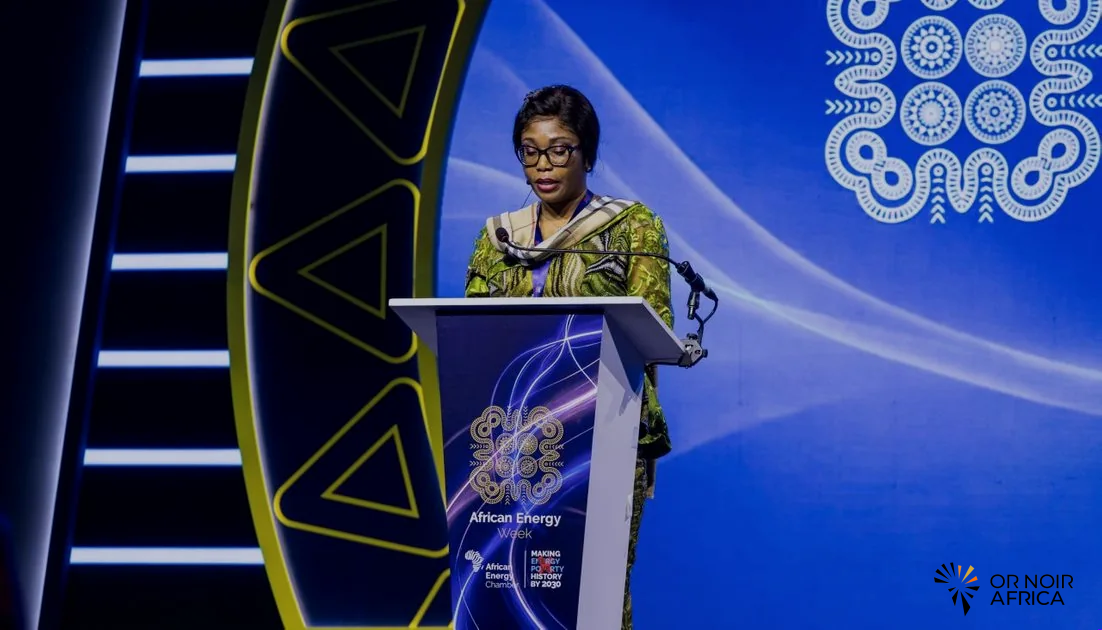
The Democratic Republic of the Congo is preparing a revision of its 2015 hydrocarbons law to modernise the fiscal framework and attract partners in exploration and infrastructure. Minister of State for Hydrocarbons Acacia Bandubola Mbongo presented these priorities at African Energy Week 2026. The legislation is under review: the proposed changes must not be considered already adopted or applicable to existing contracts.
The reform aims to clarify investment conditions while ensuring tangible benefits for the Congolese economy. Kinshasa wants in particular to reduce some tax burdens, strengthen transparency and incorporate provisions on governance, framework stability, local content and environmental management. This balance is central for a country with substantial geological potential but major constraints in infrastructure and implementation capacity.
Modernising the framework to attract partners
Law No. 15/012 of 2015 governs upstream and downstream petroleum activities. The government launched its review in July 2025 to adapt the rules to market conditions. Operators want precise information on tax obligations, revenue-sharing mechanisms, permitting timelines and investment rules. A clear framework can reduce uncertainty, but lower taxes do not necessarily attract capital if costs, risks and procedures remain difficult to predict.
The DRC highlights estimated oil potential of 22 billion barrels across the Central Basin, East African Rift and Atlantic coastal basin. Dozens of blocks are presented as open for exploration. This potential remains an estimate of resources to be confirmed and developed, rather than reserves that can be commercialised in the short term. Investors will need to assess data, geology, access costs and project feasibility in each area.
The Albertine Graben in the east of the country is presented as a priority. Discoveries in neighbouring Ugandan areas support regional geological interest without guaranteeing the same results across the border. The National Petroleum Data Bank, established in 2026, is intended to facilitate access to historical information and give companies a more structured basis for studying blocks.
Downstream activities and infrastructure are also on the agenda
The government seeks partners to meet demand in a domestic market of around 120 million people, where fuel consumption exceeds 100,000 cubic metres per month. Mining sites are major consumers requiring regular supplies. Authorities have identified needs for pipelines, storage depots, import and export terminals, refining capacity and distribution networks across several regions.
These investments can strengthen energy security and reduce logistical costs, but require reliable commercial contracts. Terminals and depots need customers able to commit to volumes and pay on time. Cross-border pipelines require agreements between countries, while refineries need access to feedstock and markets for their products. The design of the entire chain will determine whether projects can secure sustainable financing.
Mining demand can improve the economics of some infrastructure, particularly in provinces where extractive activities need diesel or electricity. But reliance on a single sector carries risks: mineral prices, mining production and security conditions can change. Integrated planning must connect mines' needs with other consumers, avoiding networks viable only with a few large customers.
Tax relief must be accompanied by transparency
The intention to ease some burdens aims to make projects more competitive. For the state, the difficulty is determining where incentives are genuinely necessary and measuring their contribution. Tax exemptions must be justified by additional investment, jobs, production or infrastructure that the project would not deliver on the same terms without support. Publishing the measures and their results would help preserve confidence and protect public revenue.
The government has said it wants Congolese people to benefit concretely from projects through skilled jobs, expertise, accessible services and local added value. This requires local content provisions to be accompanied by training programmes, supplier financing and criteria that enable national businesses to meet industrial requirements. Unclear obligations can create delays; consistently applied rules can instead strengthen local capabilities.
Transparency and environmental protection requirements will need to be integrated into the new framework from the drafting stage. Exploration and transport projects can affect communities, water, land and ecosystems. Early consultation, accessible remedy mechanisms and independent monitoring are necessary to prevent risks from becoming social or operational costs.
A reform to assess by its effects
The law's revision should be assessed against verifiable outcomes: permitting timelines, contracts awarded, investment committed, projects financed, production and state revenue. Signing memorandums or opening blocks to investors is insufficient to measure progress. Preparation stages and final decisions must be distinguished.
The DRC can use its oil potential to strengthen supply and its industrial base, but changing the legal framework will not automatically produce these results. Infrastructure, legal certainty, data quality and institutional capacity remain decisive. The reform's challenge is therefore to make rules predictable while protecting the country's share of value.
The priorities presented at AEW signal a willingness to change the framework after more than a decade. The next step will be publication of a precise text and definition of its implementation. Through the transparency of the process and results of the first projects, investors and citizens will be able to judge whether the reform truly reflects Kinshasa's stated energy sovereignty objective.
Have any thoughts?
Share your reaction or leave a quick response — we’d love to hear what you think!
-
 0
-
0
-
0
-
0
-
0
-
0





