

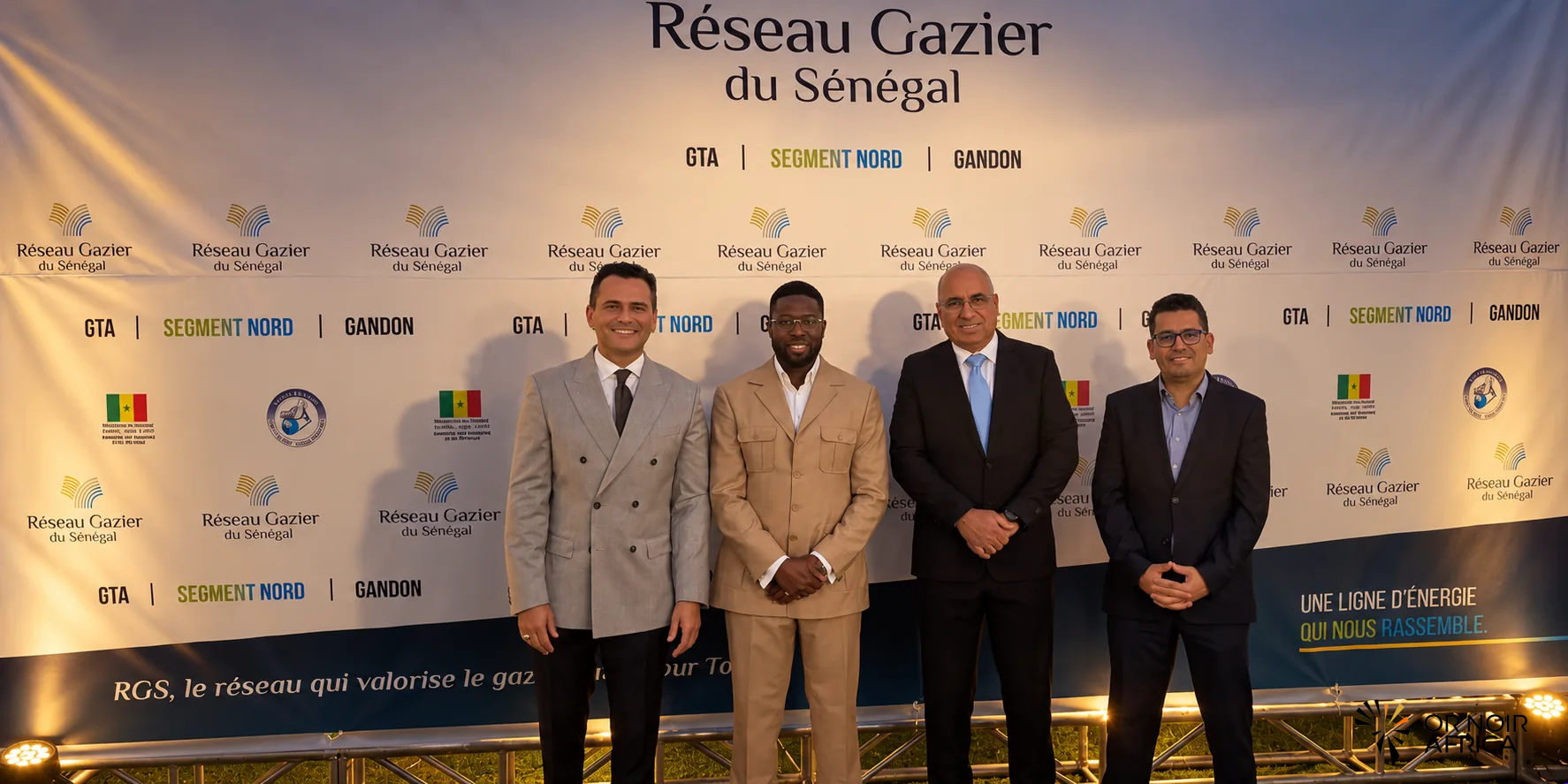
**Categories:** News, Gas **Tags:** Senegal, gas network, JESA, PETROSEN, gas infrastructure **Excerpt:** The JESA-led consortium is supporting Senegal's gas network in developing infrastructure spanning nearly 400 kilometres. The network is intended to link offshore resources to power plants and industrial areas, subject to financing and execution of its various sections. **Slug:** senegal-jesa-reseau-gazier-national-infrastructures **Image alt:** Representatives of Senegal's gas network project at a ceremony photographed in the evening.
Senegal has appointed a JESA-led consortium to provide project-owner support in preparing development and operation of its future national natural gas transmission network. The infrastructure, intended to extend nearly 400 kilometres, will connect offshore resources to power plants and industrial areas.
JESA works alongside OMCo, a subsidiary of Morocco's National Office of Hydrocarbons and Mines, and the French Antea group. The consortium supports Réseau gazier du Sénégal (RGS), a PETROSEN Holding subsidiary, in works management, technical interfaces, risk monitoring and operational preparation. Installation of the first pipeline in the northern section, held in September at Gandon, marked the visible start of this new phase.
Connecting offshore resources to local uses
The project forms part of Senegal's Gas-to-Power and Gas-to-Industry strategies. It is intended to transport offshore gas, particularly from the Grand Tortue Ahmeyim (GTA) project, to electricity generation facilities and industrial sites. The aim is to reduce dependence on imported fuels and give businesses more predictable energy access.
The northern section, with an announced length of around 85 kilometres, is designed to transport up to 300 million cubic feet of gas per day. It combines offshore and onshore sections. This nameplate capacity does not mean those volumes will be available at commissioning: deliveries depend on gas field schedules, construction, testing and supply contracts.
RGS ownership is shared between PETROSEN Holding with 51%, the Sovereign Fund for Strategic Investments (FONSIS) with 39%, and Senelec with 10%. This structure brings together the national petroleum company, public investor and electricity operator. It must support coordination between gas production, transport and end users.
An engineering and operational preparation role
Project-owner support aims to safeguard programme stages. The consortium contributes to contracting, technical supervision, schedule monitoring, interface coordination and operational preparation. These functions are particularly important for a network linking offshore facilities, onshore works and industrial sites subject to high safety standards.
Operational preparation starts before construction ends. Operators must define maintenance procedures, emergency management, spare-part availability and staff training. Long-term performance will depend on construction quality and the ability to maintain pipeline, pressure-reduction station and control equipment integrity.
Using Moroccan and French expertise illustrates regional cooperation on energy infrastructure. OMCo brings experience particularly associated with managing the Maghreb–Europe Gas Pipeline. Transferring skills to Senegalese teams will be central to local network operation with control of costs and risks.
Gas availability is not enough
Supporting the economy requires a complete chain: offshore production, supply contracts, transport, suitable power plants and creditworthy consumers. If one section is delayed or gas volumes vary, plants may continue using alternative fuels. Delivery reliability and pricing will determine gas's appeal for industrial users.
Gas can contribute to electricity security by providing dispatchable generation and replacing some liquid fuels. However, its role must be assessed over time, accounting for costs, methane emissions and renewable development. The network can also support industry if consumption areas are connected at a competitive price.
Local content is another project dimension. Construction can involve Senegalese businesses and workers in building, security, logistics and maintenance. Accessible tenders, training requirements and predictable payments will help SMEs participate. Benefits must be measured in awarded contracts, lasting jobs and transferred skills.
A major project to track in stages
Installation of the first pipeline is a milestone, but the complete network will develop section by section. The most useful indicators will be physical progress, available financing, section commissioning, volumes actually transported and the number of connected customers.
The project can improve Senegal's energy security and support industrialisation if production, transport and demand evolve together. JESA's support aims to strengthen technical and operational programme management. Success will ultimately be judged by gas availability, network reliability and tangible benefits for power plants, businesses and areas along the route.
Have any thoughts?
Share your reaction or leave a quick response — we’d love to hear what you think!
-
 0
-
0
-
0
-
0
-
0
-
0