

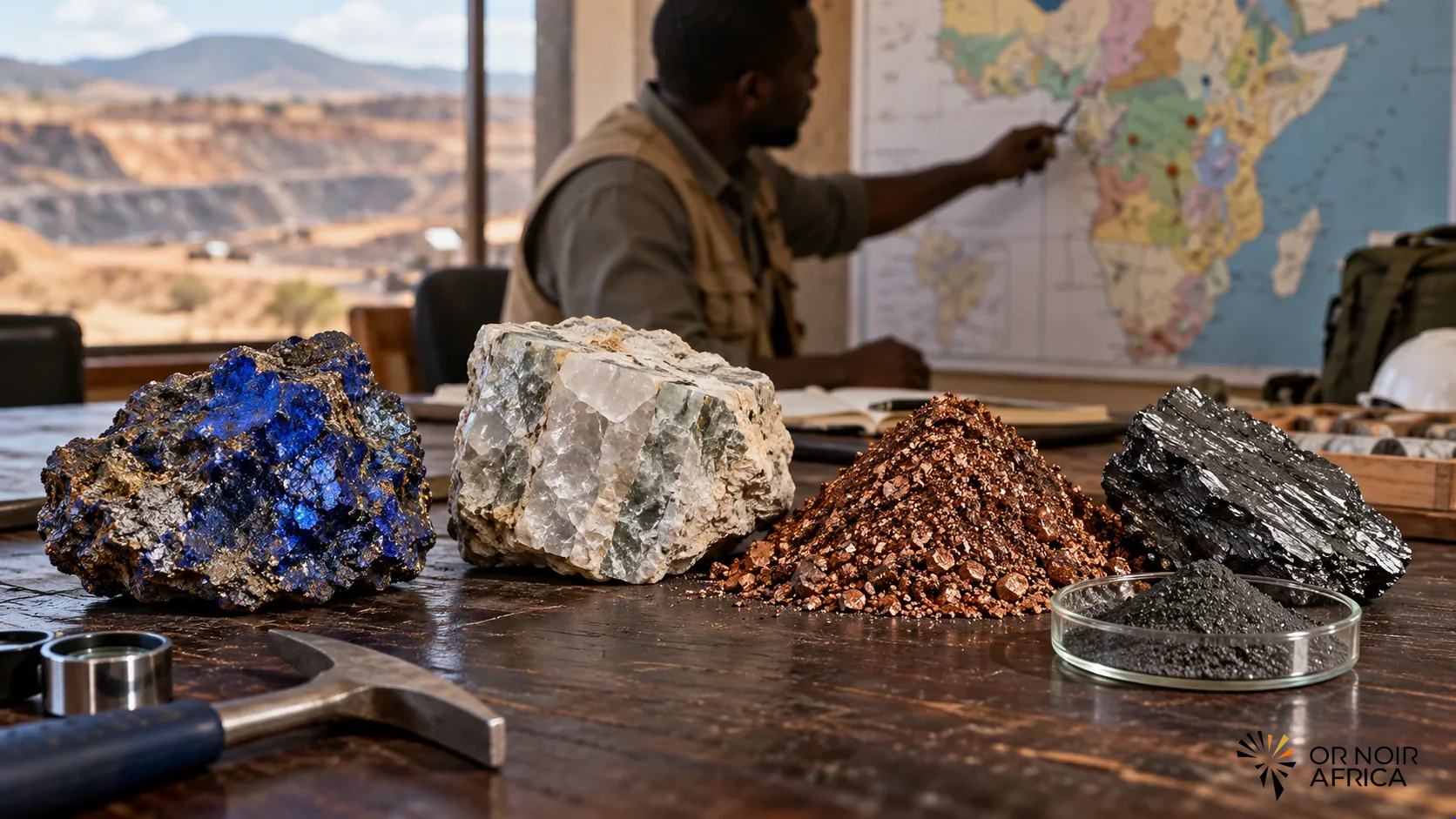
**Categories:** News, Mining **Tags:** Turkey, mining investment, Africa, critical minerals, economic cooperation **Excerpt:** From Angola to Niger and Senegal, Ankara is stepping up agreements and discussions on mineral resources. Its presence still relies largely on cooperation frameworks; their conversion into exploration, financing and production remains to be demonstrated. **Slug:** turquie-partenariats-miniers-afrique-investissements **Image alt:** Geologists and engineers examine mineral samples in a field laboratory in Africa.
Turkey is gradually expanding its economic relations with African countries and making mineral resources one of the pillars of this strategy. Memorandums, technical exchanges and diplomatic meetings are taking place from Niger to Senegal, as well as in Egypt, Sudan, Nigeria and Angola. The aim is to develop cooperation on exploration, mining technologies and access to strategic minerals.
A meeting held on October 6, 2026, between Turkey’s ambassador to Angola and Angola’s minister of Mineral Resources focused in particular on partnership opportunities. It forms part of a broader trend, without at this stage constituting an announcement of a major investment or a financed mining project. This distinction matters: an increasing number of diplomatic agreements does not automatically translate into commercial operations.
From memorandums to operational projects
Nigeria and Turkey signed a memorandum on mining sector cooperation in May 2026. The framework covers investment promotion, geological research, data exchanges, beneficiation technologies, training and skills development. Nigeria is seeking capital and expertise to develop a sector where exploration and processing remain constrained by infrastructure and financing.
In Senegal, a memorandum signed in 2024 provides for cooperation on critical minerals and rare earths. Other initiatives have been undertaken with Niger, Egypt and Sudan. Turkey’s state-owned MTA International Mining notably carried out exploration work in Sudan from 2018 before suspending it for security reasons. This example shows that agreements and geological studies are exposed to security conditions and operational risks.
For a memorandum to become a project, several steps are necessary: selecting a deposit, feasibility studies, obtaining permits, financing, infrastructure, sales contracts and environmental assessment. Governments must also clarify local content obligations and risk sharing. Cooperation announcements should therefore be tracked through implementation indicators.
Why African minerals interest Ankara
Critical minerals have become an industrial priority for countries seeking to secure their supply chains and develop sectors such as batteries, electronics and energy equipment. Africa has diverse geological potential and growing markets. For Turkey, a presence in mining activities can complement its commercial and industrial ties on the continent.
Cooperation can cover exploration, engineering, equipment, training and processing. Turkish companies could contribute technical skills and commercial relationships with suppliers and buyers. African countries, for their part, seek partners capable of investing and supporting local capabilities. The benefits will depend on negotiated terms and the role given to domestic businesses.
Strategic interest does not remove the need for economic analysis. Mineral prices are volatile, infrastructure costs can be high and some deposits require substantial investment before any production. The availability of electricity and transport can determine the viability of a processing facility. Projects must also account for environmental standards and community rights.
International competition can strengthen negotiating power
Turkey is not alone in seeking mining partnerships in Africa. Companies and governments from Asia, Europe, the Gulf and North America are entering more agreements to secure resources and develop value chains. This competition can give African states more options, provided they compare proposals and avoid excessive dependence on a single partner.
Authorities can use tenders and regulatory frameworks to require appropriate training, subcontracting and processing plans. Commitments must remain realistic and consistent with the size of the deposit. A local refining requirement without reliable energy or a market can delay a project, while an agreement focused too narrowly on raw ore exports limits opportunities to add value.
Turkish agreements will be assessed against concrete results: capital invested, permits obtained, exploration work financed, production started, workers trained and purchases from local businesses. Intermediate milestones must be made public to distinguish announcements from active projects.
Turkey’s mining presence in Africa therefore remains in a phase of diplomatic and commercial expansion. It can create opportunities for financing and skills transfer, but its impact will depend on converting cooperation frameworks into viable projects. For producing countries, the challenge is to attract partners while strengthening their ability to negotiate benefits and build sustainable value chains.
Have any thoughts?
Share your reaction or leave a quick response — we’d love to hear what you think!
-
 0
-
0
-
0
-
0
-
0
-
0





