

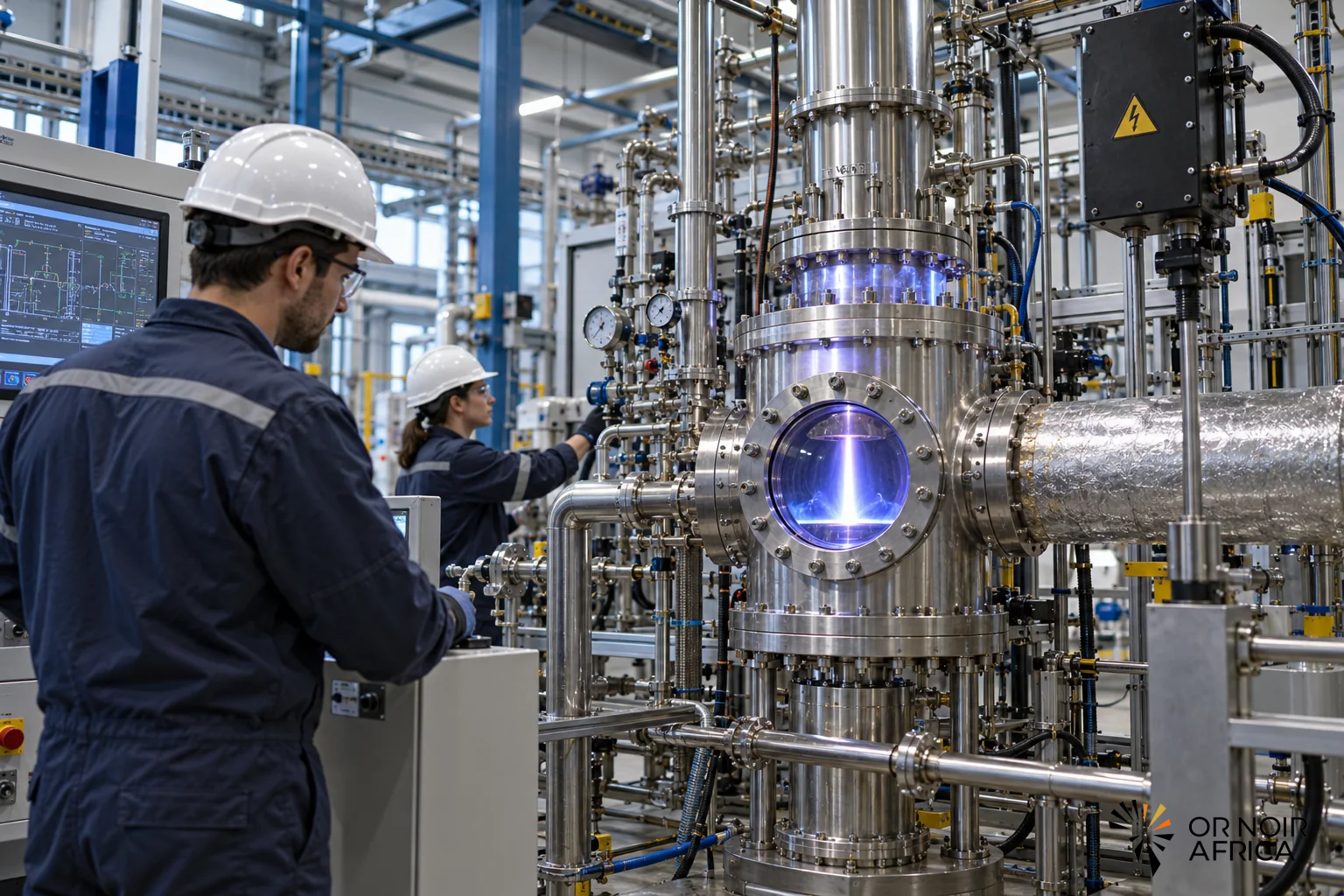
**Categories:** Analysis, Energy **Tags:** hydrogen, plasma pyrolysis, industrial decarbonisation, methane, energy technologies **Excerpt:** Plasma pyrolysis breaks methane down into hydrogen and solid carbon without directly forming CO₂ in the reaction. A consultancy estimates that this niche market could grow rapidly, but electricity consumption, costs and the commercial value of the carbon remain decisive uncertainties. **Slug:** pyrolyse-plasma-hydrogene-marche-perspectives-limites **Image alt:** Engineers wearing safety equipment observe a pilot methane plasma pyrolysis reactor at an industrial facility.
Methane plasma pyrolysis is attracting industrial companies seeking solutions to produce hydrogen with lower emissions. The process applies substantial electrical energy to break methane molecules down into hydrogen and solid carbon. Unlike conventional reforming, the reaction does not directly produce carbon dioxide. This feature is nevertheless insufficient to automatically describe the hydrogen as ‘clean’: the methane's origin, the electricity used and carbon management determine the overall footprint.
A market report published in October 2026 estimates that the sector could grow from approximately $9.2 million in 2025 to $104 million in 2033, with an announced compound annual growth rate of 34.6%. This remains a very small market in absolute terms, and projections are not contracts, already-installed capacity or a guarantee of demand. The document also contains an inconsistency between its promotional title, which refers to $145 billion, and its detailed tables, which give $104 million by 2033. The detailed figures must therefore be read cautiously.
A reaction different from conventional processes
Plasma pyrolysis uses a reactor in which an arc or another plasma device heats the gas to very high temperatures. Methane then separates into hydrogen and solid carbon. This carbon can potentially be commercialised in certain materials or industrial processes, differentiating the business model from simple gas production.
The technology could interest refineries, chemicals, ammonia production and certain steelmaking processes that already consume hydrogen. A facility located near an industrial user could limit transport requirements and integrate with existing infrastructure. Pilot projects and recent financing show that developers are seeking to move from demonstration to larger units.
Comparison with electrolysis and gas reforming nevertheless depends on local conditions. Electricity and gas costs, water availability, compression and purification costs, and annual operating hours significantly affect the price of delivered hydrogen. Commercialising solid carbon can improve revenues, but requires consistent specifications and a market capable of absorbing the volumes produced.
A market that still needs to prove its model
Market assessments forecast rapid growth from a limited base. Estimates depend on how the sector is defined: reactor sales, technology licences, hydrogen production or integrated systems. They also rely on deployment assumptions that can vary with energy policy, low-carbon electricity availability and changes in methane prices.
The main technical challenge is electricity consumption. Plasma requires substantial power, and equipment for generation, gas treatment and carbon recovery represents considerable investment. For an industrial site, the challenge will be to demonstrate competitive energy efficiency, availability and costs at commercial scale, beyond laboratory or pilot results.
Solid carbon is not automatically a high-value co-product. Its market depends on purity, form and properties. Carbon black, graphite and other materials markets have different requirements and limited absorption capacity. If supply exceeds qualified demand, the co-product's price could fall below developers' forecasts.
The climate question must be assessed across the full lifecycle. When methane is fossil-derived, upstream leaks can reduce the process's potential advantage. If electricity comes from high-emitting power plants, indirect emissions can also be substantial. Emissions associated with gas, energy and carbon management must therefore be measured and compared with competing methods.
Implications for gas-producing countries
For African economies with gas resources, the technology could offer an option for local value creation if industrial users are present. Local hydrogen production could support chemicals, refining or certain materials. However, this prospect requires firm markets, reliable electricity supply and a clear environmental framework.
Public authorities must avoid confusing technological potential with economic maturity. Before granting incentives or launching infrastructure, plasma pyrolysis should be compared with renewable-powered electrolysis, reforming with carbon capture and direct electricity use. The choice will depend on local costs, emissions, volumes and end uses.
In the short term, the market will probably remain driven by pilot projects and targeted industrial applications. Indicators to monitor include capacity actually commissioned, cost per kilogram of hydrogen, electricity consumption, the quality of carbon produced and sales contracts. Plasma pyrolysis deserves a place among the available solutions, but expansion will depend on measurable commercial and climate evidence.
Have any thoughts?
Share your reaction or leave a quick response — we’d love to hear what you think!
-
 0
-
0
-
0
-
0
-
0
-
0