

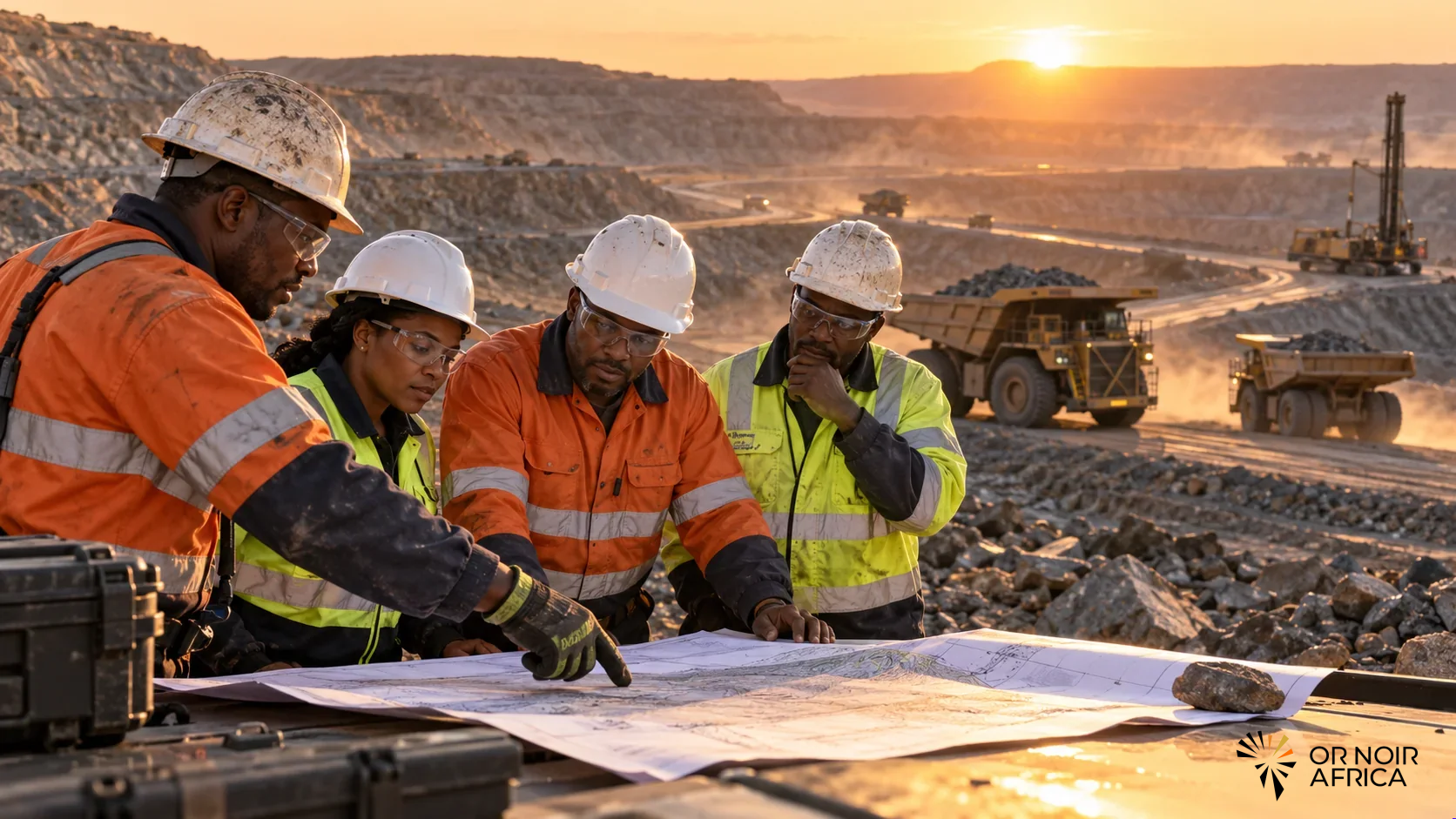
**Categories:** News, Energy, Mining **Tags:** South Africa, investment, infrastructure, energy, mineral processing **Excerpt:** Pretoria targets approximately 3 trillion rand of investment between 2026 and 2030, equivalent to nearly $181 billion. The challenge will be to turn announcements into capital actually deployed, particularly in energy, transport, mining and industrial processing. **Slug:** afrique-du-sud-objectif-investissement-181-milliards-projets **Image alt:** South African engineers and mining managers examine plans for an industrial project at an open-pit mine.
South Africa intends to attract approximately 3 trillion rand of investment over 2026–2030, equivalent to nearly $181 billion according to the estimates used in the program’s presentation. This ambition aims to accelerate infrastructure modernization, strengthen energy security, support mining activity and expand the country’s industrial capacity.
The figure indicates the scale of the expected effort but must be put in context. At the sixth South African investment conference, held in March 2026, authorities announced commitments of 889.8 billion rand for 81 projects. The new five-year target is to build on these announcements and public infrastructure spending. An investment pledge, however, is not equivalent to a funded construction project or expenditure already injected into the economy.
The main test: delivering on commitments
Experience from the first investment mobilization cycle shows the difference between commitments and realized investments. Official figures report approximately 634 billion rand that had actually entered the economy by March 2026 from earlier commitments, with projects completed or under construction. Monitoring execution will therefore be as important as announcing the new target.
The factors that turn pledges into projects are well known: bankable studies, permits, electricity grid access, land availability, financing, logistics and regulatory predictability. An announced project can be delayed by an electricity connection, insufficient rail access or changing financing conditions. The volume of pledges alone does not indicate their maturity.
Pretoria highlights a public infrastructure program of approximately 1 trillion rand over several years. Transport, electricity, roads, ports and water are to support private investment by reducing costs and operational constraints. Development banks and institutional investors can supplement public financing, particularly by sharing the risks of long-term projects.
Energy and logistics at the heart of competitiveness
Electricity reliability remains essential for industry, mines and new processing projects. Sector reforms and the growth of private producers have helped expand the energy project pipeline, but grid connection and transmission line expansion remain challenges. Announced generation capacity becomes useful only if electricity can be delivered to consumers.
The same logic applies to logistics. Mines need reliable rail and port corridors to move ore and processed products. Delays or capacity restrictions affect export revenues and can reduce the appeal of new mines. Infrastructure investment can therefore deliver benefits for energy, exports and industrial employment alike.
Local mineral processing is another focus of the program. South Africa has an industrial base, mining expertise and strategic resources, but creating value locally depends on energy, markets, technology and cost competitiveness. Refining or manufacturing projects must connect to strong outlets and regional value chains rather than rely solely on political targets.
Measuring results beyond announced capital
The investment program is also presented as a driver of job creation and growth. To assess its effects, indicators will need to distinguish announcements, financial closes, committed expenditure and assets actually in operation. Expected jobs must be compared with positions created, and promised energy capacity with megawatts actually available.
The sectoral and geographic distribution of projects also matters. Investment concentrated in a few major hubs can leave some provinces and small businesses behind. South African suppliers, SMEs and training organizations can benefit from the cycle if contracts are accessible and skills requirements are anticipated.
Authorities therefore have an interest in publishing regular updates on project progress, obstacles and amounts disbursed. Transparency improves investor confidence and helps identify reforms that deliver results. It also gives the public a basis for assessing the economic significance of announcements.
The $181 billion target reflects a desire to reposition South Africa as an investment destination and industrial platform. Its credibility will nevertheless depend on execution. If commitments translate into more reliable grids, competitive mining projects and new productive capacity, investment mobilization can support more sustainable growth. Without that conversion, the figure will remain an indicator of ambition rather than an economic result.
Have any thoughts?
Share your reaction or leave a quick response — we’d love to hear what you think!
-
 0
-
0
-
0
-
0
-
0
-
0





