
Growth in Ivorian gold is creating a market alongside mining itself: sample analysis. At Koné, MSALABS has begun processing samples for Montage Gold under a five-year contract. In Korhogo, another facility is preparing to receive its first samples before the end of 2026. These projects meet an essential technical need while raising an industrial question: what share of mining analysis can be performed sustainably in Côte d’Ivoire?
The laboratory’s decisive role
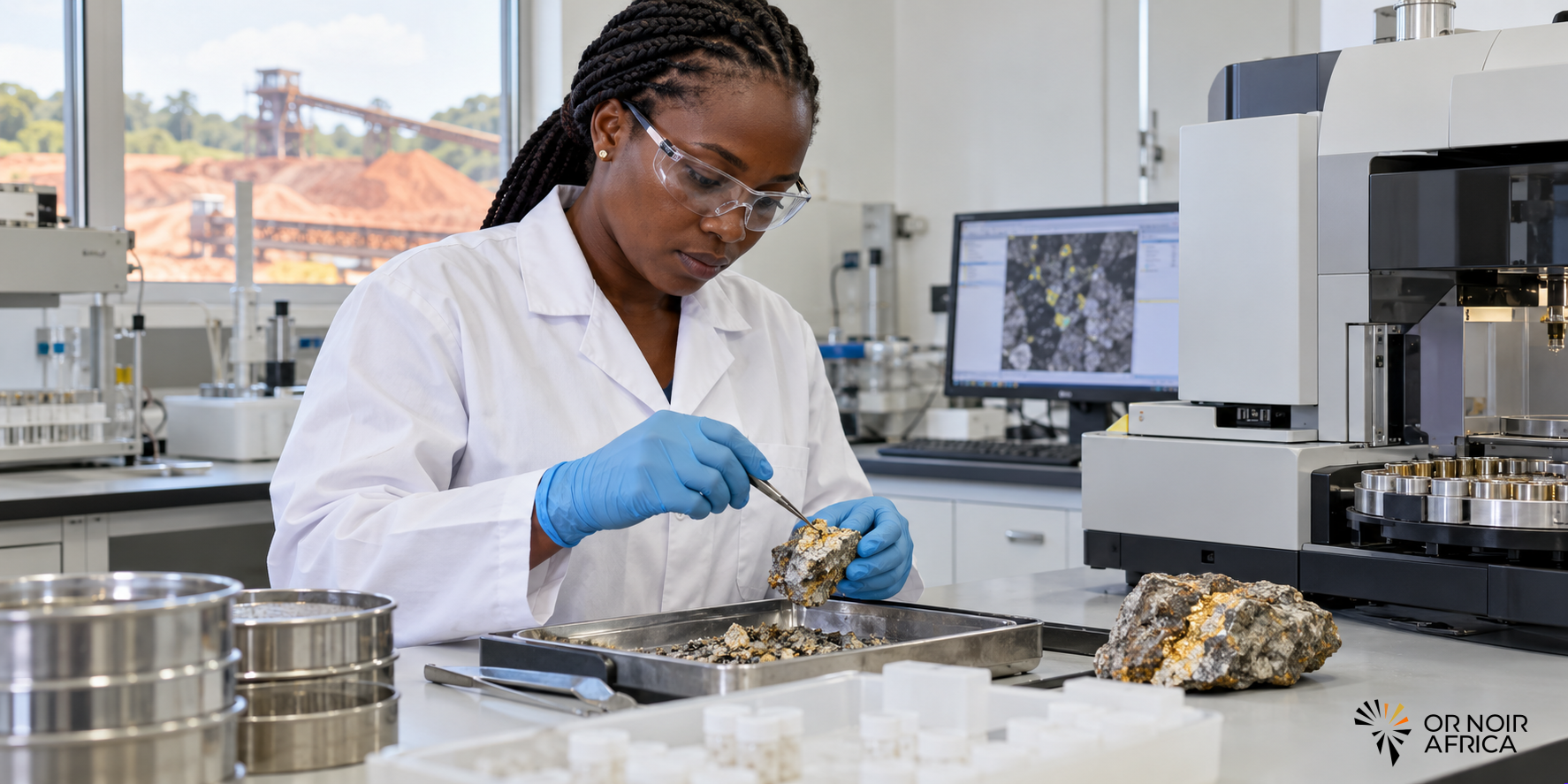
Before deciding where to drill, which area to mine or what ore will feed a plant, a company must measure rock composition. Geologists collect samples at different depths; laboratories prepare them and quantify gold grades and other elements. Results feed into resource estimates and the technical and economic studies that determine whether a deposit can be developed.
At Koné, MSALABS, a Capital Limited subsidiary, is building and operating a laboratory at Montage Gold’s future mine site. The contract runs for five years and provides analysis capacity close to operations. Faster turnaround may help teams adjust drilling campaigns and avoid routinely transporting samples to distant laboratories. Activity levels will nevertheless depend on the exploration timetable and the project’s subsequent production ramp-up.
In Korhogo, MSALABS is preparing a second facility scheduled to start before year-end. Its opening could expand the local service offering. As with any new capacity, steady demand will determine whether equipment is sufficiently utilized to cover operating costs and maintain competitive turnaround times.
Competition is already established
International operators have been present for several years. SGS opened a commercial laboratory in Yamoussoukro in 2022, adding gold analysis to its sample preparation activities. Bureau Veritas operates a mining laboratory in Abidjan’s Yopougon industrial zone. This presence reflects demand from growing mines and exploration programs, but also exposes local facilities to competition based on accuracy, speed, costs and reliability.
Laboratories can also share different stages of a campaign. Samples prepared in Yamoussoukro have been sent to Ghana for gold analysis and Ireland for other elements. Check analyses at a second laboratory help verify results. This practice safeguards quality, but also means that part of the service value and laboratory expenditure leaves the country where the ore is explored.
MSALABS generated global revenue of $73.5 million in 2025, up 68.2% year on year, according to Capital Limited’s figures. The company expected $85 million to $95 million in 2026. These figures cover the entire international network and do not indicate expected revenue from Ivorian facilities.
The role of national expertise
The Société pour le développement minier de la Côte d’Ivoire (SODEMI) also has a laboratory in Abidjan. Its gold analysis service obtained ISO/IEC 17025 accreditation in 2023, recognizing technical competence for specified tests. Accreditation may support customer confidence, but does not itself guarantee orders. Well-maintained equipment, quality-control procedures, reliable turnaround times and qualified staff are also needed.
SODEMI Director General Koné Moussa Seydou highlights the precision of the public laboratory’s equipment, which can measure metal grades at fine scales. This technical strength may enhance its credibility with operators without itself guaranteeing contracts.
Ivorian authorities want to increase the use of this expertise in mining. In May 2026, SODEMI presented its services to artisanal miners as part of efforts to support professionalization. Reliable analysis can support traceability and help miners better understand the value of their output. It nevertheless replaces neither formalization rules nor controls on gold marketed.
For national laboratories, the challenge is turning accreditation and expertise into regular business. Companies must trust results and facilities’ ability to handle large volumes. Orders may be shared among several providers according to investor requirements and verification protocols.
From mining potential to local value
Côte d’Ivoire’s gold production has almost quintupled since 2012, supported by new mine openings and expansions of existing sites. Exploration and new project development should sustain demand for analysis. Sector growth will nevertheless not automatically create a complete local service chain. Laboratory companies must demonstrate competitiveness against foreign providers and win contracts that ensure equipment utilization.
Indicators to monitor include samples processed locally, turnaround times, the share of analyses outsourced abroad and the value of contracts won by Ivorian businesses. Cooperation between public and private laboratories could complement the offering, provided that results remain independent and methods transparent.
New projects in Koné and Korhogo signal that analysis is becoming a distinct segment of Côte d’Ivoire’s mining ecosystem. Their contribution to value creation will now depend on regular orders, recognition of results and national players’ ability to capture a larger share of services associated with exploration and production.
Have any thoughts?
Share your reaction or leave a quick response — we’d love to hear what you think!
-
 0
-
0
-
0
-
0
-
0
-
0