

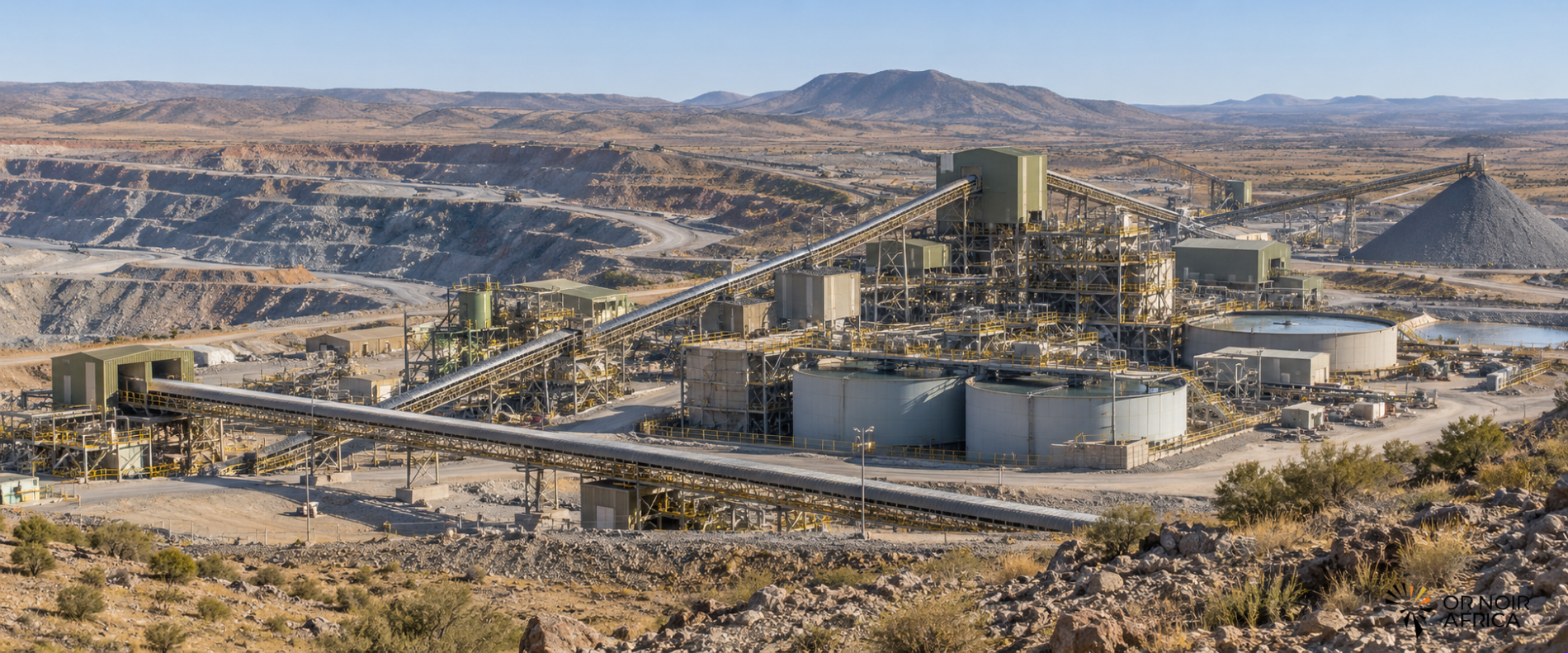
Ongoing investment in three mines in southern Africa could strengthen the continent’s zinc production capacity. The most visible development is the completion of Gamsberg’s second phase in South Africa, where annual concentrate capacity is expected to increase from around 250,000 to nearly 500,000 tonnes once ramp-up is complete. The trend also involves Kipushi in the Democratic Republic of the Congo and Rosh Pinah in Namibia, but the announced targets do not all represent volumes already produced.
Gamsberg doubles its production potential
South African President Cyril Ramaphosa inaugurated the Gamsberg Phase II concentrator on October 16. The mine is operated by Vedanta Zinc International in Northern Cape province. According to information released by the South African authorities, the expansion is expected to increase ore processing from around four million to eight million tonnes a year and bring annual zinc-in-concentrate production to between 450,000 and 500,000 tonnes.
Commissioning marks the completion of construction, but commercial volumes will depend on ramp-up, ore grades and equipment performance. Installed capacity is a design ceiling, rather than a guarantee of annual production from the first year. The operation will also need to manage inputs, water, energy, maintenance and ore movements to maintain steady operations.
The project is presented as a major industrial investment in the country’s north and is expected to support between 800 and 1,000 jobs during operations. Its local impact will depend on contracts awarded to regional businesses, training and job stability once construction ends. Announced employment targets will need to be compared with jobs actually created and purchases from South African suppliers.
Kipushi and Rosh Pinah add to regional growth
In the DRC, Ivanhoe Mines has completed a debottlenecking program at Kipushi intended to increase annual ore-processing capacity by around 20%. The mine recorded record quarterly volumes in the early months of 2026. Ivanhoe forecasts production of up to 290,000 tonnes of zinc this year, compared with 203,168 tonnes in 2025. This is the operator’s forecast, and achieving it will depend on operational performance and the quality of the ore processed.
In Namibia, Rosh Pinah’s RP2.0 expansion is expected to double processing throughput from 700,000 to 1.4 million tonnes of ore a year. Appian Capital Advisory, which owns the mine, is targeting average production of around 77,000 tonnes of zinc a year after the expansion. The project has entered its final construction stage, but this average target does not mean the new level will be reached as soon as it is commissioned.
These operations follow different paths: Gamsberg is expanding substantial industrial capacity, Kipushi is optimizing a producing mine, and Rosh Pinah is modernizing an existing facility. The figures are not directly comparable, since some describe ore processed, others contained zinc or concentrate produced. This distinction is essential when assessing the supply that can actually reach smelters.
Demand supports investment without eliminating risks
Zinc is mainly used to protect steel against corrosion, but it is also used in alloys and equipment for construction, transport and infrastructure. The energy transition adds demand for galvanized steel for grids, renewable energy installations and certain industrial equipment. This trend may strengthen demand expectations, but it does not guarantee high prices or sufficient margins for every mine.
Mining production must also be distinguished from refining. Concentrate may be exported to a smelter outside the producing country; an increase therefore does not automatically mean more refined metal, local manufacturing or domestic value added. The challenge for the countries concerned will be to capture a greater share of the value chain while ensuring access to the necessary infrastructure, skills and energy.
South African, Congolese and Namibian investment may reduce dependence on a handful of global sources, but it does not eliminate market risks. Greater supply, rising operating costs or project delays can shift the balance. Final expansion decisions and expenditure remain exposed to financing conditions and metal prices.
Ramp-up remains to be confirmed
The coming quarters will allow the actual contribution of Gamsberg Phase II and the other projects to be assessed. Indicators to watch include tonnes processed, contained zinc production, unit costs, utilization rates and the pace of local recruitment. Announced targets indicate growing regional capacity; operating results will confirm whether that capacity becomes stable supply.
For southern Africa, zinc growth offers an industrial opportunity, provided that governments and operators support mines with reliable infrastructure and a realistic processing policy. The challenge extends beyond extracting more. It also involves ensuring that new capacity is competitive, meets lasting needs and delivers measurable benefits in mining regions.
Have any thoughts?
Share your reaction or leave a quick response — we’d love to hear what you think!
-
 0
-
0
-
0
-
0
-
0
-
0





