

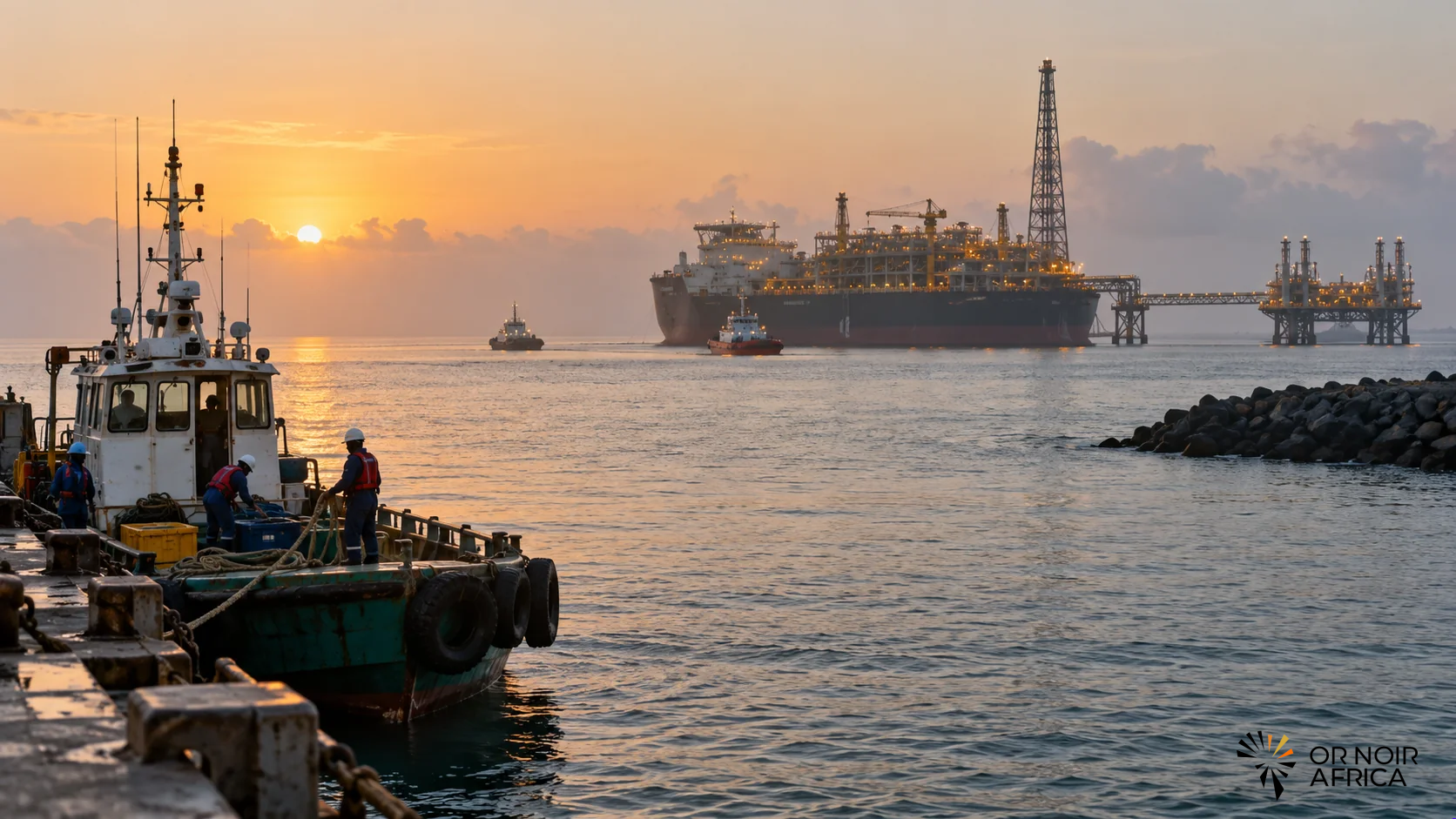
Senegal has entered a new energy phase: Sangomar oil and Greater Tortue Ahmeyim gas are now being produced, while new investment is announced in refining and exploration. However, revenues received so far remain distant from the expectations accompanying the 2014 discoveries. This difference does not mean the projects have no value. It is a reminder that production does not automatically translate into immediate fiscal windfalls or rapidly falling energy costs.
Available figures illustrate this transition. The two major offshore fields began operating between 2024 and 2025. By the end of March 2026, cumulative Sangomar production reached 62 million barrels. GTA had delivered 4.81 million cubic meters of liquefied natural gas, according to data reported at the time. In the first full production year, 2025, public revenues associated with the two projects amounted to CFA franc 75 billion.
Initial revenues do not capture the projects' entire value
The ramp-up of an oil or gas field is often accompanied by a mechanism for recovering companies' expenditure. Under production-sharing contracts, the portion known as “cost oil” reimburses eligible costs before remaining revenues are distributed. This timing can limit public revenues in the first years even as production volumes increase.
Several measures must therefore be distinguished: physical production, revenues accruing to the state, operator profits, tax receipts and indirect economic benefits. A barrel extracted is not a barrel of public revenue. How costs are audited, contractual provisions applied and revenues reinvested influences the national outcome. Transparency on these elements would help assess projects beyond announcements of reserves or capacity.
Potential nevertheless remains substantial. Available estimates put Sangomar reserves at 600–630 million barrels and 67.9 billion cubic meters of gas. GTA, shared with Mauritania, would represent between 566 and 707 billion cubic meters of gas. At full capacity, these resources can support exports, domestic supply and new industrial activities. Realizing these prospects nevertheless depends on investment decisions and access to the necessary infrastructure.
Refining and new blocks: signals to turn into delivery
Two recent announcements can help revive the energy portfolio. Société africaine de raffinage has partnered with Turkish investor Yamata on a new refinery project announced at four million metric tons per year. Meanwhile, an agreement with ENI concerns exploration of five offshore blocks. These projects signal renewed interest and open prospects for additional capacity.
A refinery can strengthen supply security and create downstream value, but performance will depend on construction cost, financing, access to crude and competitiveness against imported products. Announced capacity must also be assessed against regional demand, logistics infrastructure and product quality. For exploration, drilling commitments, deadlines and risk sharing will be more concrete indicators than block awards alone.
Developing gas for the domestic market presents another challenge. Electricity, industry and fertilizer production could benefit from more accessible domestic gas, but this requires pipelines, adapted power plants, offtake contracts and networks able to transport energy. Without these investments, some resources may be exported while businesses and households continue to depend on imported or expensive fuels.
A value opportunity dependent on public choices
The strategy must also account for the country's financial constraints. When hydrocarbon revenues are anticipated too early, they can lead to expenditure commitments before the corresponding flows are available. Prudent management should rely on cautious price and production assumptions, multiyear fiscal planning and mechanisms to smooth revenues when prices fluctuate.
Local value is another decisive lever. Contracts can encourage training, national subcontracting, maintenance and the development of Senegalese suppliers. These benefits cannot simply be decreed: they require available skills, quality standards and support for companies to meet industry requirements. Results can then be monitored through jobs created, local procurement shares and capabilities transferred.
Senegal can also use future revenues to support sectors less exposed to hydrocarbon volatility. Electrification, transportation infrastructure, technical education and agro-industry offer ways to turn an exhaustible resource into lasting economic assets. Diversification reduces the risk of public spending following oil cycles.
The sector's outcome therefore lies neither solely in the promise of a large windfall nor in weak initial revenues. It depends on the ability to advance projects, control costs, serve the domestic market and retain a growing share of value in Senegal. Discoveries opened an opportunity; contractual, fiscal and industrial choices will determine what it delivers for the economy and population.
Have any thoughts?
Share your reaction or leave a quick response — we’d love to hear what you think!
-
 0
-
0
-
0
-
0
-
0
-
0