

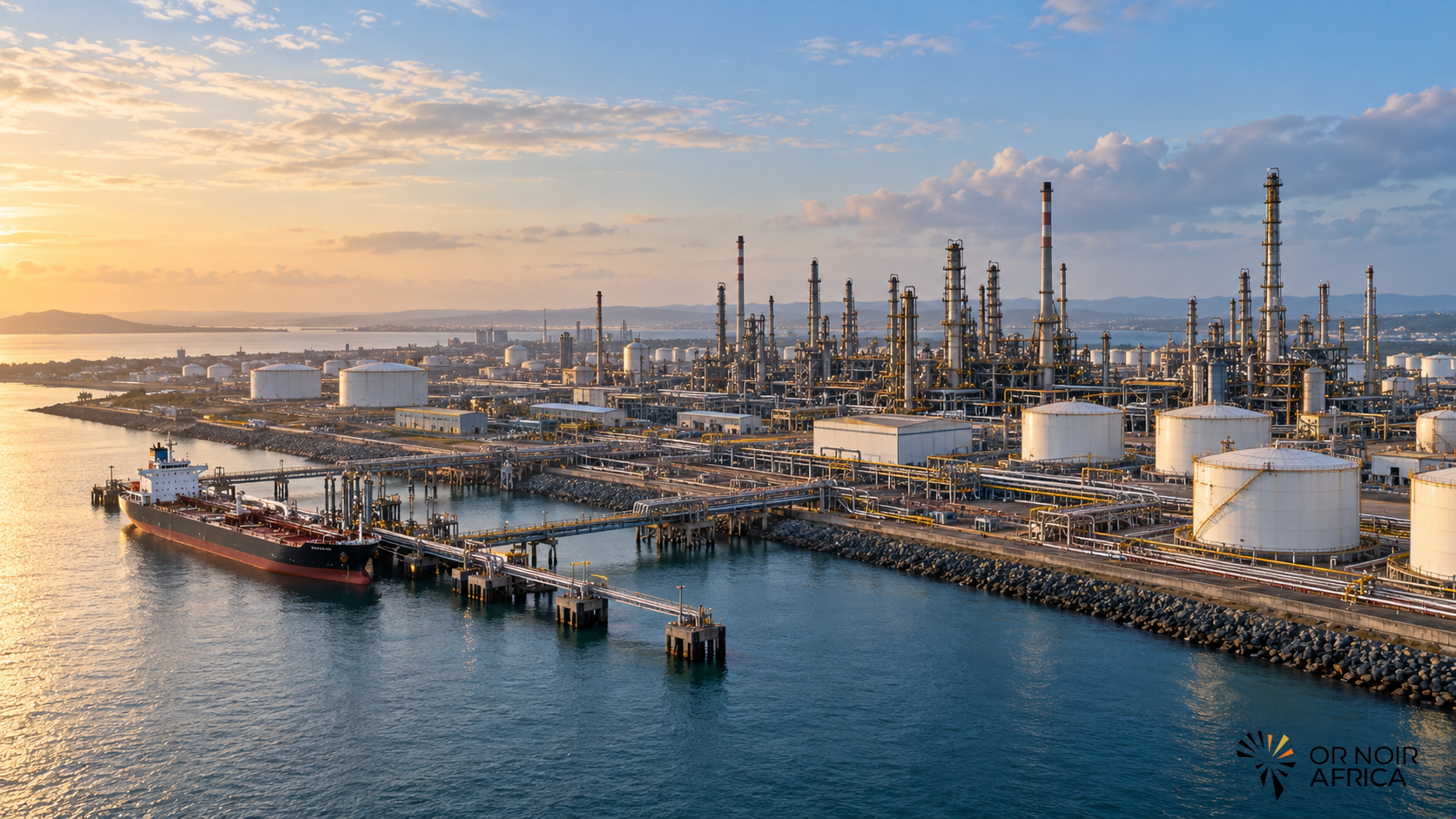
The Middle Eastern crisis brings renewed attention to a question often overshadowed by crude oil volumes: where is the capacity to turn crude into usable fuels? Nigeria’s Dangote refinery has become an important international supplier as supply and trade-flow disruptions tighten petroleum-product markets. Its role suggests Africa can help diversify refining geography, but the continent’s expansion projects remain exposed to supply, financing and execution obstacles.
The Lekki refinery now processes up to 700,000 barrels per day, according to statements by its chief executive cited at an industry forum. Its jet fuel output supplied 20% of European demand between June and August 2026. Export product loadings averaged more than 302,000 barrels per day over the first nine months of the year, compared with an average of around 268,000 barrels per day in 2025, according to Vortexa data reported in industry coverage.
Processing crude becomes a security issue
Energy markets depend both on crude sources and on facilities capable of processing it. A high concentration of refineries in a few regions makes supply chains vulnerable when conflicts, sanctions or shipping disruptions reduce fuel exports. Importing countries can then face jet fuel, diesel and gasoline tightness even if crude volumes remain available elsewhere.
The Nigerian case illustrates the value of large-scale integrated refining capacity. The refinery first meets part of domestic demand, then exports surpluses to West Africa and other markets. This logic distinguishes a refinery serving local demand from an asset able to sell internationally according to price differentials and commercial opportunities.
Dangote’s development has also exposed this model’s difficulties. The project required several years of construction and faced technical and financial challenges. Nigerian crude supply has not always met the complex’s requirements, and it still imports some feedstock. Domestic crude production, supply agreements and vessel availability therefore remain important variables in the refinery’s economics.
Expansion could reshape regional flows
Dangote Group has begun work to increase the Nigerian complex’s capacity to 1.4 million barrels per day. The announced schedule envisages several years of construction, with completion expected toward the end of 2028. This increase would make Lekki an even more important fuel supply hub for West Africa and international markets.
The group is also considering a new refinery of around 700,000 barrels per day at Lamu, on Kenya’s Indian Ocean coast. If built, it could bring processing closer to East African markets and regional shipping routes. The project nevertheless remains an industrial ambition, with its own land, financing, crude supply and supporting infrastructure challenges.
Geographical diversification alone does not guarantee greater resilience. A new refinery must receive crude, export or distribute products, access storage facilities and connect to transport networks. It must also compete with established complexes in Asia and the Middle East. Project size removes neither delay risks nor refining-margin volatility.
High margins are not a permanent assumption
Dangote’s profitability improved amid exceptionally strong refining margins, partly linked to product tightness during the crisis. These conditions supported financial results reported by the company in 2026. They should not be extrapolated over the asset’s lifetime: margins can narrow when capacity restarts, supplies recover or demand slows.
A possible stock-market listing could broaden capital access and support expansion, but does not replace rigorous planning. Investors will assess cash requirements, feedstock contracts, construction costs and the ability to export consistently. Greater visibility into the financial structure could also improve transparency at a group whose projects have regional significance.
For African countries, the issue goes beyond fuel availability. Competitive refining capacity can reduce some finished-product imports, create industrial jobs and support logistics. But benefits must be assessed alongside environmental costs, energy use, product quality and market access. Refining is not in itself a transition solution; it is a link in supply security for economies that still consume large quantities of hydrocarbons.
A new balance remains to be built
The current crisis shows refining capacity has become a source of commercial strength and energy security. Africa could play a greater role through large projects, but this will depend on mobilizing capital, securing supply and managing complex infrastructure.
Dangote has demonstrated that a world-scale complex can be commissioned on the continent and export products internationally. Its Nigerian expansion and the Lamu project could extend this presence. Their lasting contribution will nevertheless be measured by actual output, delivery reliability and the ability to serve regional markets without depending on exceptionally favorable margins.
Have any thoughts?
Share your reaction or leave a quick response — we’d love to hear what you think!
-
 0
-
0
-
0
-
0
-
0
-
0





