

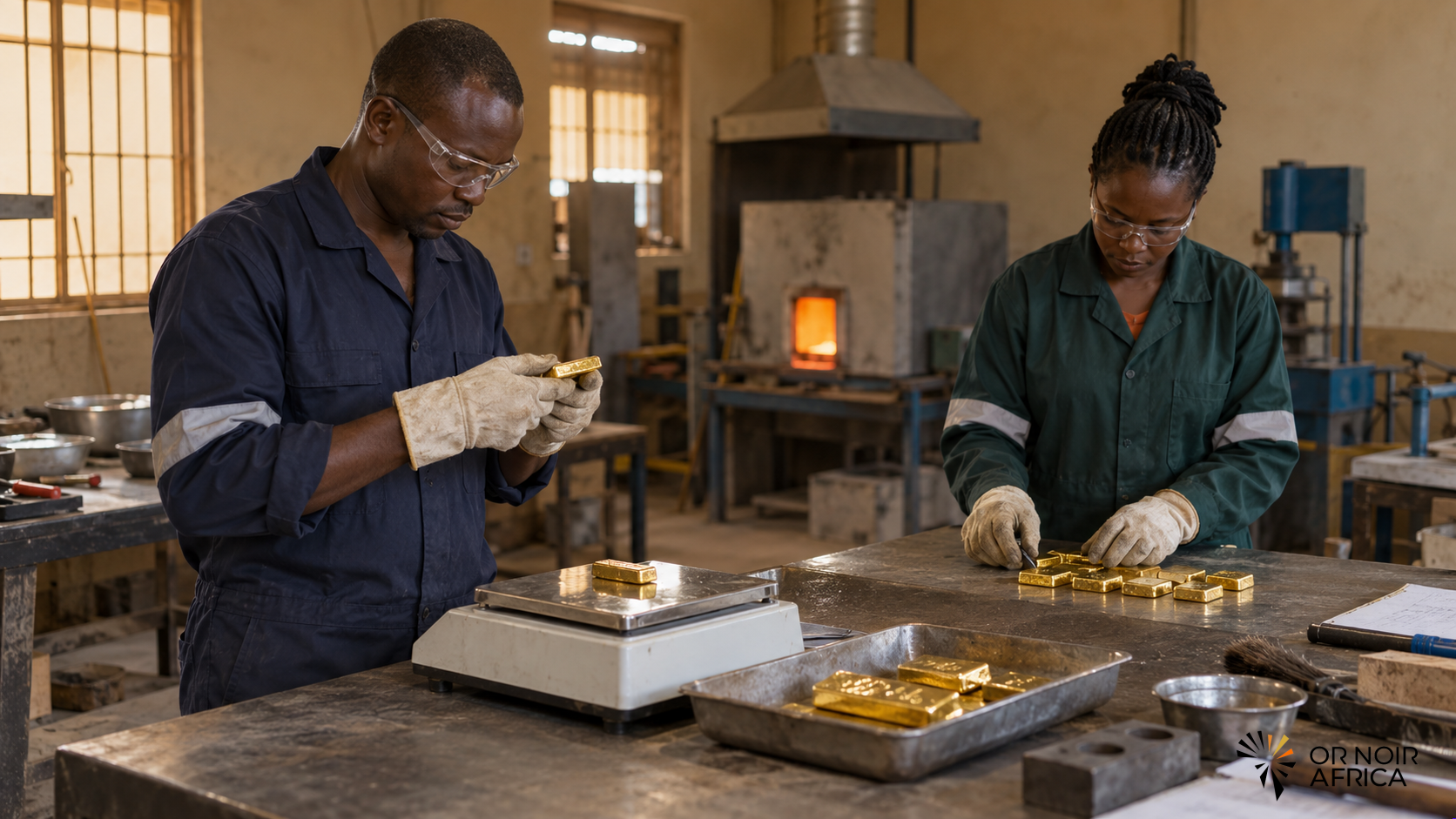
Uganda’s export earnings rose 36% year on year in August to $1.5 billion, according to a Ministry of Finance report covered on October 22. The increase was notably supported by gold shipments valued at $889 million, up 68.9% from the same month a year earlier. These figures confirm the precious metal’s growing weight in the country’s trade flows, while raising a central question: how much of this performance reflects domestic production, and how much reflects Uganda’s role as a regional processing and trading hub?
Rapid growth dominated by gold
The total value of exported goods rose from $1.1 billion in August 2025 to $1.5 billion in August 2026. At the same time, gold shipments reached $889 million. As an indication, this amount represents nearly 59% of the month’s total export value. The calculation provides an order of magnitude, as the two statistics come from different report categories and the available information does not detail the origin of each gold shipment.
This qualification matters. Uganda has developed in recent years as a regional gold processing and trading center. Export values therefore cannot automatically be equated with the value of gold mined domestically. Regional flows may be refined, aggregated or reexported from the country. Distinguishing domestic mining, local processing and trading is essential to measuring actual benefits for employment, public revenue and producers’ incomes.
The 68.9% increase nevertheless indicates that gold is a major driver of the monthly rise. It may reflect higher volumes, price movements, changes in trade routes or several of these factors together. Published data does not allow these effects to be precisely separated. Performance is therefore clearly stronger in value terms, but does not by itself measure increased mine output or value added retained in Uganda.
Support for external earnings, with resilience challenges
For the economy, higher exports bring foreign currency and contribute to external balance. The Ministry of Finance estimates that two other factors could support the shilling in the short term: an expected increase in diaspora remittances toward the end of 2026 and the central bank’s sharp policy rate increase. This is the authorities’ assessment. The effect on the currency will also depend on the persistence of foreign currency inflows, import demand and economic participants’ confidence.
The composition of exports also warrants monitoring. When a significant share of earnings relies on a product whose prices and trade flows can vary, external revenue becomes more sensitive to market movements and supply chain developments. Turning favorable conditions into lasting gains requires stronger traceability, local processing and the ability to capture more value domestically, while diversifying foreign currency sources.
Oil announced for 2027: a contribution still to be realized
The government sees the start of commercial oil production as another medium-term source of support. The ministry believes crude exports could strengthen foreign currency earnings and the country’s external position. Uganda plans to launch production in early 2027 at its western fields near the border with the Democratic Republic of the Congo.
This deadline remains a forecast target: as of October 22, 2026, the country had not yet begun commercial production. Oil revenue will depend on the actual operating schedule, production volumes, export arrangements and prices. It must therefore not be counted as support already secured for the external accounts. The ministry’s statement describes a prospect, not an observed result.
The combination of gold and oil can broaden the export base or increase dependence on extractive resources, depending on how revenue is used. The quality of infrastructure investment, fiscal management and local procurement will influence economic benefits. The challenge is not merely to export more, but to turn mining and oil income into productive capacity that remains useful when prices or volumes slow.
Measuring performance beyond export values
The August figures show favorable momentum: total exports are increasing, and gold shipments are growing even faster. To assess the strength of this trend, future releases must clarify volumes, the origin of processed gold, the share exported after processing and revenue actually captured by the state. Monitoring diaspora remittances and the exchange rate will also show whether improved foreign currency inflows persist.
Oil production announced for 2027 will provide another milestone, provided operations begin as planned and revenue benefits the economy beyond gross exports. For Kampala, the challenge is now to align trade growth, local content and diversification. August’s increase is a positive signal; its long-term significance will depend on value added created domestically and the ability to turn this growth into jobs, public revenue and productive investment.
Have any thoughts?
Share your reaction or leave a quick response — we’d love to hear what you think!
-
 0
-
0
-
0
-
0
-
0
-
0





