

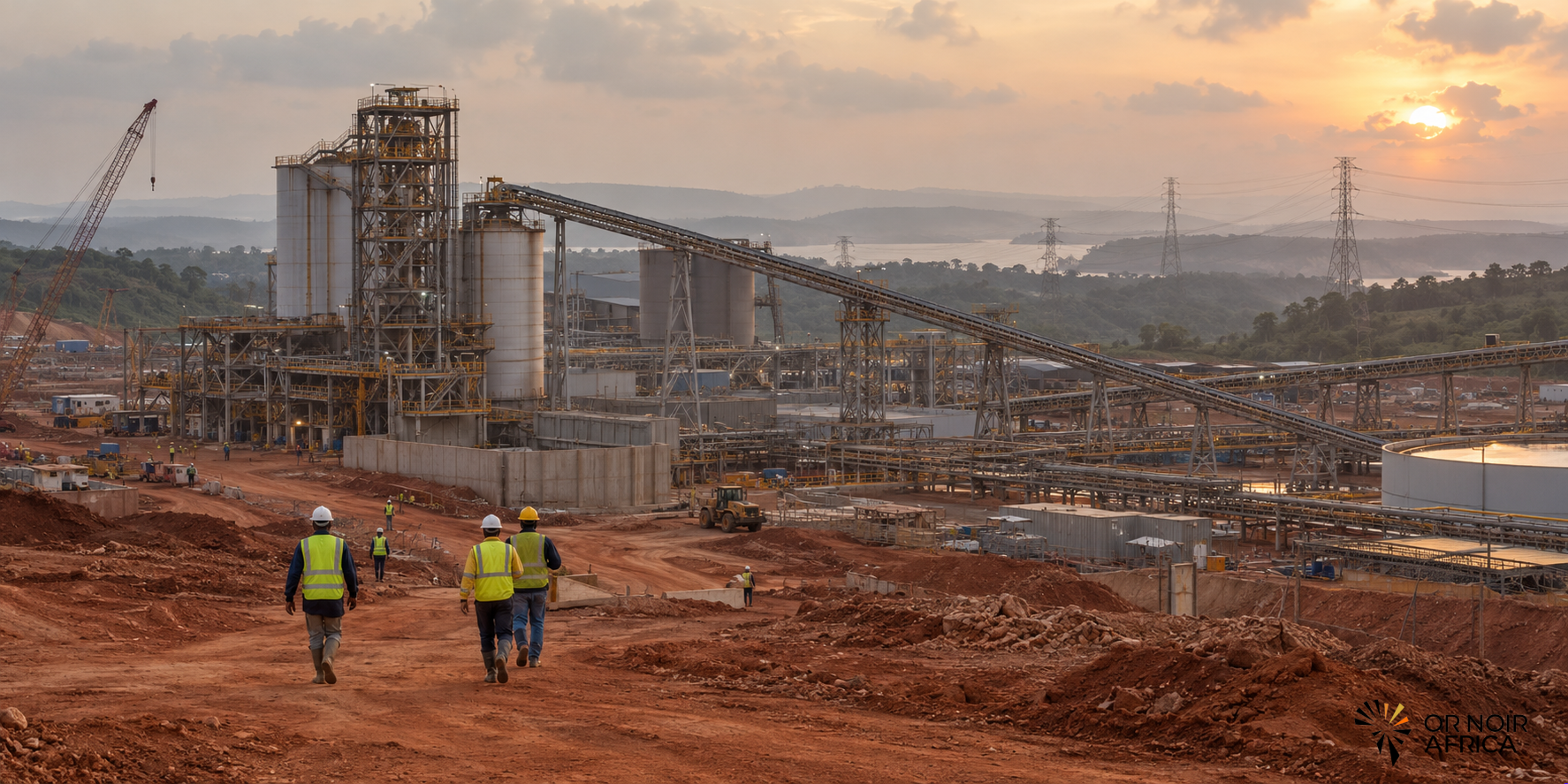
The drive to process more minerals in Africa is attracting growing investor interest. Announcements of alumina refineries, smelters and processing plants are multiplying, driven by global metals demand and states’ determination to capture a larger share of value added. One factor will nevertheless determine the credibility of this new industrial phase: access to abundant, stable and competitive electricity.
The contrast is particularly visible in Guinea. Having become the world’s leading bauxite producer and exporter, the country seeks to strengthen its processing capacity. According to Guinean officials cited during investor discussions, three alumina refineries are under construction, with a goal of five by 2030. Eventually, these facilities could produce between 7 million and 8 million tonnes of alumina annually, before a possible move toward aluminum manufacturing.
Guinea seeks to take an industrial step forward
Guinea’s strategy aims to move beyond exporting raw bauxite, much of which is destined for China. Alumina represents an additional stage in the value chain: obtained by processing bauxite, it is used notably to produce aluminum for transport, construction and packaging. As the country consolidates its refining projects, it can also attract expertise, equipment suppliers and industrial services.
The authorities are considering several ways to encourage corporate investment. Access to deposits, tax incentives and the possibility of participating in railway infrastructure are among the tools discussed. This approach can align resource access with local processing commitments, provided rules are clear, predictable and consistently enforced. Restrictions on bauxite exports have been discussed but have not yet taken effect. The timing and terms of any such measure will be decisive in maintaining a balance between local processing and export competitiveness.
The value chain does not end with alumina. Guinean officials see steel as a subsequent stage and are also accelerating preparations for iron ore pellet plants. Development of the Simandou deposit opens a broader industrial prospect, but each link will depend on commercial outlets, financing solutions and suitable infrastructure.
Energy at the heart of investment decisions
Electricity requirements illustrate the scale of the challenge. Guinea produces approximately 1,000 megawatts, mainly from hydropower. During the rainy season, it can export some output to Senegal, The Gambia and Guinea-Bissau. During the dry season, the balance reverses and the country must sometimes import electricity from its neighbors. An adviser to the Ministry of Mines estimated that industrialization, particularly alumina and aluminum production, would require between 5,000 and 10,000 megawatts.
This gap between available capacity and future needs shows why mining and energy projects must be planned together. An alumina refinery requires continuous electricity supply. Interruptions slow equipment, increase costs and undermine delivery contracts. For investors, energy availability is therefore central to the final decision, alongside ore access, regulatory stability and buyers.
Guinean officials say they are open to different economically viable energy solutions, including gas, coal and nuclear power, alongside hydropower potential and renewables. The choice must account for costs, timelines, grid reliability and climate commitments. It also requires greater regional cooperation: interconnections can facilitate trade, but do not replace necessary investment in generation, transmission and distribution.
South Africa’s experience highlights the importance of competitiveness
South Africa offers a useful lesson for projects in preparation. The country has significant chrome reserves and extensive metallurgical experience, but rising electricity costs have sharply reduced its ferrochrome industry’s competitiveness. Fewer than a dozen of 66 smelters are reportedly still operating. Energy costs have reportedly increased approximately tenfold since 2008, contributing to closures and reduced processing capacity.
Minerals Council South Africa Chief Executive Mzila Mthenjane emphasized that reliable, affordable electricity is a basic condition for industrialization. The example is a reminder that abundant resources alone do not guarantee control over their processing. Companies must also be able to rely on stable supply, predictable costs and maintained infrastructure.
The case of the Mozal aluminum smelter in Mozambique also illustrates these activities’ sensitivity to supply constraints: the facility was placed on care and maintenance after drought affected electricity supply. For states considering new complexes, energy security must therefore be integrated from the design stage, with scenarios for periods of stress and suitable backup solutions.
Four conditions for turning interest into projects
Investor discussions highlight four elements that must come together: regular raw material supply, competitive energy, stable rules and committed buyers. Access to financing is an additional factor, as processing facilities often cost billions of dollars. Institutions such as the US Development Finance Corporation and Africa Finance Corporation already support mineral processing projects in Africa and indicate that they want to expand their presence.
For producing countries, this momentum represents an opportunity to create skilled jobs, develop local suppliers and retain more value on the continent. The next step is to turn announcements into bankable projects with supply and offtake contracts, realistic schedules and available energy. Capital is already interested; by coordinating mines, electricity networks and industrial policies, governments can now give this ambition the foundations needed to endure.
Have any thoughts?
Share your reaction or leave a quick response — we’d love to hear what you think!
-
 0
-
0
-
0
-
0
-
0
-
0





