

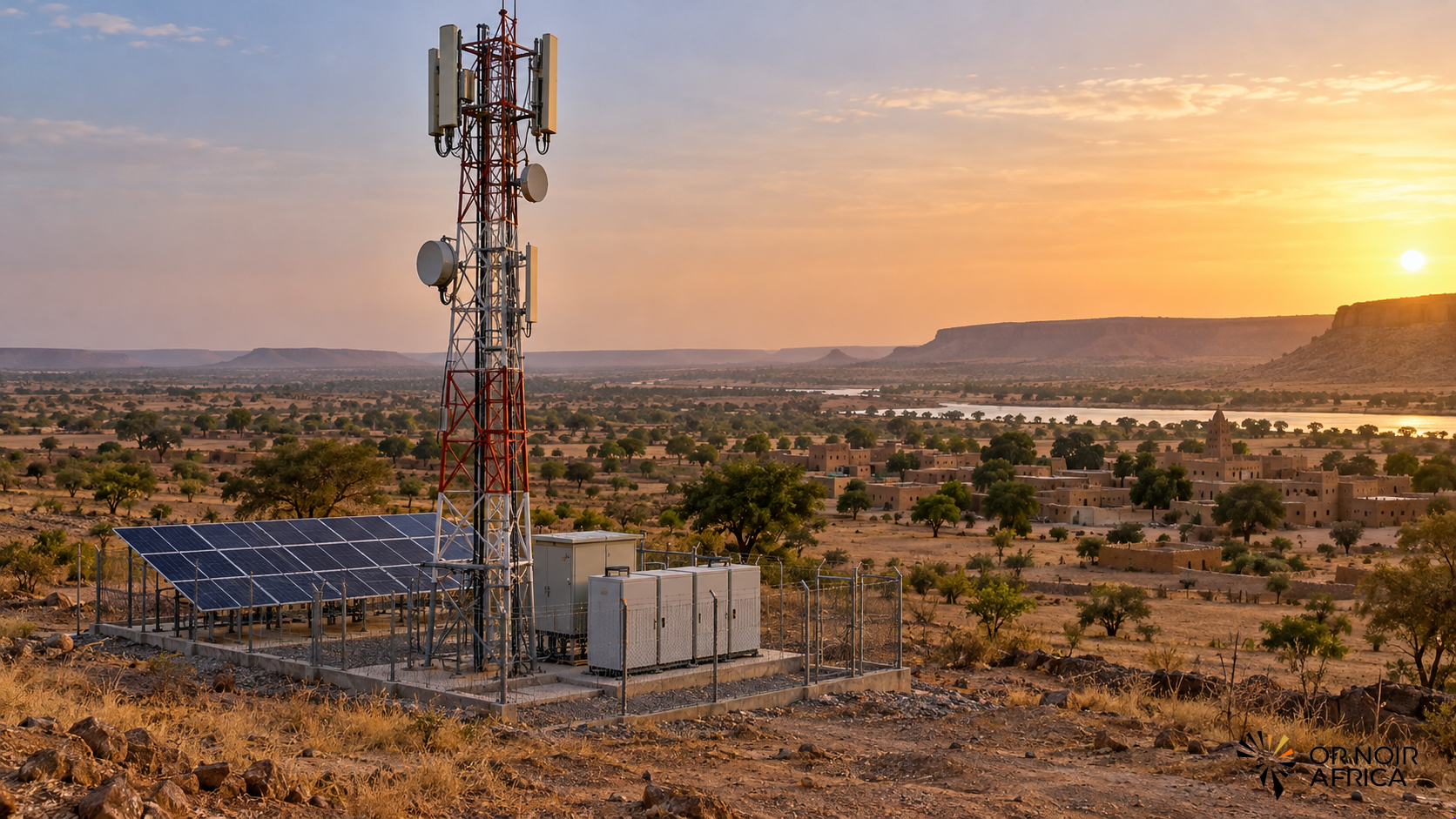
Chinese supplier Jinko ESS has announced an agreement to deliver 34 SunGiga G2 Plus storage systems, with combined capacity of 18 megawatt-hours, to a telecommunications project in Mali. The company did not disclose its partner’s name, the contract value or the sites concerned. The announced volume nevertheless marks another step in electrifying the country’s digital infrastructure, as operators seek to reduce dependence on diesel generators.
For mobile networks, energy is essential to service continuity and a major cost item. Towers far from national power grids frequently use thermal generators requiring regular fuel deliveries, maintenance and reserve stocks. Solar solutions combined with batteries can reduce engine operating hours and improve network availability, especially when fuel supply or grid electricity is uncertain.
Contract details remain to be clarified
The 34 announced systems total 18 MWh, an arithmetic average of around 0.53 MWh per unit if capacity is distributed equally. This average does not establish the actual configuration: systems may be sized according to each site’s consumption, power requirements and constraints. The manufacturer does not specify whether the contract includes solar panels, how many towers are involved or delivery and commissioning deadlines. It would therefore be premature to infer diesel savings or a quantified emissions reduction.
Implementation will depend on integrating batteries with existing equipment, the quality of photovoltaic installations and management of charging cycles. In a hot climate, ambient temperatures can accelerate cell aging and increase cooling needs. Local maintenance, spare-parts availability and training of telecom teams will be essential to maintaining performance. Large-scale deployment also requires monitoring actual savings relative to generators.
Diesel weighs on mobile tower economics
This announcement is part of a broader sector shift. A continental analysis published in 2025 estimated that around 70% of Africa’s 500,000 telecom towers depended on diesel. For remote sites, fuel could represent 30% to 60% of operating expenditure. These orders of magnitude do not describe Mali specifically, but illustrate the economic pressure operators seek to reduce through hybrid energy systems.
Solar and storage offer several potential benefits: lower fuel consumption, fewer refueling trips, less noise and local emissions, and greater autonomy during outages. Benefits nevertheless depend on each tower’s consumption profile and the system’s upfront cost. Poorly sized or inadequately maintained batteries may underperform expectations and sustain dependence on generators.
Mali had already attracted financing for this segment. In March 2025, Norfund and the Facility for Energy Inclusion concluded $40 million in financing for Communication and Renewable Energy Infrastructure (CREI), a company specializing in telecom energy assets and solutions. The agreement was intended to support deployment of solar-and-battery systems at sites in the country. In November 2025, the International Finance Corporation and the West African Development Bank announced €80 million in loans to modernize and expand Orange Mali’s network, including replacement of generators with solar equipment.
Telecommunications as a market for decentralized energy
The telecom sector provides a relatively identifiable potential customer base for stand-alone solar systems. Towers have regular energy requirements and may be spread across areas where extending the power grid is expensive. This demand can support long-term energy supply models under which specialized operators install and operate systems for telecommunications companies.
For mobile operators, part of the appeal is expenditure predictability. Fuel costs are exposed to international prices, transport expenses and supply disruptions. A hybrid solution converts part of this recurring expenditure into an initial investment, with battery replacement costs to be included over its life cycle. Purchasing decisions must therefore compare total costs over several years rather than equipment acquisition prices alone.
Nationally, the effect on connectivity will depend on the number of equipped sites and their contribution to coverage, particularly outside major cities. More reliable power may reduce network interruptions and improve digital service quality, but does not automatically increase transmission capacity or make subscriptions more affordable.
Measuring results beyond installed capacity
Jinko ESS’s agreement confirms growing interest in storage for Malian telecommunications infrastructure. Assessing its significance will require the number of sites actually equipped, the solar share, generator hours avoided, operating savings, tower availability and battery life. Publishing these data would distinguish a supply announcement from a lasting change in mobile networks’ energy model.
The contract may help structure a local market for decentralized solutions and reduce diesel exposure. Its impact will nevertheless depend on installation quality, maintenance and integration with telecom networks. In a sector where continuity of service is essential, a storage system’s value is measured as much by reliability as by nameplate capacity.
Have any thoughts?
Share your reaction or leave a quick response — we’d love to hear what you think!
-
 0
-
0
-
0
-
0
-
0
-
0





