

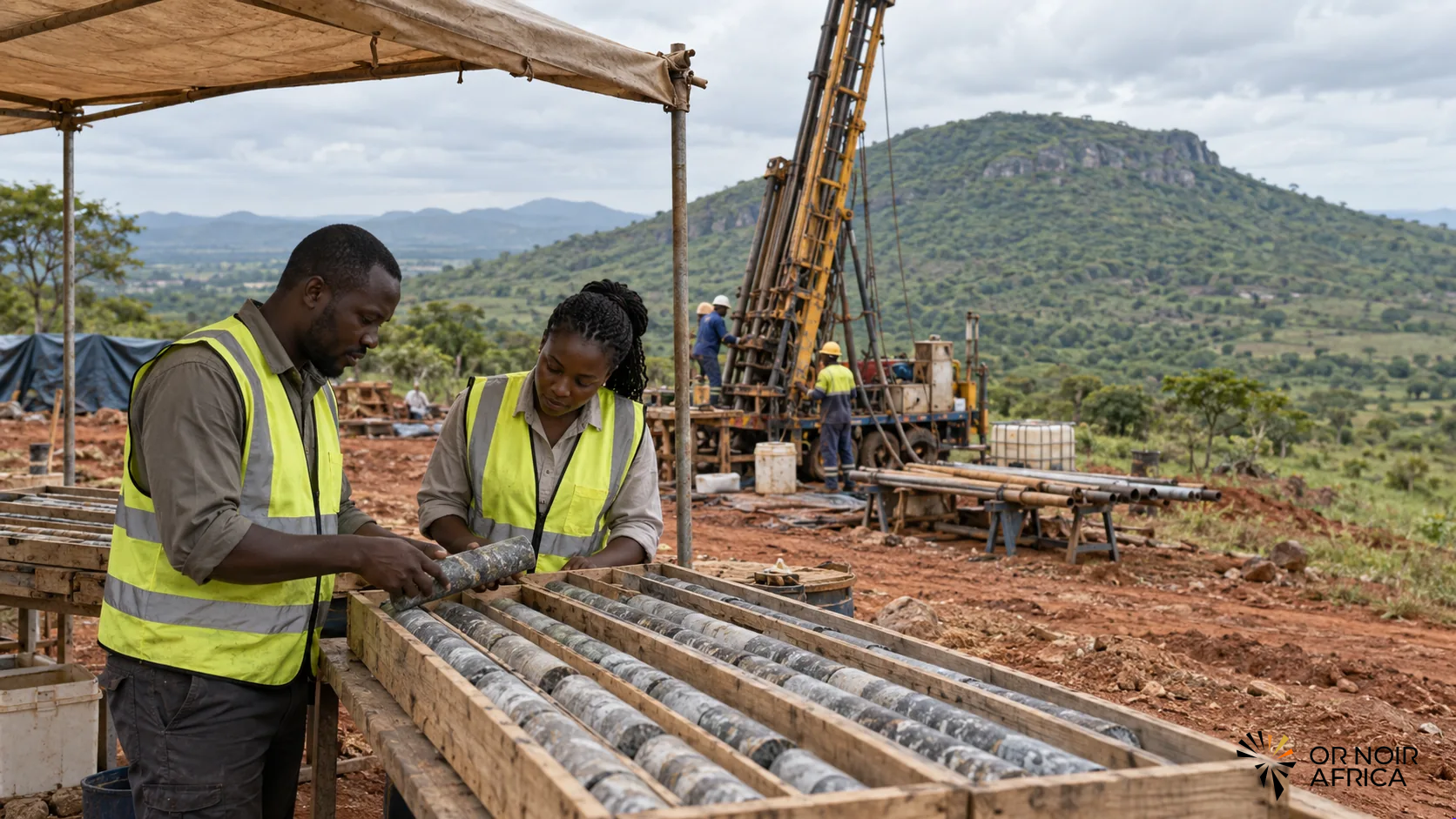
The first assay results from the Tundulu rare earth project in southern Malawi give AuKing Mining evidence to refine the site’s geological potential. Three holes from the initial programme returned intervals with notable total rare earth oxide (TREO) grades. The company announced the start of preparatory work for a maiden resource estimate, targeted before the end of 2026 subject to the necessary data being available.
These results are an exploration milestone, rather than proof of an economically recoverable deposit. Reported lengths are intervals traversed by the holes and are not true widths. Mineralisation continuity, the geometry of the bodies, results from subsequent samples and processing tests still require assessment.
Broad intervals in the first assayed holes
In its September 14 announcement, AuKing presented assays from the programme’s first three reverse circulation holes. Hole 26NH005 intersected 91 metres at 1.51% TREO from 40 metres, including 15 metres at 3.40%. Hole 26NH029 returned 80 metres at 1.54% from surface, with an 11-metre section at 4.33%. Hole 26NH004 intersected 20 metres at 2.06% from 113 metres, including 12 metres at 3.24%.
The company says these initial results exceed the historical benchmarks used for the project. They provide a reason to continue work, but come from a limited number of holes. Grades must be interpreted alongside other geological data, rather than in isolation: a rich or long intersection is insufficient to establish the volume, continuity or extraction costs of a future resource.
The initial reverse circulation programme comprises around 4,300 metres across 31 holes. Results released in September therefore cover only some of the samples collected. Other batches were undergoing analysis or transfer to laboratories, while diamond drilling was expected to improve understanding at depth.
Heavy elements attract attention
Beyond total rare earth oxides, the company highlights high proportions of heavy rare earths and yttrium in certain intervals. In hole 26NH029, a 42-metre interval has an HREE+Y proportion equivalent to 11.46% of TREO. Several shorter intervals in 26NH005 also show significant proportions.
This composition may matter for subsequent work, because heavy rare earths do not all have the same industrial uses or supply dynamics as light rare earths. A high relative proportion does not independently establish the ore’s economic value, however. The host minerals, processing behaviour, recovery rates and specifications of products that could be marketed must be determined.
The observed relationship between certain enrichment levels and phosphate minerals provides a geological lead to investigate. It must be confirmed and characterised through upcoming mineralogical and metallurgical work. For now, the information is chiefly valuable for how it can guide sampling and testing, rather than as a conclusion about profitability.
The exploration area expands
Work extends beyond the three assayed holes. The diamond drilling campaign aims to document geology at depth and prepare data for a potential maiden resource estimate. Previous holes encountered carbonatite rocks at depths beyond the initial targets. This observation indicates that the geological system extends deeper, without independently measuring rare earth grades.
A western step-out hole, reported by the company on September 21, subsequently returned a 50-metre intersection at 2.03% TREO from surface, around 400 metres west of the initial results. The reported assay nevertheless covered only part of the hole; results were still awaited for deeper sections. This signal expands the area to investigate, but does not yet establish continuity between intersections.
Caution is particularly important when successive announcements report new intersections. Drill hole mapping, depths, drilling angles and the geometry of mineralised units must be integrated to estimate true thicknesses. An exploration campaign can quickly generate attractive results while the overall deposit configuration remains poorly understood.
The next milestone: a verifiable resource estimate
AuKing says it has begun work towards a maiden mineral resource estimate, targeting publication before the end of 2026. This deadline remains conditional on sufficient data being available, completion of assays and geological interpretation. An estimate meeting applicable standards must be supported by drilling data, quality controls and a transparent modelling method.
For Malawi, Tundulu forms part of growing regional interest in critical minerals and rare earths. The national challenge will be translating exploration projects into responsible investment, local skills and economic benefits. These prospects will depend on investment decisions, infrastructure, regulatory frameworks and projects’ ability to pass technical milestones.
In the short term, the most useful indicators will be publication of outstanding assays, continued drilling, definition of the mineralised body’s limits and initial metallurgical results. Published grades make Tundulu a project to monitor; they do not replace the studies required to assess feasibility. A maiden resource estimate, if published, will allow a more robust assessment of the system’s scale and continuity.
Have any thoughts?
Share your reaction or leave a quick response — we’d love to hear what you think!
-
 0
-
0
-
0
-
0
-
0
-
0





