

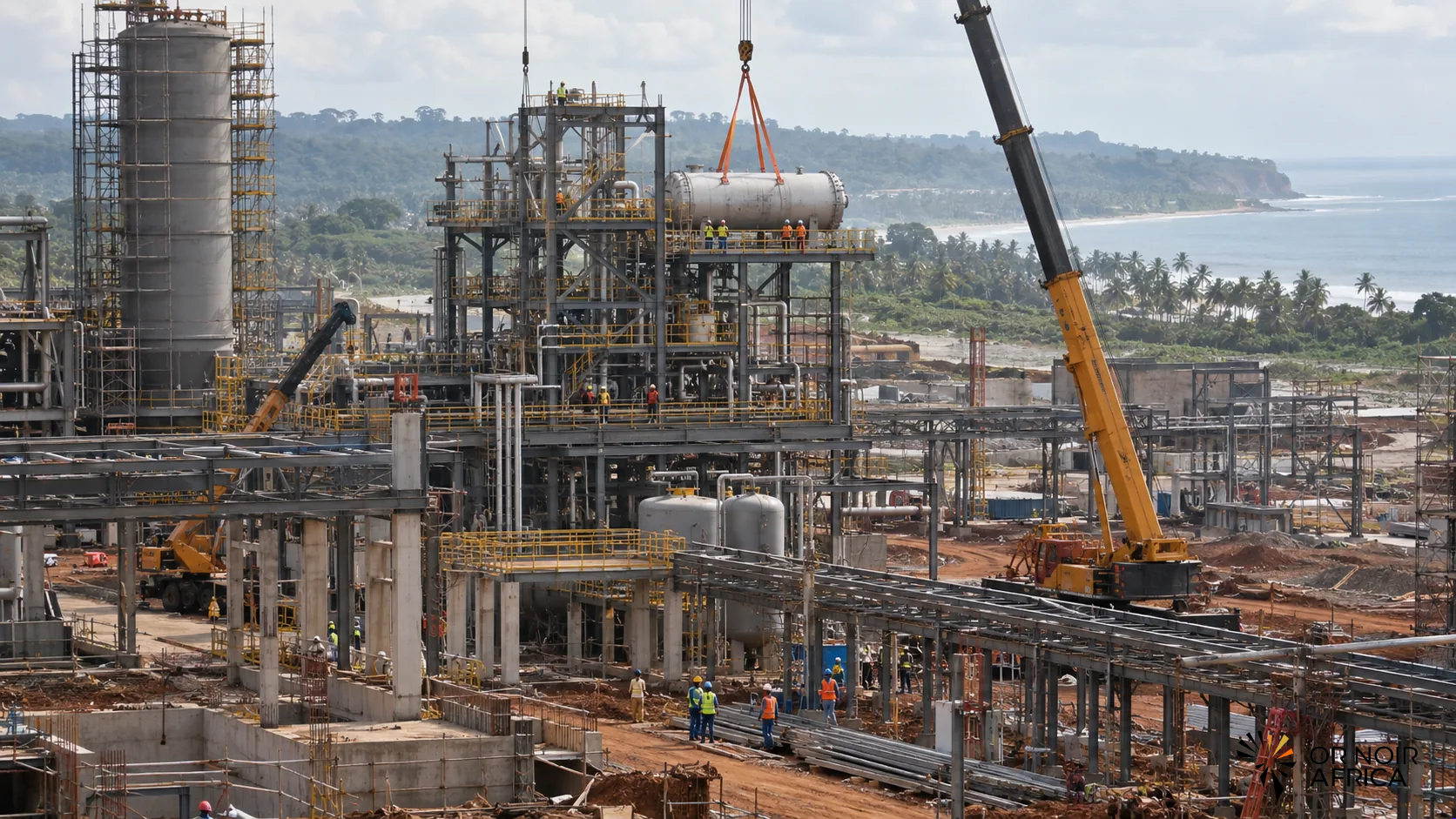
In Cabinda, northern Angola, the local phosphate fertiliser production project is reaching a construction milestone while its financing and mining components are still being established. Minbos Resources has awarded Portuguese-Angolan Grupo Arliz the second phase of plant construction under a $13.8 million contract. This stage is intended to bring the site to dry commissioning, before raw materials are introduced and production begins.
The project addresses a strategic question for Angolan agriculture: how can access to inputs be secured and dependence on imported fertilisers reduced? Building a plant does not itself guarantee this objective. Ore availability, completion of infrastructure, operating finance and the ability to sell output will determine the initiative’s actual impact.
A plant moves from foundations to equipment
The first phase of civil works covered platform preparation, access roads, drainage, slabs and foundations. Phase 2 includes steel structure assembly, mechanical installation, electrical and instrumentation equipment and process control systems. Together, these form the facility’s industrial core: they must enable phosphate mined nearby to be transformed into fertiliser farmers can use.
The Grupo Arliz contract covers this work through dry commissioning. This stage tests equipment and systems without immediately starting commercial production. It therefore marks concrete progress, but should not be confused with production start-up: testing, equipment integration, ore supply and ramp-up still remain.
Company communications place completion and dry commissioning in the second quarter of 2027. This timetable depends on construction progress and other project components. In early September 2026, Minbos stated that the steel structure manufactured in Portugal had departed the port for Angola and that installation was expected to begin in September. Available information does not independently confirm that installation is complete at the publication date.
Financing is assembled in stages
The financing plan notably relies on a $16 million facility granted by South Africa’s Industrial Development Corporation (IDC). In June, Minbos announced receipt of an initial $4.8 million disbursement to support equipment orders and continued project work. This represents an initial facility tranche, rather than the entirety of financing needed for construction and operations.
Additional financing from Banco de Fomento Angola (BFA), announced as a facility of around five billion kwanzas, is intended to cover other expenditure. In its September 2 update, however, the company still reported that final assessment of a guarantee from Fundo de Garantia de Crédito (FGC) was underway. An initial disbursement of around $1.3 million was expected after the guarantee was issued. A financing agreement or terms must therefore be distinguished from actual availability of funds: at this stage, BFA disbursement remained conditional.
This sequence highlights project execution risk. The contractor’s deadlines, lenders’ conditions and mining expenditure must align. Delays in obtaining guarantees or mobilising funds may shift subsequent stages even as plant construction progresses.
The mine remains the upstream component to secure
The Cabinda plant is designed alongside a phosphate mining operation. Fertiliser production will therefore depend on Minbos’s ability to start and supply the mine, then transport ore regularly to the processing facility. In early September, however, the company still reported a mining contractor selection process and ongoing regulatory procedures with Angolan authorities.
This distinction between plant and mine is essential to assessing progress. The industrial construction site has an appointed contractor and an announced construction contract; extraction arrangements, permits and associated operational resources still need finalising. A processing facility ready before the mine could require temporary supply solutions or delay commercial start-up.
For Angola, the stakes extend beyond one company’s timetable. Local fertiliser production can reduce exposure to imports, improve input availability and support agricultural productivity. Benefits will also depend on selling prices, logistics costs, distribution networks and farmers’ ability to access the product.
An industrial and agricultural test
Cabinda gives Minbos an opportunity to move an integrated project from development to execution. The phase 2 contract, initial IDC disbursement and equipment shipment show progress beyond initial announcements. At the same time, BFA financing remains tied to a guarantee, while the mine and its permits are not yet ready to supply the plant.
The next measure of progress will therefore extend beyond completion of a steel structure. It will concern plant commissioning, ore availability, additional financing and conclusion of the agreements needed for operations. Only then can the project turn its industrial promise into an actual fertiliser supply for Angolan farmers and, potentially, neighbouring markets.
Have any thoughts?
Share your reaction or leave a quick response — we’d love to hear what you think!
-
 0
-
0
-
0
-
0
-
0
-
0