

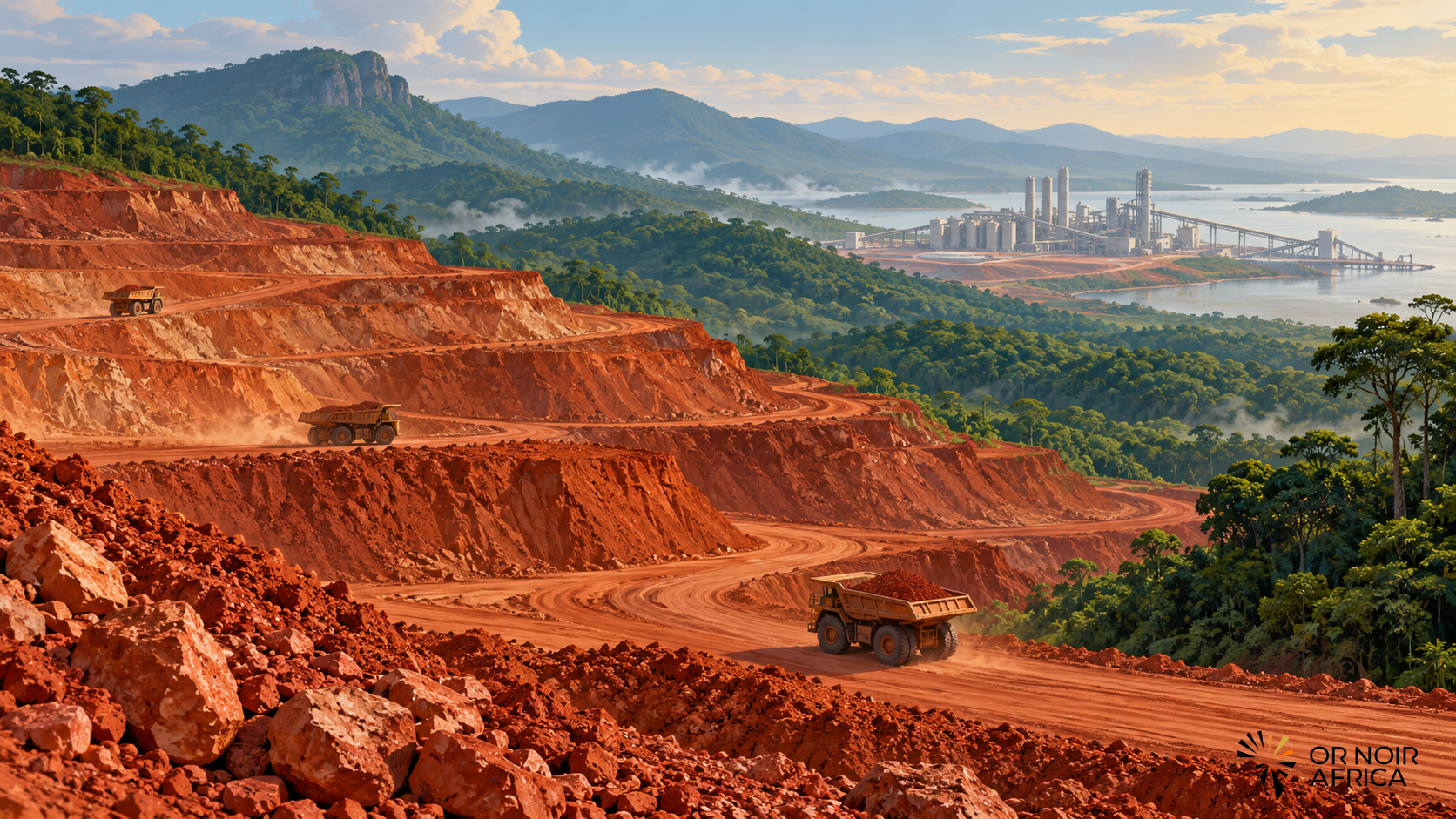
On 6 May 2026, the Guinean government, Emirates Global Aluminium (EGA) and its subsidiary Guinea Alumina Corporation (GAC) signed an amicable settlement agreement, ending a dispute lasting more than 18 months over GAC's bauxite concession, which was revoked in July 2025. Under the agreement, Conakry will pay GAC an undisclosed lump sum in exchange for transferring its assets to the new national company, Nimba Mining Company (NMC). This outcome, facilitated by the Paris Bar, closes a turbulent chapter stemming from Guinea's determination to enforce EGA's obligations to build an alumina refinery, a failure that led EGA to record a $680 million impairment in 2025. Attention now turns to NMC's ability to take over and turn mining sovereignty into a driver of industrial development.
Established by presidential decree on 5 August 2025, Nimba Mining Company (NMC) is a company governed by private law and 100% owned by the Guinean state through the Ministry of Mines and Geology. Its founding mission is not simply to fill the operational gap left by GAC, but to reposition the state as a central participant in the sector. This undertaking is embodied by Patrice L'Huillier, an engineer with thirty years of experience in the global aluminium industry, appointed CEO in September 2025. He achieved a remarkable feat: reopening the Tinguilinta mine and Kamsar port in less than three months. Having found the facilities generally in good condition, L'Huillier rapidly mobilised Guinean teams and signed an initial mining contract with Chinese company CHICO in January 2026, followed by local specialist IBS in February. As a result, NMC had already exported one million tonnes by the end of 2025, and its target for 2026 is ten million tonnes. This performance rests on an exceptional resource: the 620 km² Tinguilinta deposit contains more than four hundred million tonnes of high-grade bauxite.
These national ambitions form part of a global context in which Guinea is consolidating its leadership in the bauxite market. According to official data released on 26 January 2026, the country exported 182.8 million tonnes in 2025, up 25% from 145 million tonnes in 2024, despite tensions. China remains the main beneficiary of this mining boom, importing 200.5 million tonnes of bauxite in 2025, with Guinea supplying more than 80% of the feedstock for its alumina industry. A record 74% of Guinean exports went to China in 2025. However, links are also intensifying with India, another major consumer. The surge in volumes has paradoxically weighed on prices, strengthening buyers' negotiating power. Guinean bauxite prices have fallen by around 50% since January 2025, averaging between $59 and $62 a tonne in March 2026. In response, Conakry announced that it would reduce export volumes from April 2026, not through strict quotas but by aligning actual production with the capacities set out in feasibility studies.
Establishing a transparent pricing system is central to Guinea's strategy to regain value added. Officially launched in late March 2026, the Guinea Bauxite Index (GBX) is a national benchmark intended to guide export pricing. Its ambitious objective is to end the opacity of operators' self-certified declarations, a system that favoured information asymmetry to the benefit of foreign buyers. A credible index would allow the state to maximise royalty and tax revenue by obtaining an accurate picture of transactions. It would also provide a negotiating basis for long-term supply contracts. “To increase our revenue, we are establishing the GBX index,” Minister Bouna Sylla confirmed. “Guinea is no longer willing to export its raw material without controlling its price.” The success of GBX will depend on adoption by all market participants, including Chinese joint ventures and Asian refineries. However, obstacles are numerous: technical parameters such as alumina content, silica and freight must be incorporated, and competition from other producing countries, including Australia, Indonesia and Vietnam, remains intense. GBX accompanies a wider regulatory drive to regain control of the entire value chain. The state has accordingly established national company GUITRAM to ensure that at least 50% of bauxite is transported under the Guinean flag, and has reaffirmed its right to market 15% of each mine's production.
The agreement with EGA and the introduction of GBX are only the beginnings of a deeper transformation. Guinea has declared a national objective of building five to six alumina refineries by 2030, and NMC is positioned to develop at least one. For NMC, the refinery associated with the Tinguilinta mine, with capacity of around one million tonnes a year, is more than an intention. Preliminary studies were carried out in the early 2010s, and a site has already been identified. Currently undergoing eighteen months of feasibility studies, construction would then take two to three years, with operations beginning around 2030. The economic rationale is compelling: alumina is worth more than five times as much as raw bauxite, making local processing highly profitable. The government wants to capture this margin. “We want to move from exporting raw bauxite to producing alumina locally to create value and jobs,” is how those close to the ministry describe the objective.
NMC's strategy is not limited to aluminium. The group is positioning itself as a diversified national mining champion, spanning bauxite, gold, copper and processing. With this in mind, NMC signed a strategic, non-binding memorandum of understanding with Australian mining group Resolute Mining in late March 2026. Supported by the Ministry of Mines, the partnership aims to jointly assess the gold potential of eastern Guinea, one of West Africa's most promising regions. “This partnership with Resolute will enable NMC to launch its gold projects in accordance with state directives,” said Patrice L'Huillier, who sees it as a way to strengthen local participation in Guinea's mining ecosystem. With a combined investment commitment of around $10 million a year from 2026, the alliance marks NMC's first collaboration with an internationally listed company in gold mining, another step towards becoming a multi-resource operator.
Under NMC's impetus, Guinea is reaching a decisive milestone. By moving from a simple supplier of raw materials to a sovereign industrial participant, it is reshaping the balance in the global aluminium market. The introduction of GBX and the stated ambition to build refineries reflect an unprecedented political determination to control the value chain. However, this undertaking faces enormous challenges. Financing an alumina refinery requires several billion dollars of investment; the quality of technical execution and political stability will remain key factors in attracting capital. The course has been set, but success will depend on the country's ability to turn geological strength into lasting economic strength. The agreement with EGA marks the end of a crisis and the beginning of a new era for Guinea: greater mining independence.
Have any thoughts?
Share your reaction or leave a quick response — we’d love to hear what you think!
-
 0
-
0
-
0
-
0
-
0
-
0





