

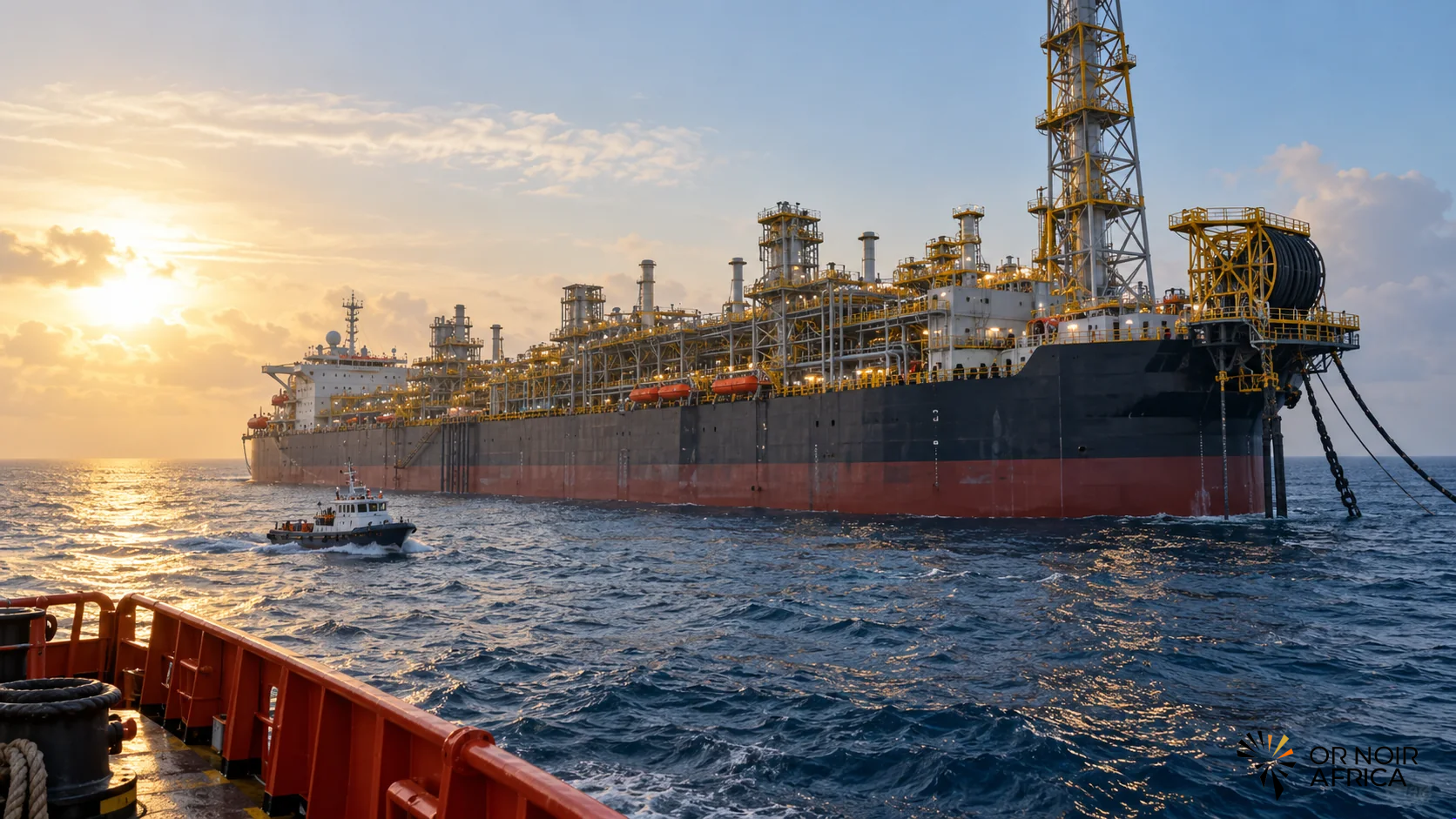
Eni and Yinson Production have signed an amendment to the contract for the FPSO John Agyekum Kufuor, located offshore Ghana, to increase its gas processing and export capacity. The modifications are intended to raise exportable gas volumes from approximately 210–220 million standard cubic feet per day to 355 million. Commissioning is expected in the first quarter of 2028.
The project focuses on non-associated gas, extracted independently of oil. It includes installing new compression and processing equipment on the floating vessel. The announcement is significant for Ghana's domestic supply, but the stated capacity must not be confused with a guaranteed production level: delivered volumes will depend on gas availability in the reservoir, pressure, demand and the operation of the entire system.
Adapting the FPSO to reservoir changes
The FPSO John Agyekum Kufuor collects and processes hydrocarbons produced offshore before they are transferred to markets. Over time, a reservoir's natural pressure can decline. The additional equipment is intended to help maintain gas processing and support exports despite this change. The program includes manufacturing and integrating two modules on the vessel's deck: one to house two gas-turbine-driven compressors, the other to process the additional volumes.
An FPSO allows hydrocarbons to be processed offshore, but the capacities of the vessel, wells and export infrastructure must work together. The upgrade is therefore a complex industrial operation requiring engineering, integration and commissioning work. The announced schedule places completion of the modifications in early 2028, while the vessel's operating contract is extended.
An investment extending Yinson's presence
The amendment extends the FPSO's firm charter period by four years, to 2036. Yinson is also to receive an additional daily rate once the work is completed. The company estimates that the contract extension and these additional revenues represent approximately $600 million in firm order backlog.
Yinson holds a majority 74% interest in the joint venture owning the vessel; the remaining 26% belongs to a Japanese consortium comprising Sumitomo, Kawasaki Kisen Kaisha, JGC Holdings and the Development Bank of Japan. For the FPSO operator, the agreement provides revenue visibility and justifies investment in long-life equipment. For Eni and its partners, it aims to strengthen the capacity to monetize gas produced by the offshore project.
The contract alone does not indicate how all costs are allocated between the parties or the final profitability of the work. This will depend, in particular, on staying within budget and on schedule, actual capacity utilization and volumes available during the contractual period.
Why gas matters for Ghanaian electricity
Gas produced offshore Ghana can supply thermal power plants and contribute to national electricity supply. Greater processing capacity offers additional operational headroom if production is sufficient and downstream infrastructure can transport the gas. Benefits for consumers will nevertheless depend on continuous deliveries, sales contracts, the transportation network and power plant availability.
The country seeks to balance the use of domestic resources, electricity generation needs and supply commitments. Increased capacity on an FPSO can help stabilize the gas chain, but does not automatically resolve payment difficulties, network constraints or technical shutdowns affecting the sector. The strategic question will be how to connect offshore capacity with the actual needs of power plants and industrial users.
Non-associated gas also presents a monetization challenge: when facilities cannot process or export it, it may be reinjected, flared or otherwise lost, depending on field conditions. The equipment expansion aims to increase marketed gas, but production data and the results of the work will allow the actual scale of improvement to be verified.
Milestones to monitor through 2028
The next steps will be detailed design, module manufacturing, integration into the vessel and testing before returning to service. Any equipment delivery delay or required FPSO shutdown could change the timetable and temporary volumes. Project delivery must also demonstrate that the announced capacity increase is reliably available, rather than merely installed on paper.
For Ghana, the operation highlights the importance of processing infrastructure in turning offshore resources into energy supply. For the industrial partners, it combines a technical investment with a contract extension. Success will be measured concretely: are the modules installed on time, do gas exports reach the planned level, and do national power plants receive the necessary volumes?
Have any thoughts?
Share your reaction or leave a quick response — we’d love to hear what you think!
-
 0
-
0
-
0
-
0
-
0
-
0





