

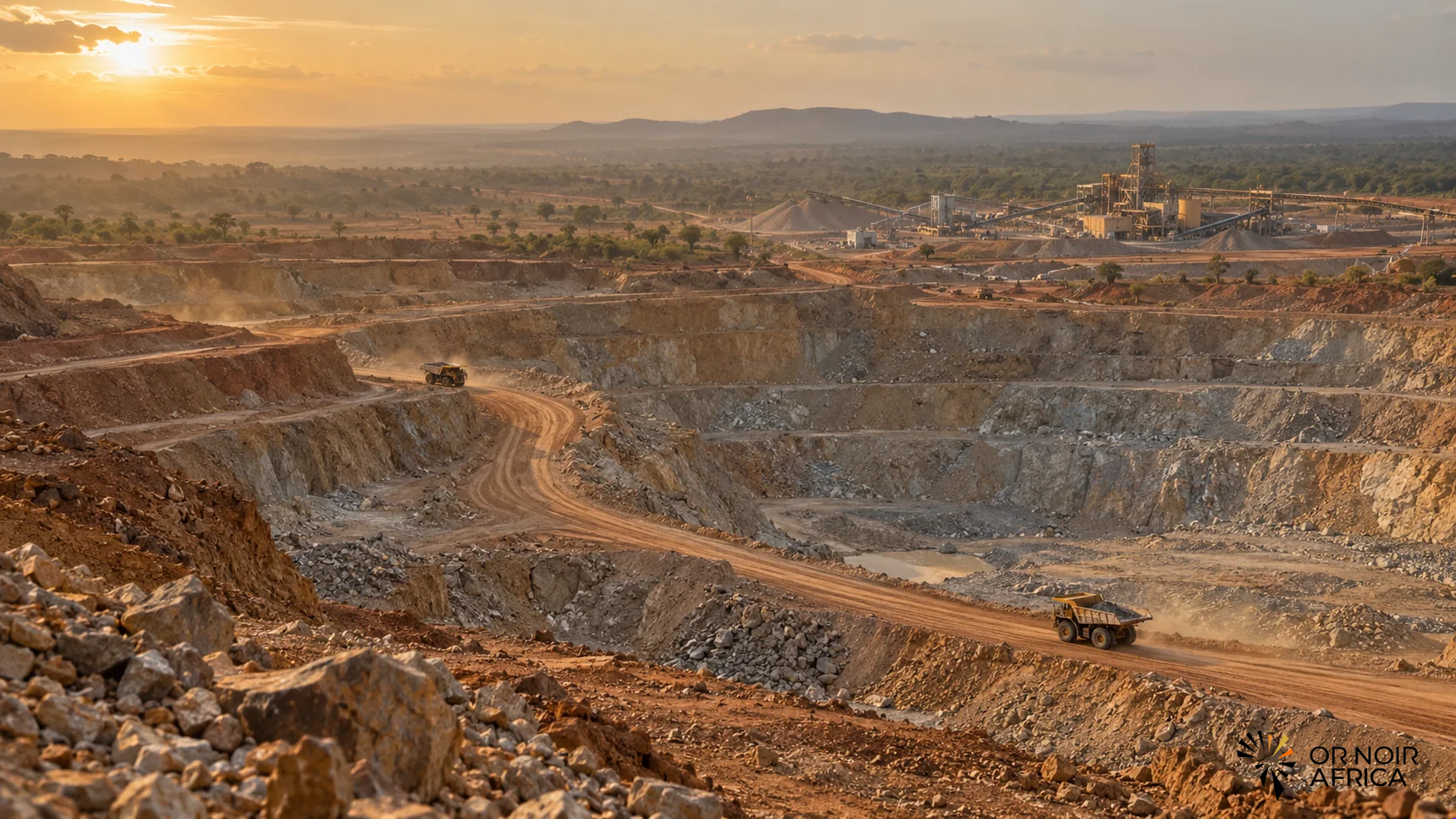
Listed gold companies move with the metal, but their paths are never identical. When gold prices retreat after a sharp rise, investors reassess producers according to costs, debt and cash-generation capacity. Endeavour Mining, present notably in Côte d'Ivoire, Senegal and Burkina Faso, has a substantial cash cushion. This strengthens financial resilience without making its shares immune to a market correction.
In the first half of 2026, the group generated $761 million in free cash flow, up 48% year on year, and reported net cash of $254 million at the end of June. These indicators provide important support as gold producers' shares have declined during sessions when the metal fell. They must nevertheless be compared with costs and volumes: cash increased amid gold selling prices substantially above the previous year's level.
Strong cash generation supported by gold prices
Endeavour sold gold at an average realized price of $4,579 per ounce in the first half, compared with $2,953 a year earlier. This increase more than offset production declining from 647,000 to 564,000 ounces over the period. Revenue and margins therefore benefited from particularly favorable conditions, even though operational performance did not improve at the same pace as financial results.
Free cash flow measures the money remaining after capital expenditure needed for operations. For a mining group, it partly determines the ability to finance new projects, reduce debt, pay dividends and repurchase shares. Endeavour's net-cash position contrasts with periods when producers must borrow to maintain assets or finance growth.
This financial cushion can help absorb a temporary slowdown. It gives the company room to continue work already underway and maintain shareholder commitments. It does not provide comprehensive hedging: if gold prices fall persistently, revenue and cash flow decline while fixed costs and investment needs may not fall at the same pace.
Costs rise faster than volumes
The main concern in the half-year results is all-in sustaining costs, which reached $1,871 per ounce, up 46% year on year. This reflects, among other factors, higher gold-price-related royalties and operating and mine-sequencing factors. The company expects annual performance to remain in line with its targets, with activity more concentrated toward year-end.
This shows why metal prices alone cannot measure producer quality. Higher prices increase revenues but may also raise royalties and expenditure where suppliers, labor and equipment face strong demand. If gold corrects while costs remain high, margins per ounce may compress rapidly.
Production is a second factor to monitor. Endeavour indicated that the third quarter could be affected by the rainy season and mine-stripping work, ahead of an expected fourth-quarter improvement. Meeting this timetable will influence annual volumes and the ability to convert high gold prices into cash.
The West African portfolio: growth driver and exposure
The group's West African operations give its performance a regional dimension. Sabodala-Massawa in Senegal, Ity and Lafigué in Côte d'Ivoire, and Houndé and Mana in Burkina Faso contribute to production and growth prospects. This footprint offers expansion potential but also exposes the group to operational, regulatory and logistical realities across several countries.
Endeavour is preparing organic-growth investments. Sabodala-Massawa's underground expansion is due to enter a new phase, while the Assafou project in Côte d'Ivoire could support future group development. These projects offer long-term production prospects but require capital and must pass permitting, construction and commissioning stages.
For host countries, the challenge extends beyond the share price. A sustainable mining presence also depends on public revenues, local procurement, training, water management and community relationships. A financially healthy company is better placed to invest, but benefits must be assessed from concrete results at sites and within local economies.
A financial cushion, not a share-price guarantee
Net cash and available cash flows give Endeavour more capacity to absorb shocks than a heavily indebted producer. They can support investment and distributions if markets become less favorable for a limited period. The company also devoted significant amounts to dividends and share repurchases in the first half, choices that must be assessed against its projects' financing needs.
Share prices nevertheless depend on expectations as much as published accounts. A gold correction, persistently rising costs, below-expected production or changing perceptions of regional risk may cause the shares to fall despite a strong balance sheet. Conversely, improving volumes and well-controlled investment could reinforce confidence if metal prices stabilize.
Endeavour Mining's cash therefore provides a real cushion, but its effectiveness depends on the duration of gold's decline and the group's ability to control costs. Upcoming results will show whether the expected year-end production recovery materializes. Assessing the producer's resilience requires tracking cash flow, cost per ounce, volumes and West African project progress together, rather than treating cash levels alone as automatic share-price protection.
Have any thoughts?
Share your reaction or leave a quick response — we’d love to hear what you think!
-
 0
-
0
-
0
-
0
-
0
-
0





