

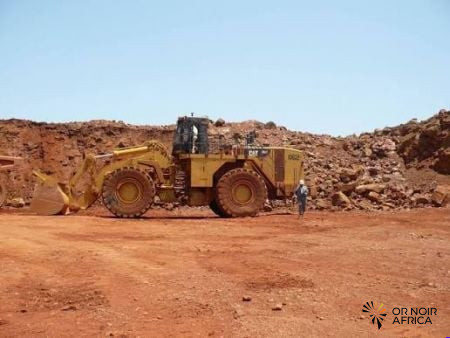
Australian junior Castle Minerals is preparing a drilling campaign at the Nielle gold project in northern Côte d’Ivoire. The company has published an initial conceptual estimate of discovery potential ranging from 800,000 to 1.4 million ounces of gold. This range is not a declared mineral resource: it relies on historical data and will need to be confirmed by further work.
The independent estimate by Ledex Pty draws notably on results from 338 auger holes and 40 reverse-circulation holes drilled at the main target. Castle plans to combine RC and diamond drilling to test the identified structures and clarify their continuity. The program remains conditional on obtaining the exploration permit, which the company hopes to receive in the fourth quarter of 2026. No budget or detailed drilling timetable has been announced.
A geological hypothesis to validate
The range published by the company provides a working target, but must not be equated with a proven, recoverable or economically viable volume of gold. Future drilling will need to confirm the geometry, grade and continuity of mineralization. Only after these stages, followed by technical and economic studies, could a project advance toward a resource estimate and a development decision.
Ledex’s principal consultant, Ann Ledwidge, described Nielle as having “significant development potential.” This assessment accompanies an initial evaluation of the site; it is neither a discovery guarantee nor a production forecast. The project’s progress will depend on field validation and permits issued by the Ivorian authorities.
A backdrop of growth in Ivorian gold
Côte d’Ivoire seeks to strengthen its gold industry and aims to become Africa’s leading gold producer by 2035. The Koné mine, developed by Montage Gold, and Assafou, led by Endeavour Mining, are expected to contribute to future supply. Alongside these developments, exploration of new targets is needed to replenish the project pipeline beyond sites already under development.
Other companies have also announced progress this year. Skylark Minerals increased inferred resources at the Zaranou project to 1.20 million ounces, while Many Peaks Minerals published an initial estimate of 1.3 million ounces at Ferké. These figures concern separate projects and do not establish an equivalent discovery at Nielle. They nevertheless illustrate competition to identify new deposits in a country with a rapidly developing gold industry.
Permitting and financing are the next steps
In August, Castle announced a fundraising of A$4 million, or approximately US$2.8 million, intended notably for work associated with Nielle. The financing allows studies to be prepared, but the start of drilling still depends on the permit. Administrative timelines, team mobilization and site access may therefore affect the operational schedule.
The next results will be decisive in moving from a theoretical target to a more robust assessment. For investors, the project’s value will depend on the quality of intersections, exploration costs and Castle’s ability to finance subsequent stages. For Côte d’Ivoire, Nielle represents an additional prospect in the sector’s growth strategy, whose impact can only be measured after mineralization is confirmed and, if warranted, a mine is developed.
Have any thoughts?
Share your reaction or leave a quick response — we’d love to hear what you think!
-
 0
-
0
-
0
-
0
-
0
-
0





