

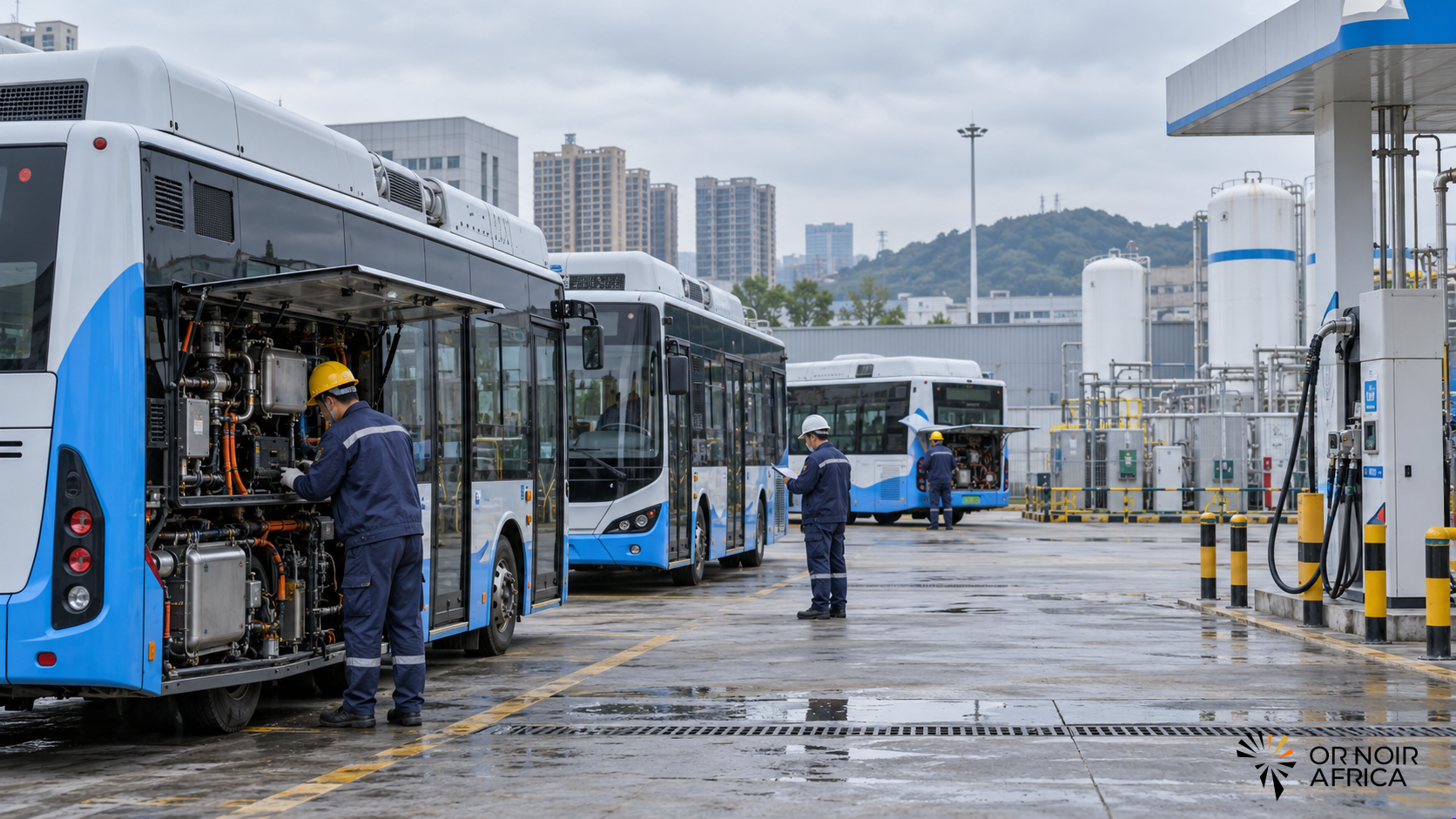
China has launched four-year pilot programs to accelerate hydrogen use across five urban and regional groupings. Authorities published a circular on October 16, prepared by the ministries of Industry and Information Technology and Finance, together with the National Development and Reform Commission. The initiative covers equipment, industrial projects, fuel-cell vehicles and refueling stations.
Selected groupings include Beijing–Tianjin–Hebei, the Guangdong–Hong Kong–Macao Greater Bay Area and three interregional clusters connecting northeastern China, eastern Inner Mongolia, the Yangtze River Delta, Xinjiang, Chengdu–Chongqing, the Yellow River loop and central plains. The stated goal is organizing supply chains and stimulating uses rather than limiting investment to isolated projects.
Public support conditional on results
Each grouping can qualify for central rewards of up to 1.6 billion yuan over four years, around $238 million using the authorities’ cited conversion. This is not automatic: ministries will assess results before allocating funds. Funding is intended to support hydrogen applications, reduce costs and help pass gains to end users.
This mechanism emphasizes execution. Groups must organize projects, strengthen industrial chains and demonstrate their ability to turn public support into actual uses. Authorities also call for avoiding local protectionism that could fragment provincial markets and limit economies of scale.
The circular provides for economic, social and environmental evaluation. This is essential to assessing effects beyond station or vehicle counts: hydrogen must be affordable, infrastructure must work and climate benefits must reflect the energy sources used to produce the gas.
Four areas, from technology to vehicles
The first area concerns technology and equipment development. China wants stronger electrolyzer, fuel-cell and hydrogen-chain component capabilities. The second concerns industrial projects, where hydrogen can serve as feedstock or energy carrier in chemicals, metallurgy and other heavy sectors.
The third promotes fuel-cell vehicles, particularly professional uses where refueling time and range matter. National policy adopted in March targets 100,000 fuel-cell vehicles by 2030. The fourth concerns refueling stations, essential for fleet operations but expensive while demand remains dispersed.
Deploying vehicles and stations together addresses a classic start-up problem: operators hesitate to build infrastructure without enough vehicles, while carriers await reliable refueling networks before conversion. Regional pilots can align both decisions by concentrating projects in corridors and industrial areas.
Reducing costs and avoiding oversized projects
The programs come as China seeks to expand hydrogen production and structure domestic demand. Official figures cited by Xinhua show more than 39 million tonnes produced in 2025, but current consumption largely comes from fossil-based processes. Expanding production therefore does not equate to renewable hydrogen growth.
Beijing targets two million tonnes of green hydrogen annually by the decade’s end. Achieving this requires substantial expansion of renewable electricity, electrolysis, storage and networks. Costs remain an obstacle, alongside aligning production facilities with industrial sites or fleets able to consume the fuel.
The circular requires thorough project analysis to prevent blind investment and resource waste. Other state-supported industries, particularly solar, showed how rapid capacity growth can create intense competition, overcapacity and margin pressure. Hydrogen’s challenge is therefore linking public support to customers, offtake contracts and usable infrastructure.
An experiment requiring long-term measurement
The five groupings start from different conditions. Some have large industrial areas, developed energy networks and specialized companies; others face long distances between production, consumers and stations. Authorities must compare results while accounting for regional differences.
Quality will be judged by delivered hydrogen costs, electrolyzer and station utilization, operational fleets, emissions reductions and facility stability. More announcements will not suffice if equipment remains underused or hydrogen replaces a more efficient direct solution.
China’s decision marks a stage in use-driven hydrogen industrialization, combining public support, deployment targets and performance evaluation. The challenge is now developing viable regional chains rather than a capacity race. Pilot results will test whether the country can turn ambition into a competitive hydrogen economy useful to sectors hardest to electrify.
Have any thoughts?
Share your reaction or leave a quick response — we’d love to hear what you think!
-
 0
-
0
-
0
-
0
-
0
-
0