

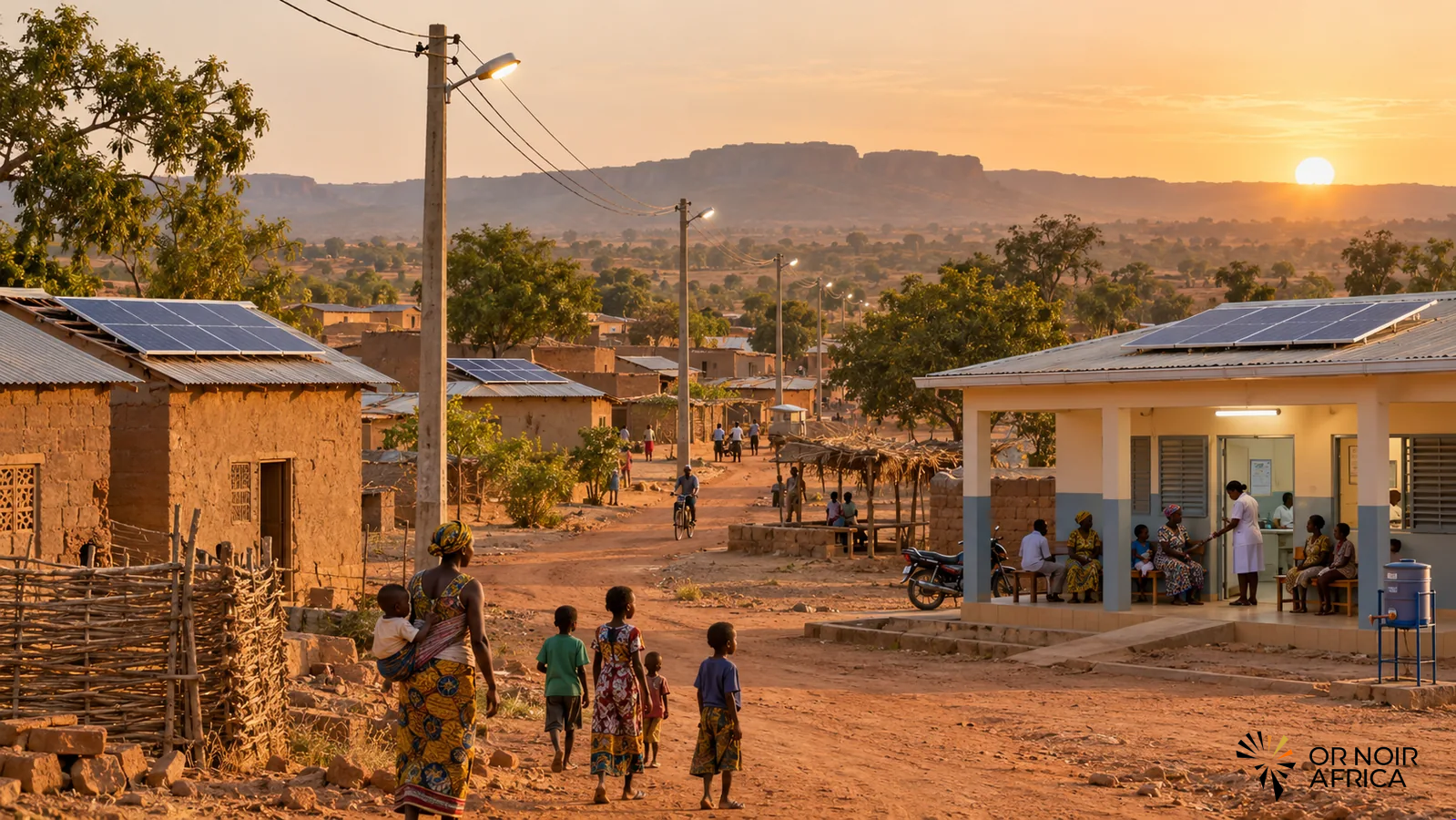
Burkina Faso and the World Bank have launched a partnership framework for 2026–2031 comprising 29 projects aligned with national priorities. The intended outcomes include electricity access for 1.9 million people. The World Bank's portfolio in the country amounts to approximately $4 billion across 29 active projects, with objectives also covering education, health, food security and irrigation.
The announcement comes as the country seeks to accelerate electrification and narrow the gap between urban and rural areas. Baseline data show that access rates are far lower in the countryside. The challenge therefore goes beyond connecting new households: electricity must be available, affordable and reliable enough to support domestic use, public services and economic activity.
An access target within a broader strategy
The new partnership framework aims to provide 2.9 million students with quality education, 23 million people with access to health services and 17.5 million people with improved food security. It also provides for the development of 12,000 hectares of irrigated land. These ambitions illustrate the multisectoral approach of World Bank programs: electricity should support schools, health centers, irrigation and local businesses.
The number of people who could gain electricity access is significant, but it must be considered in the context of national objectives. Burkina Faso's National Energy Compact targets much broader access by 2030, including connecting millions of people in urban and rural areas. The World Bank partnership framework contributes to this ambition, without on its own accounting for all the financing or expected results.
The quality of access matters as much as the connection itself. A household may be connected to the grid but face frequent outages, insufficient power or costs that limit appliance use. In remote areas, decentralized solutions and mini-grids can complement the extension of power lines. The choice between the grid, mini-grids and individual solar systems depends on population density, transport costs and local demand.
Narrowing the gap between cities and rural areas
Geographical disparities remain considerable. Recent estimates put electricity access above 80% in cities, compared with around 10% in rural areas. This difference reflects the concentration of networks around urban centers and the difficulties of serving dispersed communities. For rural families, access to modern energy can reduce reliance on kerosene lamps or generators, improve study conditions and help health services operate.
Electrifying public infrastructure can generate broader economic benefits. Health centers need reliable power for the cold chain, equipment and lighting. Schools can expand access to digital tools. Farmers and small businesses can use powered equipment for pumping, processing or preserving products. These uses nevertheless increase demand and must be anticipated in network planning.
The security situation and access constraints in some areas can slow construction and increase costs. Teams must be able to build, maintain and repair equipment, while communities should be involved in selecting sites and managing services. Delivery timelines will be crucial in distinguishing an announced target from access that is actually installed and used.
Financing alone is not enough without implementation capacity
The portfolio's 29 active projects represent substantial commitments, but their impact depends on the speed of disbursement, procurement preparation and the ability of national agencies to monitor construction. Electricity projects require imported equipment, network studies, connections and operating contracts. Supply delays or coordination difficulties can reduce the number of beneficiaries reached before the deadline.
The World Bank has said it intends to maintain dialogue with the government and adapt implementation to national priorities. This approach may facilitate local ownership, but success will depend on public indicators and regular monitoring. It will be useful to distinguish committed financing, completed infrastructure, households actually connected and electricity services genuinely available.
Electricity costs are another issue. Grid expansion must remain sustainable for public finances and operators. Tariffs must support the maintenance of facilities while remaining affordable for users. Targeted support mechanisms can protect vulnerable households without undermining electricity companies' ability to invest and maintain service.
The 2026–2031 framework thus links electrification to a broader development strategy. Its target of 1.9 million people reflects the role of energy in health, education and economic activity. For Burkina Faso, the main test will be turning commitments into reliable access, particularly in rural areas. Progress should be measured through connections and electricity quality, with visible results before the program ends.
Have any thoughts?
Share your reaction or leave a quick response — we’d love to hear what you think!
-
 0
-
0
-
0
-
0
-
0
-
0





