

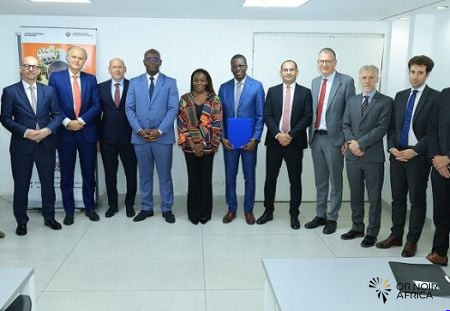
AXIAN Energy is continuing to expand its renewable portfolio in West Africa with new financing for the Kong solar plant in northern Côte d’Ivoire. The agreement announced in mid-October provides for up to €55.5 million, or approximately $62.3 million, and brings the developer together with Dutch financier FMO and the Private Infrastructure Development Group (PIDG).
The project, with planned capacity of 50 MWp, is designed to enter service in 2028. It is expected to generate 96 GWh of electricity annually, sold to CI-ENERGIES under a 25-year power purchase agreement. FMO is providing long-term debt with a twenty-year maturity, spreading repayment over a period more consistent with the asset’s useful life.
A long-term financing structure
The project company involves several ownership layers. AXIAN Energy holds 55% of Ivorian developer Africa Via, which itself owns 51% of the company responsible for Kong Solaire. The remaining 49% is held by InfraCo, a PIDG entity. The structure therefore brings together a regional operator and development institutions around an asset intended to sell its output to the national public buyer.
For a solar project, a long-term contract can make revenue more predictable and facilitate debt financing. The strength of this arrangement nevertheless depends on timely commissioning, plant performance and the buyer’s ability to meet its commitments. The announced financing is a decisive step, but is not the same as actual electricity generation.
A regional portfolio under construction
The partnership with FMO and PIDG builds on a relationship already used in Senegal. In March 2026, AXIAN Energy closed financing for a plant at Kolda combining 60 MWp of solar panels and 72 MWh of storage. FMO and the EAAIF fund, also part of PIDG, were among the financing partners, alongside DEG.
The group also benefited from a $30 million EAAIF loan in 2023 and a $60 million agreement with Mauritius Commercial Bank in June 2026. AXIAN Energy’s stated goal is to raise installed renewable capacity to 2 GW by 2030. To reach this target, the company will need to turn financing agreements into operational projects while securing grid access, sales contracts and the necessary foreign currency.
The grid integration challenge
Adding solar capacity helps diversify electricity supply and reduce exposure to imported fuels. But solar energy varies with sunshine and must be integrated into a system capable of balancing supply and demand. The storage planned at Kolda partly addresses this constraint; the Kong project, as announced, does not specify a battery. Its contribution will therefore also rely on generation planning and the grid’s ability to absorb the electricity supplied.
Developing projects across several countries can help AXIAN pool expertise and spread risk. It also exposes the group to different regulatory frameworks, buyers and grid conditions. The Kong agreement illustrates the role of development institutions in structuring long-term financing. Success will be measured when the plant is built, connected and able to supply the contracted electricity regularly.
Have any thoughts?
Share your reaction or leave a quick response — we’d love to hear what you think!
-
 0
-
0
-
0
-
0
-
0
-
0





