

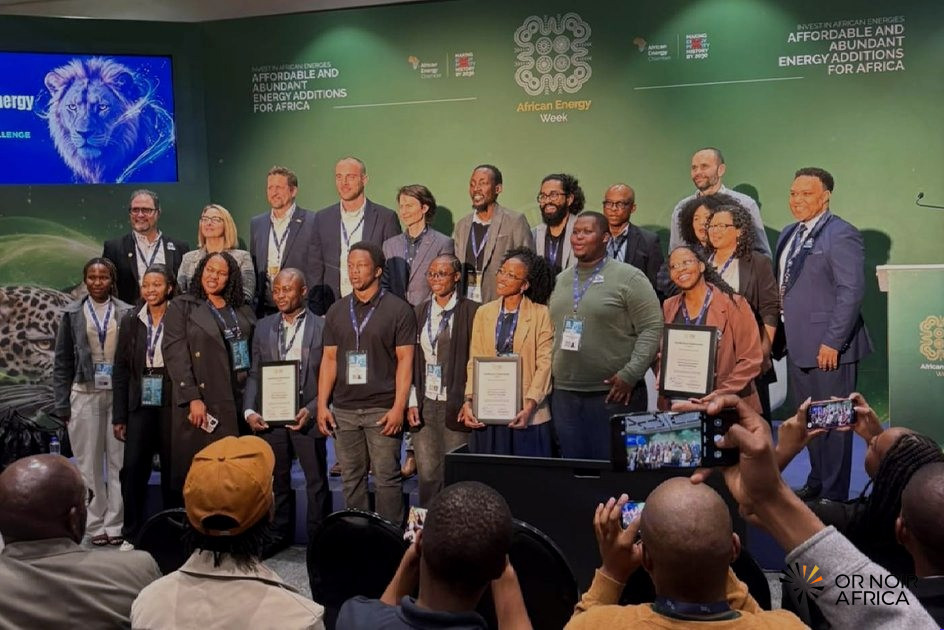
South Africa's electricity crisis requires responses combining reliability, cost control and system transformation. The Future Leaders Student Challenge held during African Energy Week 2026 placed these constraints at the heart of a university competition. Participating teams had to start with a practical problem, propose an applicable solution and explain who would benefit, how to finance it and how to measure results.
First prize went to Team Cobalt, which proposed reallocating some revenues already collected through carbon tax on power plants. The project envisages an annual fund capped at 6.2 billion rand from April 2028, without creating an additional levy. Under the proposal, 30% would finance subsidised electricity access for the poorest households and 70% would support new generation capacity.
Financing access without adding a new tax
Team Cobalt's proposal seeks to address two dimensions of the crisis: electricity costs for vulnerable households and the need for new system capacity. Its interest lies in using existing revenue and setting a legal cap, rather than promising unlimited spending. Earmarking funds could make budget trade-offs clearer and give participants visibility over amounts devoted to access and generation.
This structure nevertheless raises implementation questions. Tax revenues can vary with production, prices and fiscal rules. A lasting mechanism must therefore specify how the fund will be replenished if revenues fall, which households are eligible and how to prevent subsidies reaching consumers who do not need them. Selection of financed projects must also consider full costs, connection timelines and actual contributions to reliability.
The proposed split — around 1.86 billion rand for households and 4.34 billion for supply — highlights a central political tension: providing rapid bill relief or investing in assets that increase production. These objectives are linked but do not materialise at the same pace. Transparent allocation criteria and regular publication of results will be essential to sustain public confidence.
Solar power can strengthen the rural economy
Second-placed Team Rubidium presented Kgalagadi Axua Intelligence, an initiative combining solar installations with smart water management for farms. The project responds to constraints in rural areas of the Northern Cape, where fuel shortages, variable rainfall and El Niño-related risks can disrupt water access.
Combining solar energy with pumping or irrigation control can reduce diesel dependence and stabilise farm supplies. For farmers, however, the benefit will depend on financing access, maintenance costs and nearby technicians. Solutions must also account for water resources: cheaper pumping energy must not accelerate over-extraction from aquifers or rivers.
The financing mechanisms discussed by the team can help make equipment accessible, but viability will need verification under real conditions. Pilot projects with cooperatives and farmers could test fuel savings, irrigation continuity, yields and maintenance costs before any expansion. Innovation will then be measured by the ability to improve agricultural production without shifting the problem towards water or debt.
Preparing power plant closures with safeguards
Team Chromium, third in the competition, proposed a conditional framework for retiring Camden coal-fired power station, whose closure had been envisaged around 2030. Its approach rests on five checks: financial close for replacement solutions, replacement of measured generation, reliable supply availability, grid condition and consideration of consequences for affected populations.
This framework addresses a sensitive energy transition question: a closure date alone does not guarantee a just transition or stable supply. New capacity must be operational, connected and able to provide electricity when the system needs it. Employees, subcontractors and communities dependent on a power station must also participate in planning, with retraining and local economic development measures.
An approach based on verifiable conditions can reduce the risk of symbolic decisions disconnected from grid realities. It requires authorities to publish criteria and data allowing assessment of whether replacement capacity is sufficient. It can nevertheless be misused if requirements become a means to postpone change indefinitely. A transparent schedule and intermediate milestones are therefore necessary.
Connecting universities with sector needs
The competition was organised by the African Energy Chamber with the University of Cape Town, Stellenbosch, the University of the Western Cape, Cape Peninsula University of Technology and the University of Pretoria. Up to 150 students participated. The jury brought together expertise in engineering, energy law, renewable integration, business development and resource governance.
The initiative's value also lies in its method. Requiring students to define beneficiaries, financing and indicators pushes them beyond general ideas into implementation questions. Connections with professionals can bring academic research closer to field constraints and offer young people access to career networks.
The winning proposals will not solve South Africa's system challenges on their own. They nevertheless show that energy innovation includes designing rules, business models and social mechanisms alongside new technologies. The next challenge will be to test these ideas with public and private partners, publish results and identify those that can be replicated. At that stage, the competition can turn the interest generated at AEW into a lasting contribution to electricity security.
Have any thoughts?
Share your reaction or leave a quick response — we’d love to hear what you think!
-
 0
-
0
-
0
-
0
-
0
-
0





