

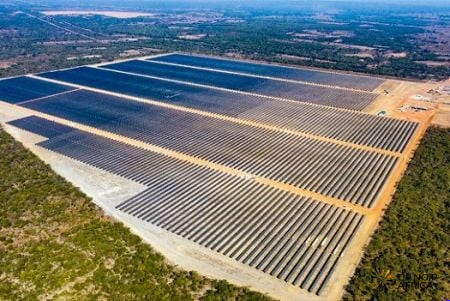
The Mailo solar plant in Zambia’s Chitambo district has reached another milestone with the start of commercial operation of its second phase. The addition of 34.5 MWp brings the site’s total capacity to 59.5 MWp, strengthening a model in which electricity is sold to industrial buyers and on the regional market rather than under a conventional contract with the national utility.
Solarcentury Africa announced commissioning on October 20. Construction of the new phase was completed in less than twelve months by Namibian company Alensy Energy Solutions. Standard Bank South Africa arranged financing, while Solarcentury’s parent company, BB Energy, provided equity. The first 25 MWp phase has been operating since July 2025.
A merchant model in a hydropower-dominated system
Mailo’s output is marketed to industrial buyers and through the Southern African Power Pool (SAPP), the regional electricity trading platform. This model gives the producer the opportunity to sell to several customers, but also exposes it to buyer availability, market rules and cross-border transmission capacity. It differs from a long-term power purchase agreement with a state-owned utility, which can make revenue more predictable.
Zambia still relies heavily on hydropower, a dependence that makes supply sensitive to hydrological conditions. Solar plants can diversify generation sources, especially during sunny periods, but their contribution varies throughout the day. Grid stability and the complementarity of solar, hydro and other resources therefore remain central to turning an increase in installed capacity into available energy.
Two investment routes for the same developer
A few days before commissioning Mailo’s second phase, Solarcentury Africa and Alensy were selected to build the 56 MWp Kafue solar plant, developed by Globeleq. The project is due to enter service in the third quarter of 2027 and will be supported by a 25-year power purchase agreement with ZESCO. Mailo and Kafue thus illustrate two financing and commercialization routes coexisting in the same country.
The Mailo phase strengthens immediately available supply and demonstrates the private sector’s ability to commission assets on a short schedule. But the merchant model requires buyers to be able to access the grid and pay for purchases. Contracts, market rules and interconnection capacity will weigh on profitability as much as sunshine and equipment costs.
The next challenge: connecting capacity to demand
The increase to 59.5 MWp is an operational milestone, but does not by itself reveal annual generation, selling prices or the site’s utilization rate. Measuring Mailo’s contribution to Zambia’s system will require tracking electricity actually delivered, the share sold on the regional market and the regularity of payments.
Simultaneous development of merchant projects and plants under public utility contracts can broaden available sources of financing. It nevertheless requires coherent grid planning so that new producers are not constrained by transmission bottlenecks. Mailo’s performance could therefore provide a reference for other investors seeking to finance renewable plants without depending on a single public buyer.
Have any thoughts?
Share your reaction or leave a quick response — we’d love to hear what you think!
-
 0
-
0
-
0
-
0
-
0
-
0





