

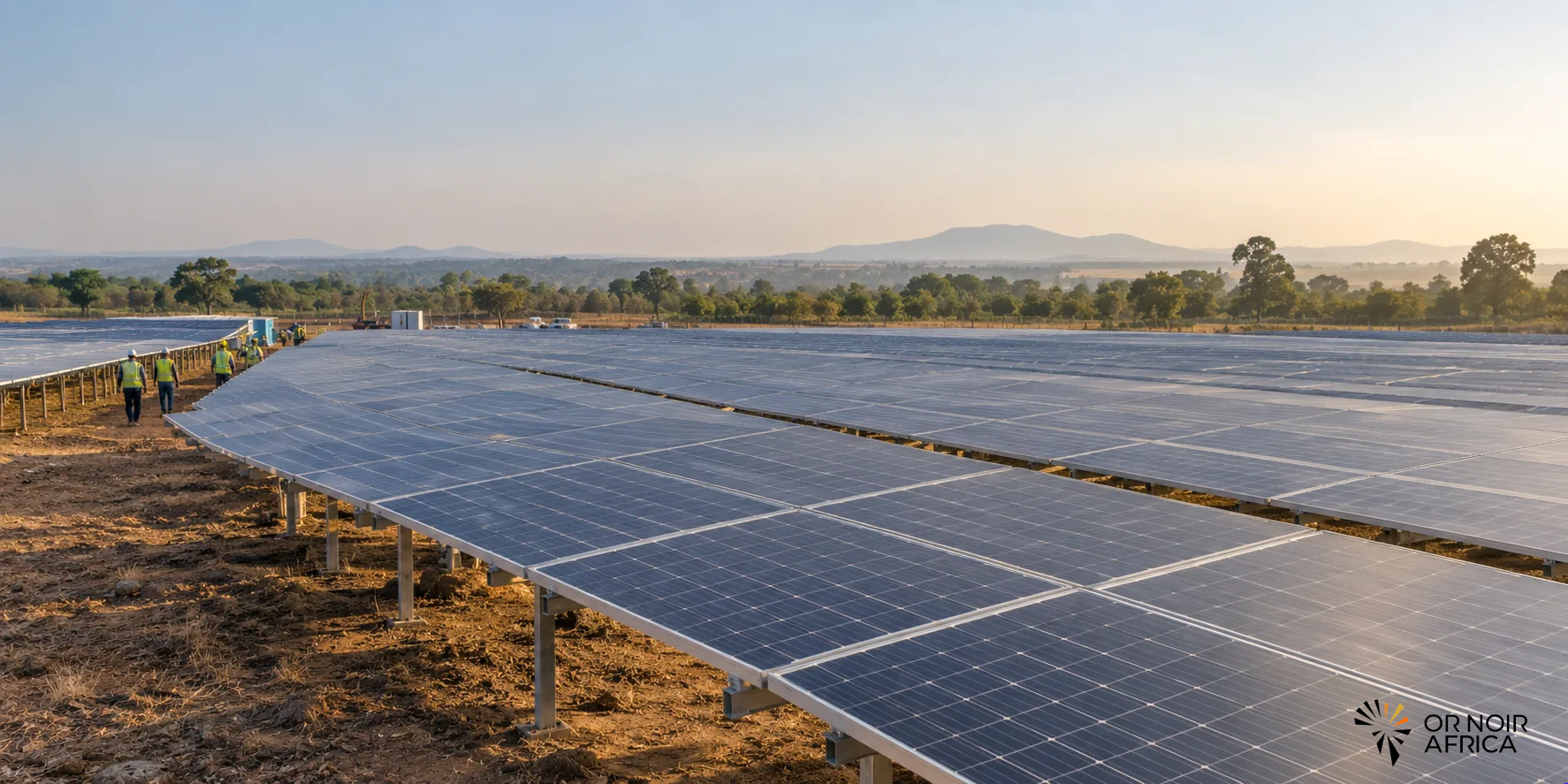
Eight years after development began, the Kafue solar project has finally crossed the threshold separating a contract award from a financeable construction project. Globeleq announced financial close for the plant, with a capacity of 40 MWac, or 56 MWp, near Kafue town in Lusaka Province. The announcement unlocks the construction phase, but also highlights the time needed to turn a renewable energy tender into electricity actually delivered.
The package brings together financing from British International Investment (BII) and the Dutch bank FMO totaling $52.1 million. Kafue Solar was developed under the GET FiT Zambia program, led by the Ministry of Energy with support from Germany’s development bank KfW. The plant will sell its output to ZESCO, the public electricity company, through a 25-year power purchase agreement. Globeleq will remain the project’s owner and handle construction and operation.
Financing that ends a long wait
Financial close gives lenders and the developer the agreements needed to commit expenditure and mobilize construction firms. It is a decisive milestone for a project awarded several years earlier. The delay is a reminder that photovoltaic equipment costs are only part of the equation. The power sales agreement must also be negotiated, grid connection secured, risks allocated, permits obtained and long-term debt raised on terms compatible with the plant’s future revenues.
Kafue will comprise two solar units of 20 MWac each. The project is designed to produce approximately 123 gigawatt-hours annually and connect to the Kafue Town substation through a transmission line approximately 3.5 kilometers long. According to Globeleq, first electricity generation is targeted for October 2027. The next test will therefore be execution: meeting the schedule, staying within budget and connecting the facilities in a power system under pressure.
The 25-year contract with ZESCO provides revenue visibility and a basis for financial institutions to assess the project. However, a purchase agreement alone does not guarantee long-term success. The public buyer’s ability to meet commitments, grid quality and financing availability for associated infrastructure also influence the risk profile. Financial close means the partners now regard these conditions as sufficiently structured to proceed, while operational risks remain to be managed during construction and operation.
Diversifying a system exposed to hydrological uncertainty
For Zambia, Kafue’s contribution is not measured solely in megawatts. National electricity generation depends heavily on hydropower and remains vulnerable to droughts that reduce water reserves. Solar can help diversify the energy mix and limit the system’s exposure to a single resource. Its daytime generation profile complements dams and can conserve water when sunshine is favorable.
This complementarity does not eliminate constraints. A growing share of variable solar requires reliable forecasts, coordinated plant management and, eventually, storage capacity or regional exchanges able to absorb fluctuations. Kafue remains modest relative to the country’s development needs, but it can provide practical experience in integrating large-scale photovoltaics and contracting new private capacity.
Electricity demand is growing with urbanization, industrial activity and mining. Businesses need more consistent supplies to invest and increase production. In this context, every new project matters, but adding plants will not replace investment in lines, substations and grid flexibility. Kafue’s expected benefits will therefore also depend on the system’s ability to transport electricity when it is generated and use it efficiently.
One component of a larger portfolio
The project is part of Zambia’s strategy to attract independent producers and international financiers. GET FiT aims to accelerate renewable energy projects through competitive tenders and standardized agreements. For the authorities, replicating this mechanism is essential: a successful close must convince other developers and financiers that a project can progress from selection to commissioning within a predictable timeframe.
Globeleq is also expanding its presence in the country. Its portfolio notably includes the Lunsemfwa hydropower plant, in which it acquired a 51% stake in 2026, and the larger Leopards Hill solar-plus-storage project, whose financing was still targeted before year-end. This diversified presence can offer commercial and operational synergies, but also increases the importance of coordination with ZESCO and the authorities on grid access and electricity contracts.
For communities near the site, the next stage will be construction, with its requirements for labor, logistics and local services. Expected construction employment exceeds 200 jobs according to information released about the project, but these positions will be temporary. Lasting benefits will depend on training, procurement from Zambian businesses and retaining local skills during operation.
Kafue Solar is therefore an encouraging signal, but its significance will depend on what follows. Electricity must be delivered on schedule, its purchase must remain sustainable for the system and the project’s experience must help accelerate subsequent developments. After eight years of preparation, financing is secured; the test now shifts from financial structuring to the infrastructure’s actual performance.
Have any thoughts?
Share your reaction or leave a quick response — we’d love to hear what you think!
-
 0
-
0
-
0
-
0
-
0
-
0





