

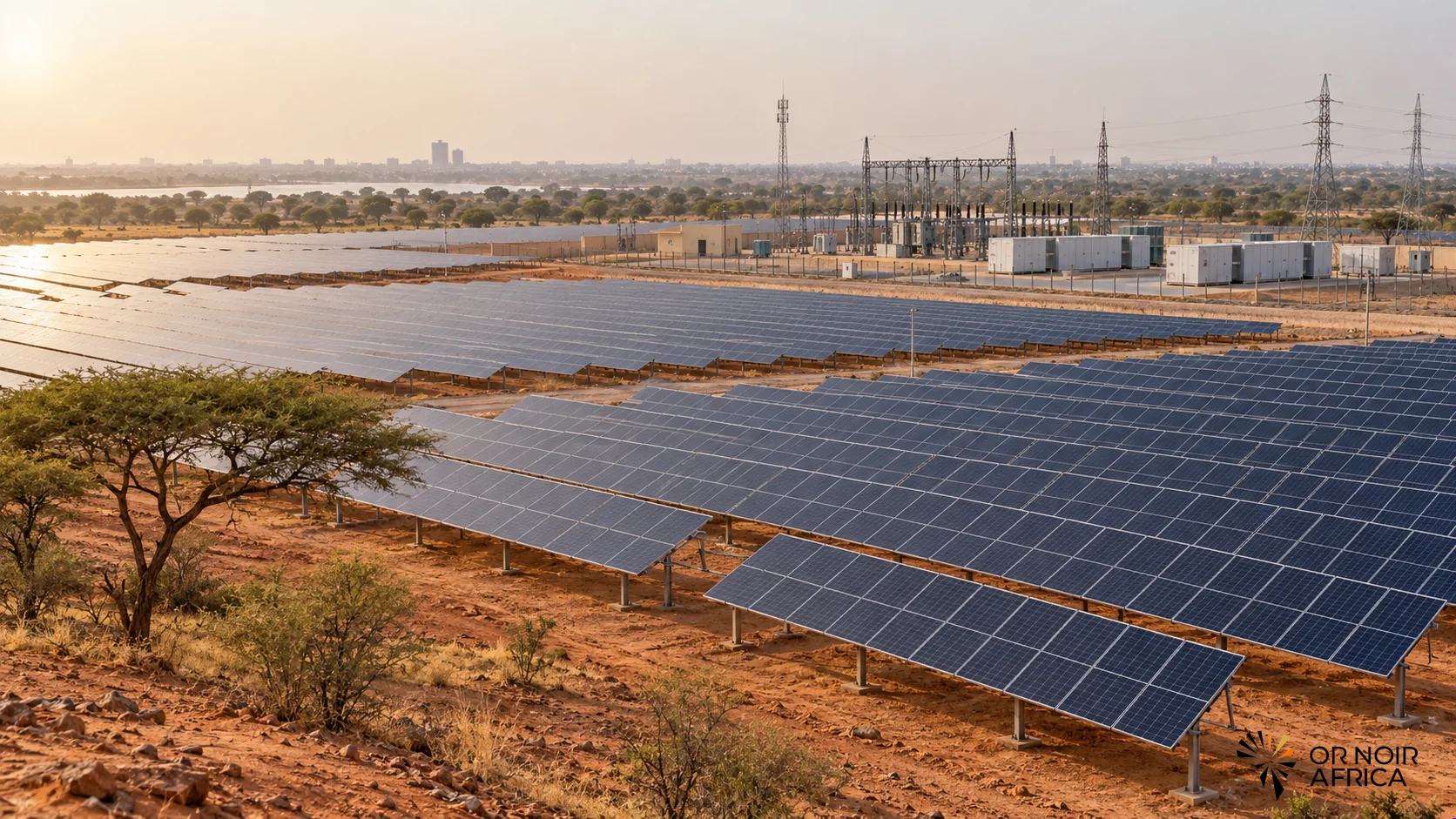
The Gassi and Lamadji hybrid solar projects, developed by Qair in Chad, have reached financial close and received an initial disbursement from the African Development Bank. This milestone enables construction to begin on two plants totaling 30 megawatts-peak, complemented by 8 megawatt-hours of battery storage. The project will supply the national grid under a long-term power purchase agreement with Tchadelec.
The announcement marks an important transition from financial preparation to execution. The projects were structured with support from the AfDB and development finance partners, including Proparco, the Sustainable Energy Fund for Africa (SEFA) and the Green Climate Fund. A €37.9 million package was mobilized. An €8 million partial risk guarantee aims to secure the letter-of-credit mechanism associated with the public buyer’s payment obligations.
Two sites, hybrid generation and a grid to strengthen
Gassi and Lamadji are designed to combine photovoltaic generation and batteries. Panels supply solar energy during the day, while storage can help manage some production variability and improve grid integration. Batteries do not replace continuous generation plants, but provide useful flexibility when sunlight and demand fluctuate.
The project is developed by Qair, one of Chad’s first independent power producers. The twenty-year power purchase agreement with Tchadelec provides commercial visibility, an important condition for mobilizing private financing in a market where the buyer’s financial strength is decisive. The partial guarantee helps reduce lenders’ perceived risk without eliminating operational challenges or construction risks.
Disbursement means initial financing conditions have been met and funds are beginning to be deployed. Next stages concern construction, equipment installation, substation connections and commissioning. Scheduling will depend on panel and battery deliveries, interconnection works and the grid’s ability to receive output.
Part of Desert-to-Power and Mission 300
Both plants form part of the AfDB’s Desert-to-Power program, which aims to expand solar generation and electricity access in the Sahel. They also contribute to Mission 300, a joint African Development Bank and World Bank Group initiative aiming to connect an additional 300 million people in Africa by 2030.
For Chad, these objectives translate into a concrete challenge: improving electricity availability and supporting demand growth. Solar plants can diversify generation and limit some dependence on imported fuels. But the final impact is not measured only in installed megawatts. It depends on hours of actual energy delivery, grid continuity and Tchadelec’s ability to sell this production to customers.
Transmission and distribution infrastructure remains decisive. A plant connected to a constrained grid may not deliver its full potential. Connection works, substation capacity, battery integration and peak-demand management must therefore be monitored. Maintenance quality will also be essential to preserve equipment performance beyond the initial period.
Blended finance as an enabler, not a guarantee of success
The financing structure combines loans, concessional financing and a risk guarantee. This blended finance model makes a project acceptable to lenders while sharing risks among institutions. It addresses a frequent obstacle in emerging markets: private developers can have technically viable projects but struggle to secure sustainable financing terms when the public buyer presents high payment risk.
The guarantee provides specific protection around the contract’s payment mechanism; it does not automatically cover every project risk. Construction costs, delays, foreign exchange changes and grid constraints still require management. Success will depend on coordination among Qair, authorities, Tchadelec and financiers, and transparency about each party’s obligations.
The twenty-year contract provides an operating horizon but also requires monitoring purchased electricity costs and how generation integrates into the national portfolio. For the country, investment value must be assessed against energy reliability, final-price affordability and contributions to electrification objectives.
From initial disbursement to electricity actually delivered
Financial close is a positive milestone, but benefits will fully materialize only at commissioning. Indicators to track include construction progress, budget compliance, effective battery capacity, connection and grid injection volumes. It will also be necessary to verify how new megawatts help reduce interruptions or supply new customers.
Gassi and Lamadji show how financial institutions and private producers can organize solar investment in a Sahelian country. They also show that capacity announcements have economic significance only when infrastructure is built, maintained and integrated into the grid. Initial disbursement advances the project toward this reality, but success will still be measured by reliable, affordable electricity actually distributed to Chadian households and businesses.
Have any thoughts?
Share your reaction or leave a quick response — we’d love to hear what you think!
-
 0
-
0
-
0
-
0
-
0
-
0





