

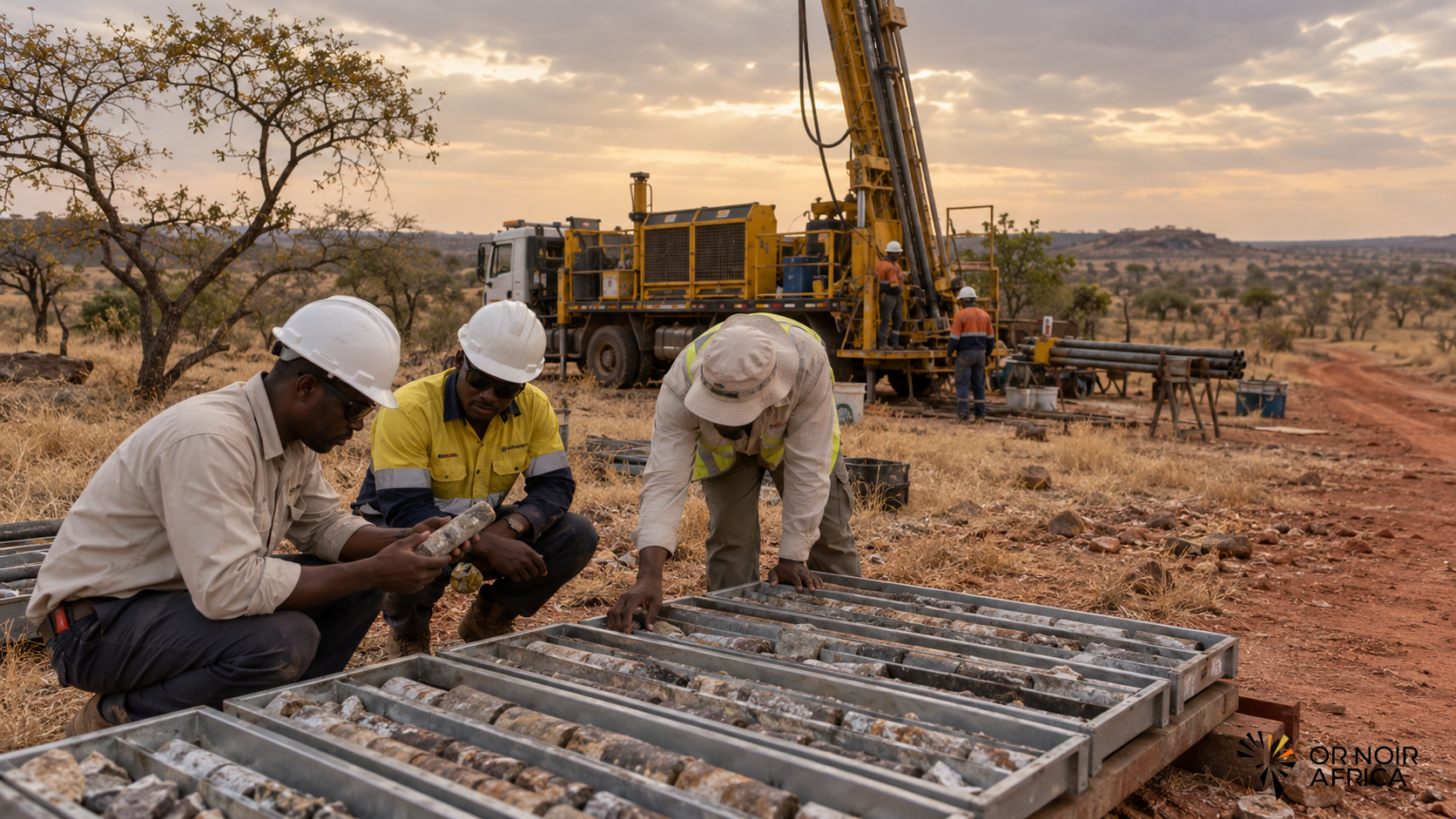
Fortuna Mining’s latest drilling results at Diamba Sud broaden exploration prospects for the Senegalese gold project without, by themselves, changing its economic status. The campaign intersected several mineralized intervals beyond Southern Arc’s currently modeled outlines, while drilling began at Bambadji, a recently acquired neighboring license. Laboratory assays from this second area are still awaited.
Two figures summarize the latest stage at Southern Arc: 7.8 grams of gold per tonne over an estimated true width of 12.8 meters, and 3.9 grams per tonne over 40.8 meters. These intersections come from separate holes. They indicate gold over notable lengths, but must not be treated as the entire deposit’s average grade or ounces already added to reserves.
Extensions beyond mining outlines
At Southern Arc, Fortuna completed 196 additional holes totaling 36,592 meters since the previous update in February. Work identified extensions to the northeast and southwest, and parallel structures to the southeast. Several zones remain open at depth or along strike, leaving targets for subsequent campaigns.
At Kassasoko, the supplementary program includes 53 holes totaling 8,787 meters. It sought to determine whether mineralization extends beyond defined limits and assess a possible connection with neighboring Western Splay. Results reinforce exploration continuity across the license, but deposit boundaries, resources and profitability can only be reassessed after data compilation and estimation work.
Paul Weedon, Fortuna’s senior vice president of exploration, presents these results as evidence of potential mineralization extensions beyond current pit designs. He also notes that geological indications at Kabewest resemble Diamba Sud, while specifying that sample assays remain pending. This assessment describes an exploration direction, not confirmed resources.
Bambadji opens a new drilling front
Fortuna has started work at Kabewest, the most advanced target on the Bambadji license near Diamba Sud. Six drill rigs are deployed under an announced 51,000-meter, $8 million program for the remainder of 2026. The area lies around 2.3 kilometers from Diamba Sud’s proposed processing plant location, proximity that could facilitate synergies if results and studies justify them.
The company says it identified more than eight drill-ready targets on the license, including Kabewest, Fatima, Djenebou, Latifa, Kach, Wari and Kabetea. Initial core descriptions report hydrothermal breccias, silica alteration and other features compared with Diamba Sud’s mineralization style. Gold grades had not, however, been published at the announcement date. The company plans drilling across several prospects through the end of 2026 and the first half of 2027.
Comparison with Diamba Sud is useful in directing exploration, but does not establish that Bambadji contains a deposit of the same size or quality. Assay results, continuity of mineralized zones and definition work are needed before a resource can be assessed. Fortuna targets an initial inferred estimate for Kabewest in its annual update scheduled for the first quarter of 2027; this goal remains subject to results and the work schedule.
Drilling can change value, but cannot establish it alone
The results come after Diamba Sud has already reached a study milestone. The feasibility study published in June reports probable reserves of 20.5 million tonnes at 1.75 grams of gold per tonne, or around 1.15 million ounces. Its economic indicators rely in particular on a gold price of $3,500 per ounce. This is a scenario assumption: costs, construction conditions, permits and future prices affect actual outcomes.
In its October 18 analysis, Simply Wall St valued the shares around 22% below a theoretical value derived from its model. This estimate relied on assumptions of sustained revenue growth and profit margins. It is a valuation scenario at a particular date, not a guaranteed target. It depends particularly on Diamba Sud’s development pace, exploration results, production start-up costs and Fortuna’s ability to finance projects while maintaining operating mines.
The main bridge between geological potential and shareholder value therefore remains converting targets into resources, then economically mineable reserves. A resource and reserve update for Diamba Sud is scheduled for year-end. For Bambadji, initial assays and the proposed Kabewest estimate in 2027 will provide more concrete reference points than geological similarity alone.
For Senegal, intensified work can support local spending, service providers and exploration-related employment. Lasting benefits will nevertheless depend on subsequent stages: investment decisions, authorizations, infrastructure development and operation of a possible mine. October’s results strengthen interest in the Diamba Sud district; the enlarged area’s industrial value remains to be demonstrated, drill hole by drill hole.
Have any thoughts?
Share your reaction or leave a quick response — we’d love to hear what you think!
-
 0
-
0
-
0
-
0
-
0
-
0





