

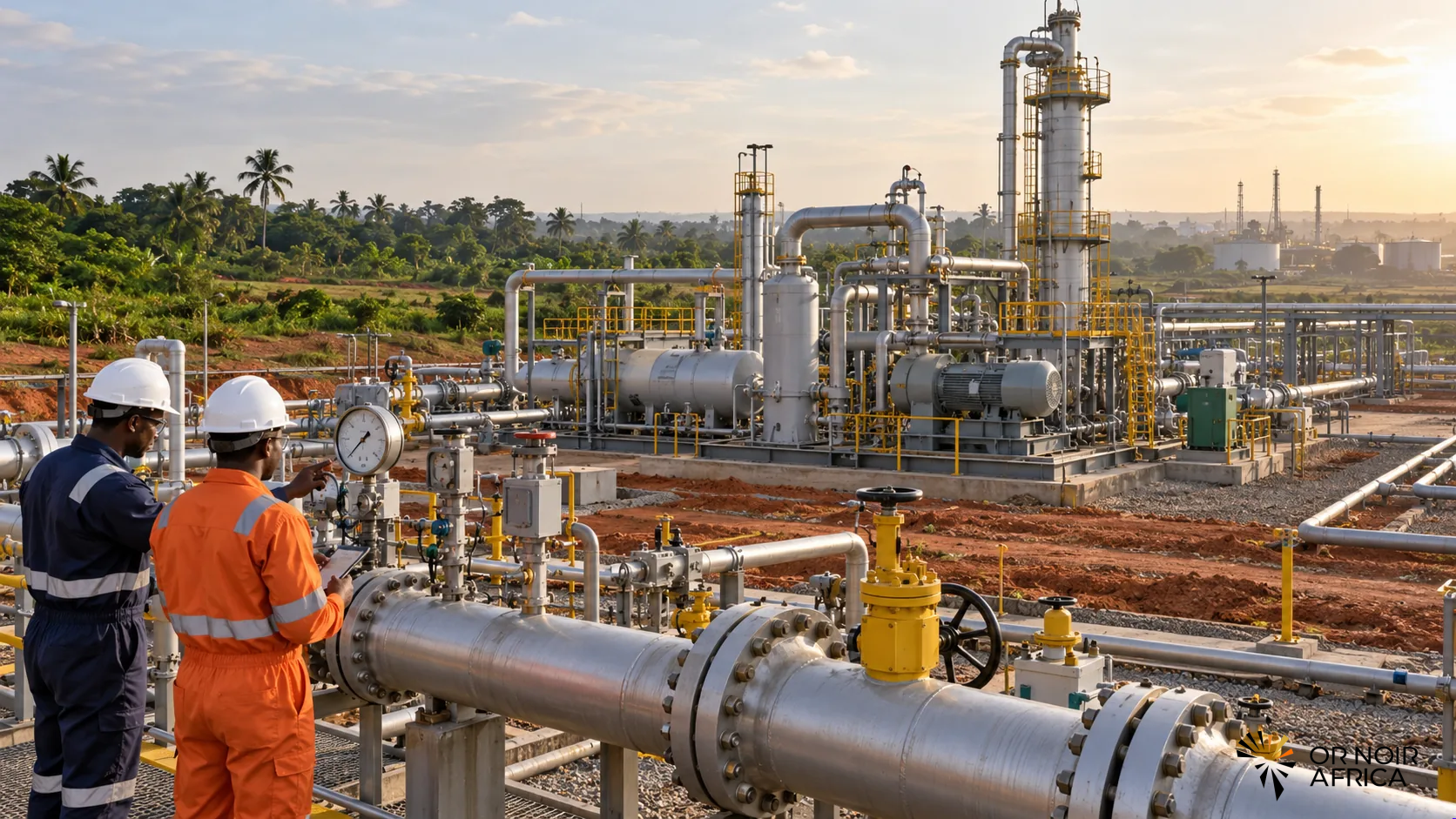
Nigeria’s domestic natural gas supply has exceeded two billion cubic feet per day, according to Minister of State for Petroleum Resources (Gas), Ekperikpe Ekpo. This growth comes as the government seeks to raise national production and complete infrastructure connecting gas basins with power stations, factories and regional markets. Crossing the threshold marks progress for domestic supply, but the gap with the country’s needs and announced targets remains substantial.
The minister said gas production had reached 7.5 billion cubic feet per day, compared with around 6.8 billion in 2023. Proven reserves reportedly rose from 208.83 to 215.19 trillion cubic feet. These figures describe distinct stages in the chain: reserves measure resources considered recoverable under defined conditions; production is gas extracted; domestic supply then depends on processing, transport and volumes actually delivered to national consumers.
The government targets production of 10 billion cubic feet per day by 2027 and 12 billion in 2030. These objectives reflect an ambition to make gas a growth driver for electricity, industry, fertilisers, petrochemicals, liquefied natural gas and transport. Delivery nevertheless requires sustained growth in investment, available infrastructure and purchase contracts that remunerate producers. Higher production does not automatically become reliable supply if pipelines, terminals or payments fail to keep pace.
The Obiafu-Obrikom-Oben pipeline, known as OB3, is one of the expected drivers. The minister announced that construction was complete and the pipeline was being prepared for initial deliveries. Its transport capacity is estimated at two billion cubic feet per day. Once commissioned, it could release more than 500 million additional standard cubic feet per day for the domestic market by connecting producing areas with consumers still short of gas.
The Ajaokuta-Kaduna-Kano pipeline, or AKK, was around 95% complete at the time of the announcement. It is intended to open a supply corridor towards the north, where industrial demand and power generation are constrained by energy access. Economic benefits will depend on customer connections, compression facilities, available volumes and the gas sales price. For factories and power stations, delivery reliability matters as much as nominal capacity on network plans.
The government is also seeking investment in midstream and downstream infrastructure. The minister said N671 billion, around $434 million, mobilised through the Midstream and Downstream Gas Infrastructure Fund had attracted nearly N1,600 billion in private investment. The funds reportedly concern 31 projects and 205 infrastructure assets. At full operation, projects are expected to supply around 475 million standard cubic feet per day to the domestic market. Nigeria also targets approximately $30 billion of gas-sector investment by 2030.
These figures demonstrate efforts to remove obstacles between extraction and gas use. Public financing can help structure gathering, processing and distribution projects, but the announced leverage will need to be followed by disbursements, completed work and assets actually commissioned. Performance will be measured through regular customer deliveries and their ability to pay for contracted volumes, rather than committed amounts or the number of portfolio projects.
Domestic gas shortages affect several economic sectors. Thermal power stations need predictable supply to generate electricity; manufacturers can replace more costly or polluting fuels with gas; fertiliser producers and petrochemical industries require it as feedstock. More consistent availability can therefore improve competitiveness and reduce some energy costs. However, these benefits also require more reliable electricity networks, operational processing facilities and a tariff framework enabling producers to cover costs without making energy unaffordable for consumers.
Gas expansion also raises security, financing and energy transition issues. Infrastructure must be protected against sabotage, leaks reduced and projects assessed against emissions and operating lifetimes. Gas can support industrialisation and complement renewables where the grid lacks flexibility, but major pipeline investments must rest on lasting demand to avoid underused assets.
Exceeding two billion cubic feet per day shows domestic supply is growing, while completing OB3 and finalising AKK could improve access to new markets. The next step will be to verify initial deliveries, actual domestic volume growth and the ramp-up of financed projects. Nigeria’s challenge extends beyond having substantial gas resources: it is to turn them into accessible, consistent and productive energy for households, businesses and industry.
Have any thoughts?
Share your reaction or leave a quick response — we’d love to hear what you think!
-
 0
-
0
-
0
-
0
-
0
-
0





