

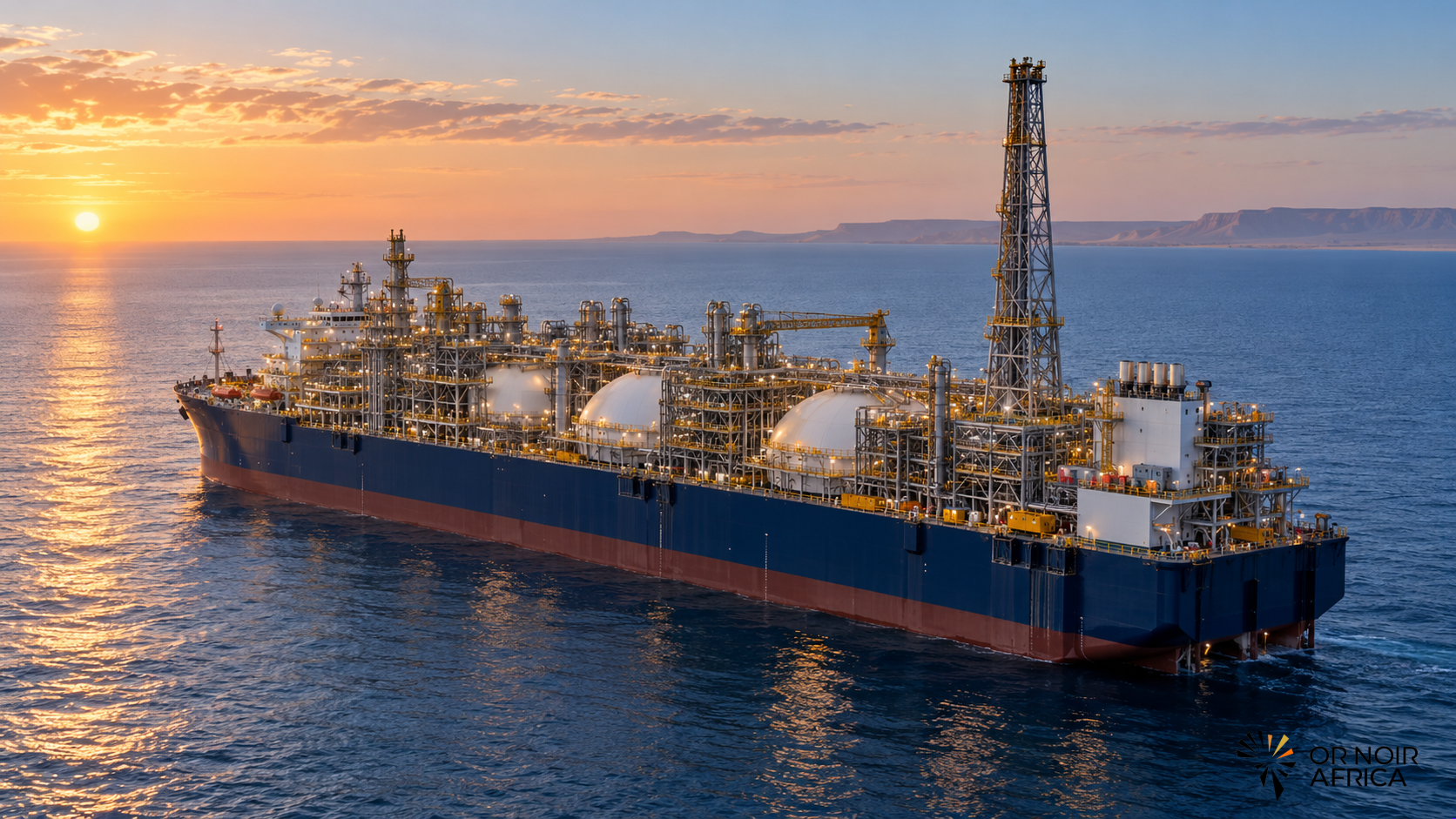
Mauritania’s liquefied natural gas (LNG) exports reached around 603,000 tonnes in the third quarter of 2026, 16% above the same period a year earlier. This increase confirms accelerating sales since shipments began from Grand Tortue Ahmeyim (GTA), shared with Senegal. It nevertheless requires qualification: quarterly volumes declined from the second quarter, and September recorded a slight year-on-year fall.
Annual growth driven by GTA
Between July and September, Mauritanian cargoes totaled around 603,000 tonnes, against 521,000 tonnes in the third quarter of 2025, a difference of 82,000 tonnes. Exports in the first nine months of 2026 reached nearly 1.97 million tonnes, against 823,000 tonnes in the same period a year earlier. Cumulative growth thus exceeds 139%.
The annual comparison partly reflects the ramp-up of a still-recent industry. Mauritania began LNG exports in early 2025 from offshore GTA. Gas is processed and liquefied offshore by a floating facility with announced operating capacity of 2.5 million tonnes per year. Third-quarter data therefore show substantially higher shipments than in the first operating year, but do not mean the country has reached a stable pace or guaranteed annual production.
The quarterly decline recalls cargo volatility
The 16% increase compares the same quarter in two years. Sequentially, exports fell more than 9% from the second quarter of 2026. September volumes also declined 0.5% from September 2025, the first monthly year-on-year fall since exports began. These movements do not establish a trend reversal, but show deliveries can vary significantly between quarters.
For an offshore project, cargo timing depends on well production rates, floating-unit availability, maintenance, logistical constraints and buyers’ lifting dates. Export figures measure volumes shipped during a given period. They must not be confused with annual nameplate capacity, gross field production or volumes separately allocated to each partner country.
This distinction is particularly important for GTA. Mauritania and Senegal jointly develop the field and infrastructure. Offshore liquefaction enables gas to reach international markets as seaborne cargoes, but volumes and revenue are shared under project-specific arrangements. Growing exports from Mauritania therefore do not mean all project revenue or volumes accrue to it.
China and Bangladesh among the main buyers
Destinations changed in the third quarter. China was the leading market, taking around 152,000 tonnes across two cargoes. Bangladesh received nearly 135,000 tonnes, ahead of Italy at around 122,000 tonnes and Egypt at around 76,000 tonnes. Other markets absorbed nearly 119,000 tonnes. China and Bangladesh together accounted for nearly 48% of quarterly exports.
This distribution illustrates LNG’s ability to reach distant markets and adjust destinations according to contracts and needs. It also underlines the importance of avoiding dependence on too few buyers. European, Asian and African customers broaden outlets, but concentration among the two largest importers is an indicator to monitor over coming quarters.
Diversifying destinations can support commercial resilience, provided cargoes can be sold competitively. Liquefaction, shipping and regasification costs add to the gas price. Producers’ captured value therefore depends not only on exported tonnage, but also on sales contracts, agreed prices and delivery regularity.
Economic benefits will depend on duration
Growing shipments come as Mauritania seeks to make gas a driver of growth and external revenue. Higher sales can support foreign-currency inflows and increase energy’s economic weight. However, strong growth from a still-low base is insufficient to measure lasting benefits. Multiyear volume trends, revenue actually received by the state and the share benefiting local businesses and workers must be observed.
Long-term gains will also depend on converting the offshore project into domestic benefits. This requires training, local suppliers’ market access, revenue transparency and infrastructure investment. With GTA’s cross-border development, coordination between Nouakchott and Dakar will be decisive in organizing project management and resource development.
The next step: confirming regular exports
Third-quarter results confirm a clear increase from 2025 and marked growth over the first nine months. But the quarter-on-quarter decline and September’s slight fall recall that the trajectory is not linear. The decisive indicator will be maintaining high deliveries while ensuring floating facilities’ reliability.
For Mauritania, the challenge goes beyond increasing tonnage. It involves stabilizing exports, preserving GTA LNG’s competitiveness in distant markets and turning the activity into lasting revenue and economic capabilities. Annual growth is encouraging; cargo regularity and the quality of benefits will reveal its real significance.
Have any thoughts?
Share your reaction or leave a quick response — we’d love to hear what you think!
-
 0
-
0
-
0
-
0
-
0
-
0





