

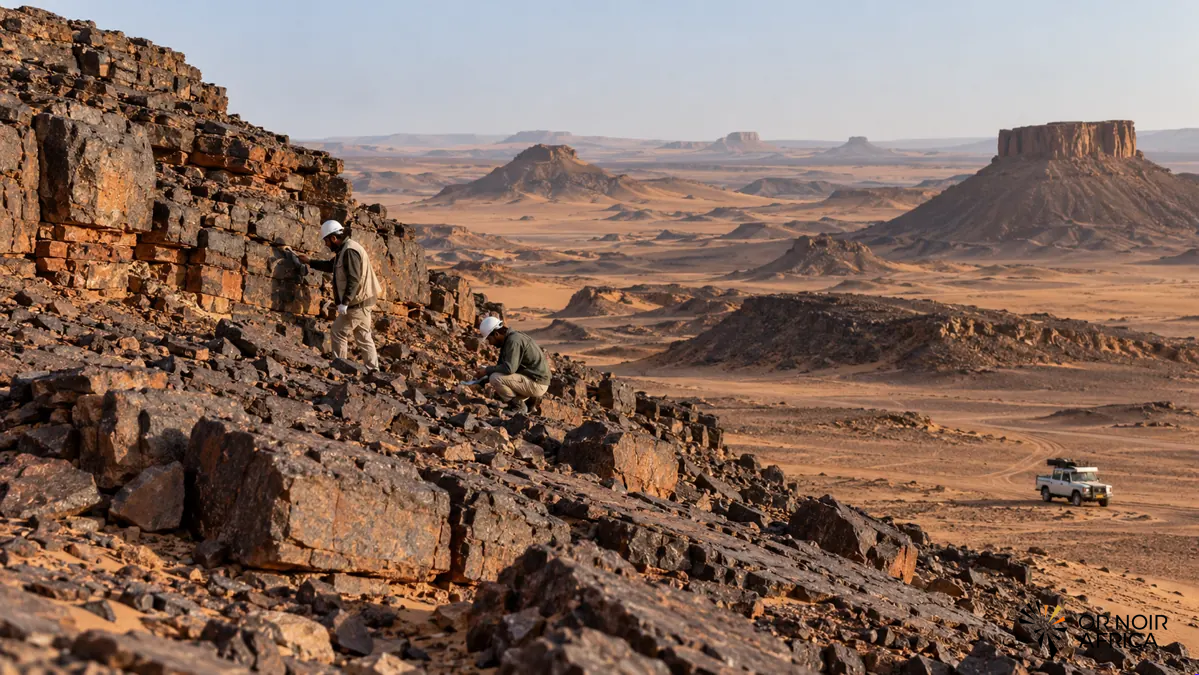
**Categories:** Event **Tags:** Libya, African Mining Week, mineral exploration, Wadi al-Shati, mining investment **Excerpt:** Libya’s National Mining Corporation will present its resources and priorities at African Mining Week in Cape Town from October 14 to 16. The aim is to open discussions with investors and specialists, while geological assessment and infrastructure remain steps to address. **Slug:** libye-potentiel-minier-african-mining-week-2026 **Image alt:** Geologists conducting a field survey in a desert mineral area in Libya.
Libya intends to use African Mining Week 2026 to draw attention to a sector still little known beyond its hydrocarbons. Libya’s National Mining Corporation will participate in the gathering in Cape Town from October 14 to 16. It is expected to present the country’s resources, development priorities and areas where international expertise could contribute to assessment and exploration work.
The program includes a national mining companies forum and a session devoted to Libya. This presence gives Tripoli a platform to engage with investors, mining companies and technical specialists. It nevertheless constitutes neither the announcement of a financed project nor the automatic opening of permits. Participation in a trade event is better measured by the partnerships that follow, the quality of data exchanged and the ability to turn interest into concrete studies.
Moving beyond an exclusively oil-focused image
Libya’s economy remains closely associated with oil and gas production and exports. This specialization has shaped public revenues, infrastructure and the country’s commercial relationships. It also makes growth vulnerable to price fluctuations, production interruptions and political tensions. Mining diversification can therefore help broaden the productive base, provided potential resources are established and projects can operate within a predictable framework.
The Wadi al-Shati formations, where iron ore occurrences are known, illustrate possibilities that remain to be examined. The presence of a geological resource is nevertheless insufficient to demonstrate that it can be profitably mined. Volumes, grade, deposit continuity, ore characteristics and processing conditions must be determined. A study must also assess distances to roads, water, electricity, ports and markets likely to buy the output.
These checks are particularly important for bulky minerals such as iron ore, where transport can account for a significant share of the final cost. A deposit far from infrastructure may require considerable investment before the first shipment. International prices, energy costs and the ability to negotiate long-term markets will then determine the project’s competitiveness.
Geological data as the first asset
To attract investors, Libya will need to make reliable, comparable geological information available. Mapping campaigns, field analyses and geophysical studies reduce the uncertainty surrounding a prospect. They give the state a stronger basis for delineating areas, awarding licenses and assessing operators’ proposals.
Data quality also affects risk allocation. A company is more likely to commit exploration expenditure when it can access sufficiently detailed surveys and understand licensing rules. Conversely, missing information, discrepancies between studies or uncertainty over data ownership can delay a decision. Authorities can improve attractiveness by publishing maps, technical reports and transparent procedures while protecting operators’ legitimate commercial information.
African Mining Week can help identify providers capable of carrying out this work, but the conference does not replace field campaigns. Discussions with service companies, universities or geological institutions could help define technical needs. A funded program must then be established, methods selected and results published for investors to examine.
Making the investment framework clear
Mineral potential attracts capital when the rules are sufficiently clear. Companies assess permit duration and costs, the fiscal regime, revenue repatriation arrangements, local content obligations and dispute resolution mechanisms. They also examine security conditions and institutional continuity. These factors influence decisions as much as deposit quality.
For Libyan authorities, promoting the sector must therefore be accompanied by a precise explanation of award procedures and the respective responsibilities of government bodies. Competitive licenses can stimulate exploration, but must protect public interests and prevent land speculation. Verifiable work commitments, reporting requirements and technical oversight help ensure that mining rights translate into actual investment.
Environmental and social governance must also be considered from the preliminary stages. Water access, protection of inhabited areas, tailings management and community dialogue influence a mine’s viability throughout its life. Companies increasingly seek projects capable of demonstrating compliance with financing and traceability standards. A credible mining strategy must therefore integrate impacts and local benefits rather than address them after a deposit is discovered.
Turning interest in Cape Town into measurable steps
Libya’s African Mining Week session can introduce potential partners to priority sectors and areas. To produce results, this visibility must lead to documented exchanges: information requests, technical protocols, mapping campaigns, feasibility studies or training projects. The number of meetings will not be a sufficient indicator without a follow-up timetable.
The next milestones are therefore institutional as well as geological. They involve clarifying available data, selecting areas to study, assessing infrastructure and publishing consistent investment conditions. The state must also determine which skills it wants to develop locally so that studies and future projects contribute to Libyan expertise.
The National Mining Corporation’s initiative signals a desire to present Libya as a mineral exploration territory alongside its role as a major hydrocarbons player. This ambition is relevant as many countries seek to diversify revenues and derive greater value from their resources. It must nevertheless rest on geological evidence, stable rules and projects suited to local constraints. Only then can the Cape Town showcase become a starting point for lasting investment rather than simply a communications exercise.
Have any thoughts?
Share your reaction or leave a quick response — we’d love to hear what you think!
-
 0
-
0
-
0
-
0
-
0
-
0