

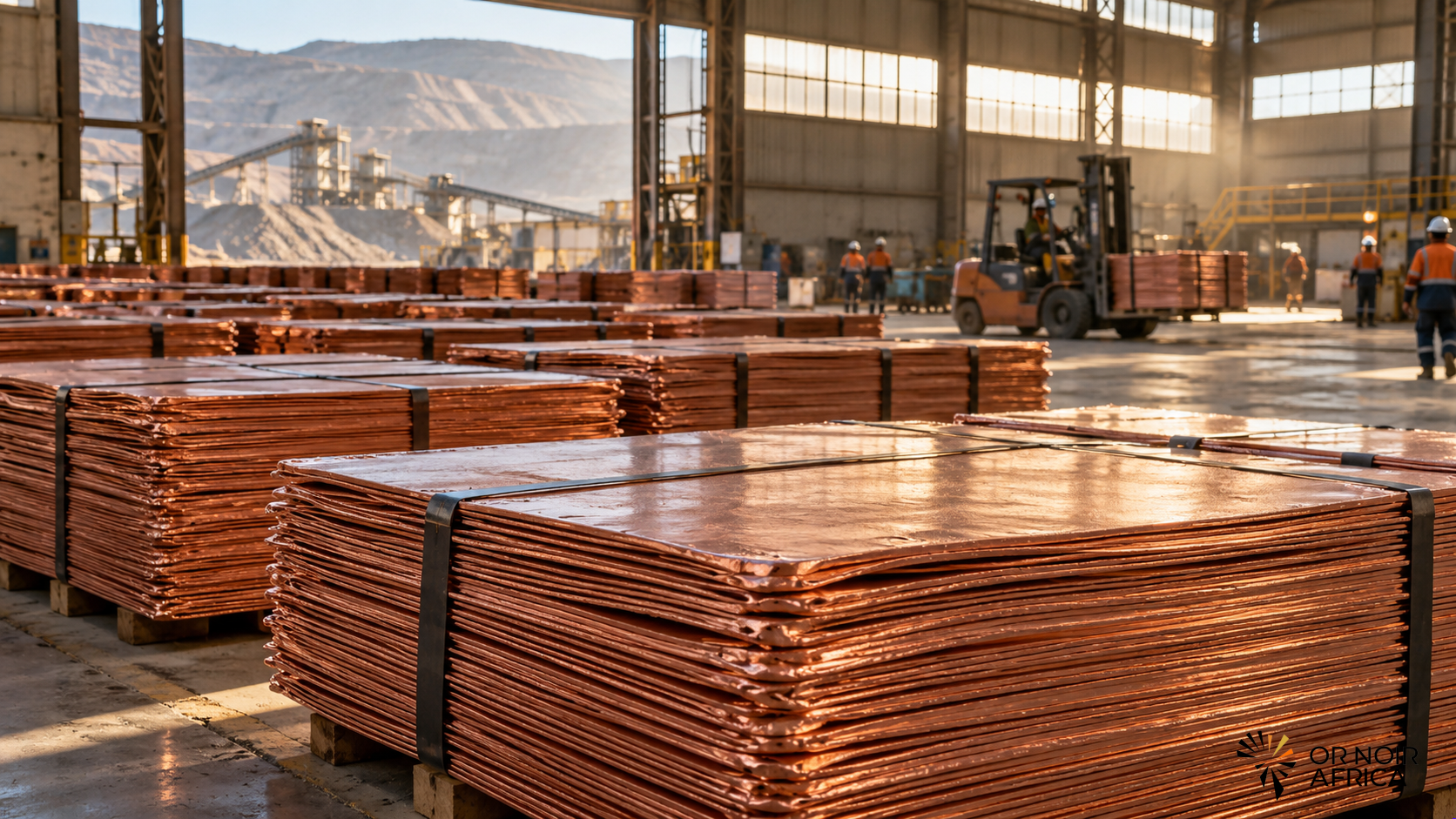
Goldman Sachs has raised its copper price forecasts for 2026 and 2027, citing weaker-than-expected mine supply and a tightening market outside the United States. The bank now estimates that copper could average $15,400 per tonne in 2027, compared with its previous estimate of $13,800. It also raised its forecast for the end of 2026 to $14,700 per tonne, from $13,735 previously.
These figures express a market expectation, rather than a price guarantee. An annual average can conceal substantial differences between periods, while a year-end forecast is a reference point rather than an assured trajectory. The significance of the revision lies above all in the factors Goldman highlights: the difficulty of increasing mine production rapidly and competition between the United States and China to secure refined copper.
A deficit visible outside the United States
According to estimates reported by Reuters, Goldman Sachs expects a supply deficit of around 950,000 tonnes in 2026 and 220,000 tonnes in 2027 outside the United States. The geographical qualification matters. An aggregate global balance may appear less tight when stocks in different regions are added together, but those stocks are not necessarily available where smelters and industrial users need them.
Trade flows, transport costs, tariffs and stockpiling decisions therefore influence the prices available to buyers. Competition between the United States and China can widen regional differences if shipments are drawn toward one market at another’s expense. This pressure does not necessarily mean that metal is in short supply everywhere at the same time; it indicates that the location and availability of stocks are becoming decisive.
Goldman’s forecast also reflects the limits of mine supply. Copper cannot respond immediately to rising demand. A new project requires studies, permits, infrastructure, financing and a lengthy construction phase. Existing operations can also suffer delays, declining grades or disruptions. An upward price revision can thus reflect difficulty bringing additional volumes to market quickly.
Why African producers are affected
The Democratic Republic of the Congo and Zambia play a major role in global copper supply. A sustained price increase can improve producers’ prospects, support export earnings and strengthen investor interest in Copperbelt projects. However, the effect on each company or on public finances will depend on its volumes, costs, taxation, contracts and ability to transport ore.
The metal’s price does not automatically translate into equivalent local revenues. A mine may produce less than expected, face higher costs or transfer a substantial share of its profits abroad. Transport and electricity infrastructure also determine the volumes that can be extracted, processed and delivered. For producer countries, the challenge is therefore to turn a favorable price environment into productive investment, public revenues and benefits for local economies.
Local processing is another central issue. Higher prices can increase the value of concentrate or cathode exports, but do not remove the obstacles to establishing smelters, refineries or downstream industries. These activities require reliable electricity, substantial capital, market access and predictable governance. The price signal can help justify new investment; it does not replace the economic conditions that make it viable.
An expected increase does not eliminate risks
The price outlook remains subject to several uncertainties. Improved mine production, facilities returning to service, weaker industrial demand or changes in trade policy could ease the market. Conversely, supply disruptions or stronger competition for stocks could intensify regional pressure. Goldman’s revision should therefore be read as a scenario based on available information, rather than a promise of returns for producers or investors.
Nominal prices must also be distinguished from real profitability. Even if copper becomes more expensive, energy, labor, equipment and transport costs may rise alongside it. Financing costs and taxes also change the share of value accruing to operators and states. Assessing the benefits of an increase requires examining each project’s production costs and contracts rather than relying on an isolated benchmark price.
Indicators to watch in 2027
The coming months will show whether the anticipated deficits translate into sustained pressure. Visible inventories, Chinese imports, refined copper availability and changes in mine output will be key indicators. For Central and Southern Africa, mine production, investment in transport corridors and processing capacity will also need to be monitored.
The forecast of $15,400 per tonne thus puts supply at the forefront, but does not by itself indicate who will benefit. For producer countries, the opportunity will be to improve production reliability, negotiate balanced contracts and develop activities with greater added value. For buyers, the challenge will be to secure supplies without confusing global inventories with metal actually available in their region.
Copper therefore remains at the intersection of geology, infrastructure and trade geopolitics. Goldman’s higher forecast highlights the difficulty of increasing supply quickly, while the estimated deficit outside the United States shows that the geography of flows matters as much as global volumes. For Africa, with its rich copper resources, this dynamic can open opportunities, provided local capabilities and rules for sharing value advance at the same pace as demand.
Have any thoughts?
Share your reaction or leave a quick response — we’d love to hear what you think!
-
 0
-
0
-
0
-
0
-
0
-
0





