

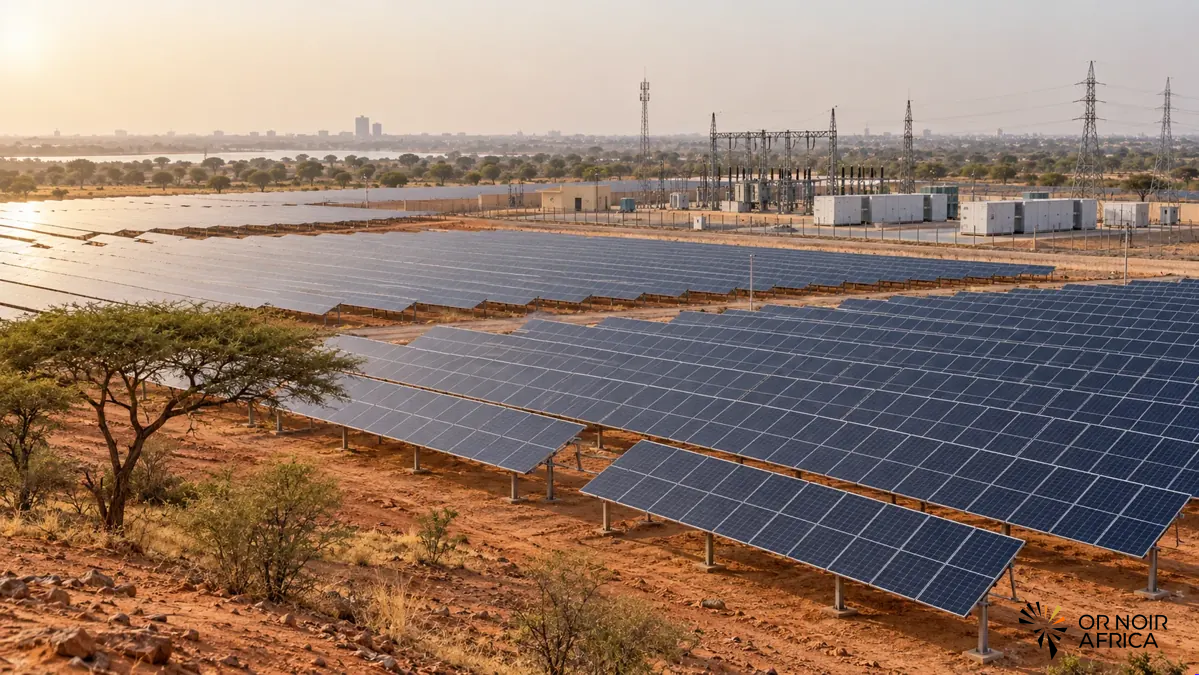
**Categories:** News, Energy **Tags:** Côte d’Ivoire, solar energy, battery storage, Dabakala, Niakaramandougou **Excerpt:** Developers have been prequalified for two 100 MWp solar plants at Dabakala and Niakaramandougou, each paired with 33 MWh of storage. The next stage will involve detailed bids and operator selection. **Slug:** cote-ivoire-projets-solaires-batteries-dabakala-niakaramandougou **Image alt:** Photovoltaic solar panels paired with storage batteries at an African site.
Côte d’Ivoire is advancing two photovoltaic solar plant projects with battery storage. Developers have been prequalified for Dabakala and Niakaramandougou, each designed around 100 MWp of solar capacity and a 33 MWh storage system. This confirms procedural progress, but operators have not yet been finally selected and contracts remain to be finalised.
Both projects use an independent power producer (IPP) model, in which private companies finance, build and operate facilities under a contractual framework with the state or public buyer. The proposed concessions run for 25 years. This allows investors to recover construction costs while the buyer gains new capacity without financing the entire project alone.
Combining solar and storage
A solar plant generates electricity when sunlight is sufficient. A battery can store some output and release it later, helping smooth intermittency and shift energy to hours when demand or grid needs are higher. Storage improves flexibility but does not make a solar plant continuously available: its contribution depends on power, discharge duration and operating mode.
Public tender documents sometimes present different storage capacity parameters: 33 MWh in project sheets and prequalification information, compared with 100 MWh mentioned in an institutional communication launching consultation documents. This discrepancy must be clarified in final contractual documents. It matters because storage duration determines the electricity available after sunset and the value of the service provided to the grid.
Installed power, expressed in megawatts-peak (MWp), measures panels' maximum potential under standard conditions. It does not represent constant 100 MW generation. Annual output depends on sunlight, equipment performance, losses, grid availability and possible restrictions imposed by the system operator.
Grid connection and integration issues
Benefits from new generation depend on the grid's ability to absorb and transport electricity. Dabakala in the northeast and Niakaramandougou in the north-central region must connect to infrastructure capable of handling variable injections. Planning for lines, substations and control equipment must advance at the same pace as plant construction.
Storage can support system balance by absorbing some energy during high-generation periods and returning electricity when the grid needs it. However, coordination between producer, grid operator and buyer is decisive. Contracts must specify battery dispatch arrangements, minimum availability, energy losses and remuneration for services.
Solar expansion supports Côte d’Ivoire's objective of increasing renewables' share of the electricity mix. Its system remains largely thermal-powered, and the country seeks to diversify generation. This strategy must reconcile supply security, consumer costs and flexibility constraints. Solar plants with storage can contribute if integration is planned and equipment maintains long-term performance.
A procedure that must still deliver contracts
Prequalification narrows candidates to developers considered capable of presenting technical and financial bids. It generally precedes detailed bids, proposal assessment, contract negotiations and financial close. These stages determine electricity prices, each party's risks and commissioning schedules.
Financing costs and electricity purchase conditions will influence the final tariff. Authorities must assess proposals using several criteria: price competitiveness, equipment reliability, performance guarantees, operator experience, financial strength and local content. Battery maintenance and replacement commitments will be particularly important because battery life may be shorter than the concession.
Both plants can create opportunities for Ivorian companies in civil works, security, maintenance, transport and services. A clearly defined local-content strategy would help turn construction spending into lasting economic benefits. Training local technicians is also needed to monitor facilities combining photovoltaic generation, power electronics and storage.
Transparency about schedules and contracts would strengthen investor and public confidence. The next expected information concerns shortlisted candidates, final battery capacities, tariff structure, financing completion and delivery dates.
Prequalification therefore marks a milestone in Ivorian solar development, but results will depend on implementation quality. Success will be measured by megawatt-hours actually injected, battery availability, electricity costs and the plants' effect on grid reliability. Beyond announced capacity, these criteria will determine the projects' contribution to national energy security.
Have any thoughts?
Share your reaction or leave a quick response — we’d love to hear what you think!
-
 0
-
0
-
0
-
0
-
0
-
0





