

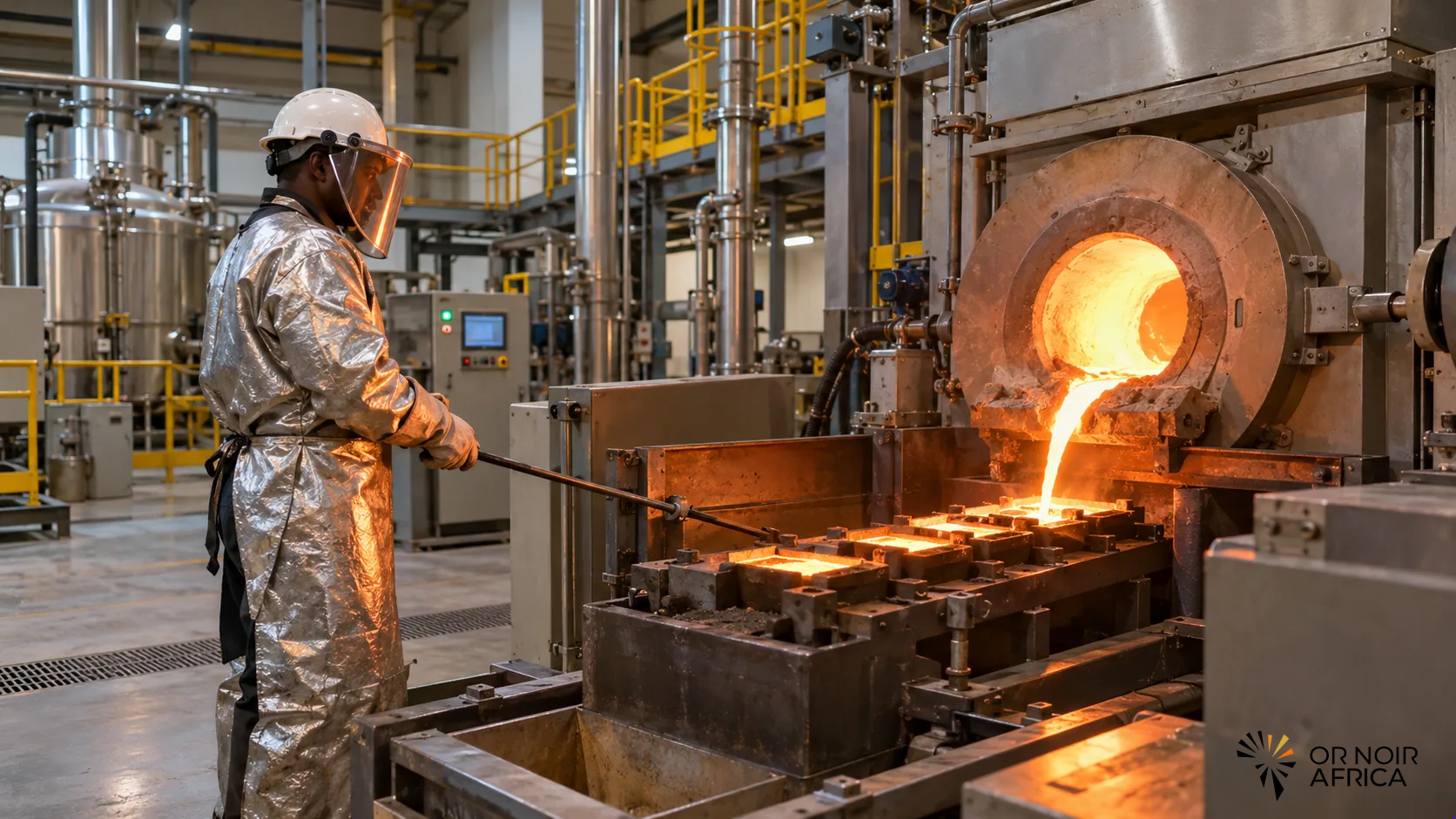
Raffinor-BF’s inauguration marks industrial progress for Burkina Faso, but commissioning the plant raises a more demanding question: where will the gold needed for regular operations come from? Wholly owned by the Société nationale des substances précieuses (SONASP), the facility has announced capacity of 150 tonnes of gold annually and targets a product with 99.99% purity. Refinery capacity becomes economic value only if sufficient, traceable and competitively priced volumes are delivered.
Burkina Faso produced more than 94 tonnes of gold in 2025, including nearly 43 tonnes from artisanal and semi-mechanised mining. These volumes seem substantial relative to the plant, but do not automatically constitute available stock for Raffinor-BF. Producers have existing sales contracts and export channels; artisanal gold passes through specific collection systems. The new refinery will need to win a place in these flows or conclude supply agreements that make its service attractive to sellers.
Capacity exceeds immediately available supply
Comparing annual capacity of 150 tonnes with national production indicates the challenge, rather than directly measuring a shortfall. Some gold cannot be redirected without changing contracts, marketing rules or economic incentives. A plant can also begin operating below nominal capacity. The question is whether it can maintain sufficient activity to cover costs, gradually improve utilisation rates and attract regular customers.
The project was launched in 2023 with Malian company Marena Gold before SONASP took over all shares. Its estimated cost is CFA7 billion, excluding land value. This public investment will deliver its full benefits only if technical capacity becomes commercial activity. Potential revenues come from refining, but also from capturing margins previously earned abroad, creating specialised jobs and developing local services around the gold value chain.
The regulatory framework offers a way to attract gold from industrial mines. The 2024 mining code requires holders of large- or small-scale mining permits to process or add value to part of their production in Burkina Faso. An April 2025 decree specifies the framework, while the proportion to be processed or beneficiated is to be set by ministerial order. To make this obligation effective, authorities will need to clarify the volumes concerned, compliance arrangements and practical conditions for producers to deliver to the refinery.
Rules must be accompanied by commercial incentives
A beneficiation obligation can guarantee an initial market, but regulation alone does not make a transaction attractive. Mines will compare processing costs, settlement times, security conditions, quality requirements and operational reliability with their existing channels. If the refinery offers a competitive, predictable service, it can become a commercial partner. If procedures or costs are excessive, companies will seek minimum compliance without necessarily making full use of national capacity.
Ghana provides a recent example of a supply mechanism. Since July 2026, authorities have concluded an agreement with industrial producers to buy 30% of their production, particularly to support local refining capacity. This illustrates that a plant and a beneficiation policy are often accompanied by a commercial mechanism bringing volumes together. Burkina Faso could examine contracting, collection and payment models while adapting them to its mining structure and SONASP’s capacity.
Artisanal gold is another potential source. Accounting for nearly half of national production in 2025, this segment could provide significant volumes. However, it requires rigorous collection arrangements, origin checks and transaction controls. A credible supply chain must distinguish authorised flows, limit smuggling risks and ensure transparent payments. The refinery can help formalise the market if producers and collectors see concrete benefits in using SONASP channels.
Imports could supplement volumes
EITI documents also envisage imports. This would broaden the supply base and could help maintain operations if domestic volumes are insufficient. It nevertheless requires checks on gold provenance, customs requirements, transport costs and competition from neighbouring refineries. Several regional projects also seek to capture metal flows, potentially reducing feedstock availability for each new facility.
International experience shows that utilisation remains decisive. In Ghana, Gold Coast Refinery operated below capacity for a long period before an agreement with the Ghana Gold Board. In South Africa, falling domestic production prompted Rand Refinery to diversify supply sources. These examples show that a refinery depends on more than resources within its own country: it must participate in regional markets, establish contracts and ensure the traceability of processed metals.
For Ouagadougou, launching Raffinor-BF is therefore the start of a supply policy as much as an industrial achievement. Indicators to monitor include gold actually refined, the share from local mines, artisanal gold collected, any import share and supplier payment times. Publishing them would help assess whether the refinery creates a lasting local industry or operates intermittently.
Burkina Faso has substantial gold production and a framework capable of directing some of it towards local processing. Success nevertheless depends on converting these strengths into executed contracts, legally traceable feedstock and competitive services. Capacity of 150 tonnes measures the ambition; annual processed tonnage will show whether it becomes a viable industry.
Have any thoughts?
Share your reaction or leave a quick response — we’d love to hear what you think!
-
 0
-
0
-
0
-
0
-
0
-
0