

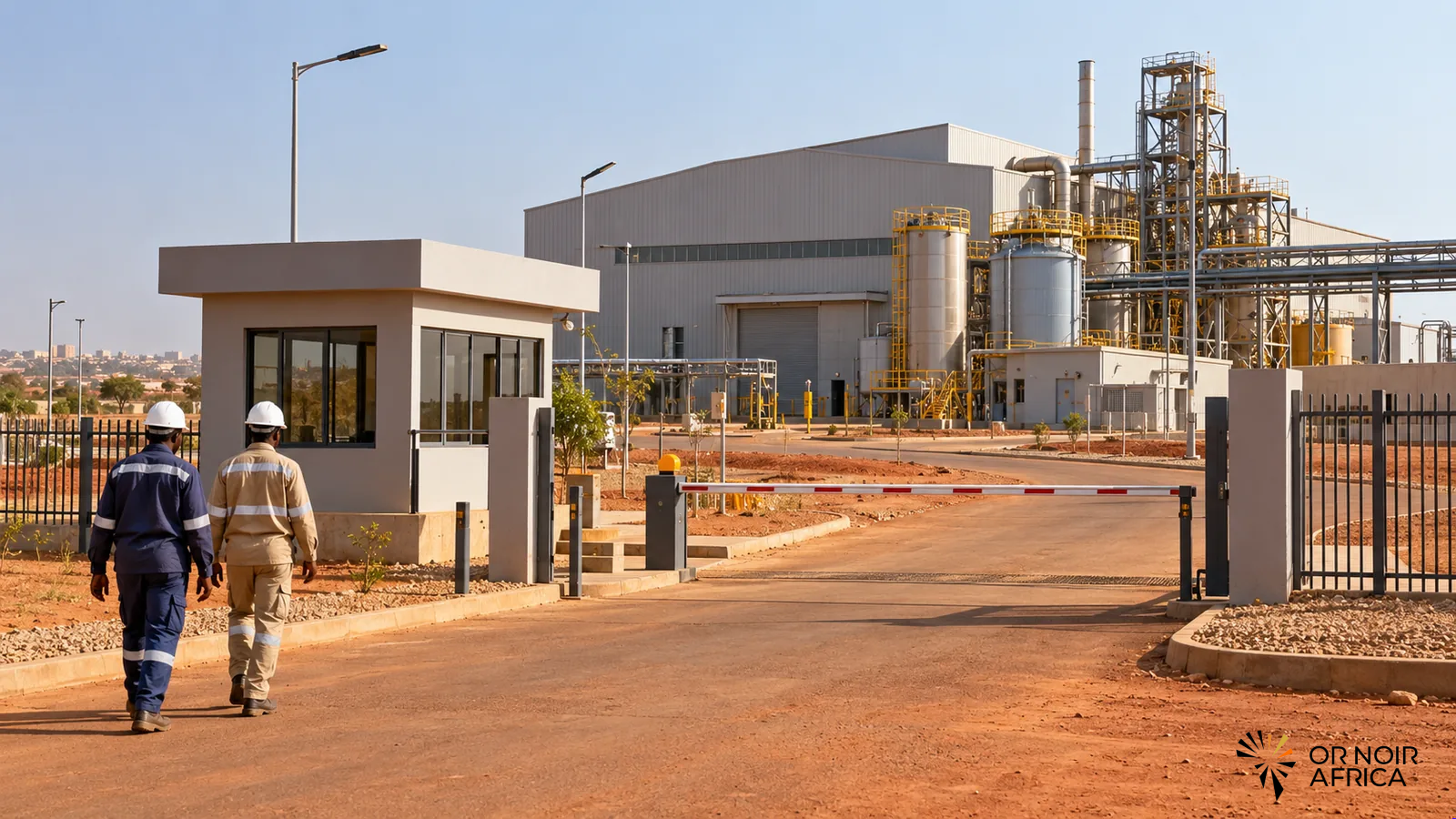
Burkina Faso has inaugurated its first national gold refinery, RAFFINOR-BF, in Ouagadougou. Financed with more than CFA 11 billion from the state, notably through the National Precious Substances Company (SONASP), with participation from the domestic private sector, the facility marks a turning point in policy on local processing of the metal. The first phase has a refining capacity of 164 tonnes a year; the authorities ultimately aim for capacity of 515 tonnes.
The plant's opening gives concrete form to the ambition of retaining more value within the country. The government wants to process, monitor and certify a larger share of domestically produced gold, whether from industrial mines or artisanal operations. However, a facility's capacity should not be confused with its actual utilisation. The most demanding phase begins now: supplying the plant consistently, ensuring that batches meet compliance requirements and finding buyers willing to incorporate the product into their supply chains.
Capacity exceeding reported production
The authorities said that Burkina Faso had produced 94 tonnes of gold the previous year. Raffinor's initial capacity therefore exceeds that benchmark, while its ultimate target of 515 tonnes is substantially higher. This is not necessarily inconsistent: a facility can accommodate gradually formalised artisanal flows or volumes from other countries. Nevertheless, these sources of supply must be established through transparent, compliant channels.
The ramp-up will depend on several factors. Operators must be willing to sell their gold to, or entrust it to, a national facility; the refinery will need to offer competitive processing and payment times; and international buyers must recognise the quality and traceability of its bars. Operators may also have existing contracts with foreign refiners and financing arrangements already built into their sales. Any change to these channels requires commercial negotiations, rather than a political decision alone.
The refinery is part of a wider regional trend. Mali is building a facility with capacity of around 200 tonnes a year with Russia's Yadran group, while Côte d'Ivoire is developing a public precious metals company and plans capacity of 100 tonnes in the first half of 2027. Across West Africa, the proliferation of projects raises questions about the allocation of supply flows, market size and international recognition. Theoretical capacity exceeding domestic supply is useful only if facilities can operate competitively and consistently.
Refining involves more than melting and casting
To sell a bar on major markets, a refinery must document its operations and the origin of the gold it processes. Purity is essential, but buyers, banks and insurers also examine origin controls, anti-money-laundering measures, environmental procedures and independent audits. These requirements determine access to organised markets and the confidence of commercial partners.
Burkina Faso will therefore need to consolidate a traceability system covering the entire journey, from the production site to the plant and point of sale. This is particularly important for artisanal gold, whose volumes are dispersed and collection is difficult to monitor. A refinery can help organise flows, but cannot by itself resolve informal mining, smuggling or responsible sourcing issues. Control begins upstream and requires administrative tools, collection points and incentives for producers.
Public financing makes it possible to establish infrastructure that the market alone might not have built at this stage. However, it commits national resources and creates expectations of measurable results. Monitoring should cover processed volumes, utilisation rates, operating costs, tax revenue, skilled jobs and the share of local suppliers. Announced capacity is not a sufficient indicator of an investment's economic or social return.
Turning the promise of sovereignty into benefits
Local processing can retain skills, improve statistical information and strengthen export controls. It can also facilitate integration between artisanal collection, formalisation and financial services. For local producers, its value will be measured by market access, remuneration, payment times and the security of transactions. For the state, it will be measured by the ability to collect revenue due and ensure compliance across the sector.
Security remains a central constraint. Mining areas and transport routes face risks that could interrupt production or alter itineraries. A national refining chain cannot function without secure, reliable logistics or cooperation between the bodies responsible for mining, customs, security and finance. Supply stability will be as important as the plant's technical operation.
RAFFINOR-BF is therefore strategic infrastructure whose success will not be decided on inauguration day. It will depend on the ability to supply the facility, guarantee the origin of volumes, obtain buyer recognition and make the model profitable over time. Burkina Faso has taken an initial industrial step. The next will be to demonstrate that local refining can generate concrete benefits for the economy and sector participants, rather than stopping at installed capacity alone.
Have any thoughts?
Share your reaction or leave a quick response — we’d love to hear what you think!
-
 0
-
0
-
0
-
0
-
0
-
0





