

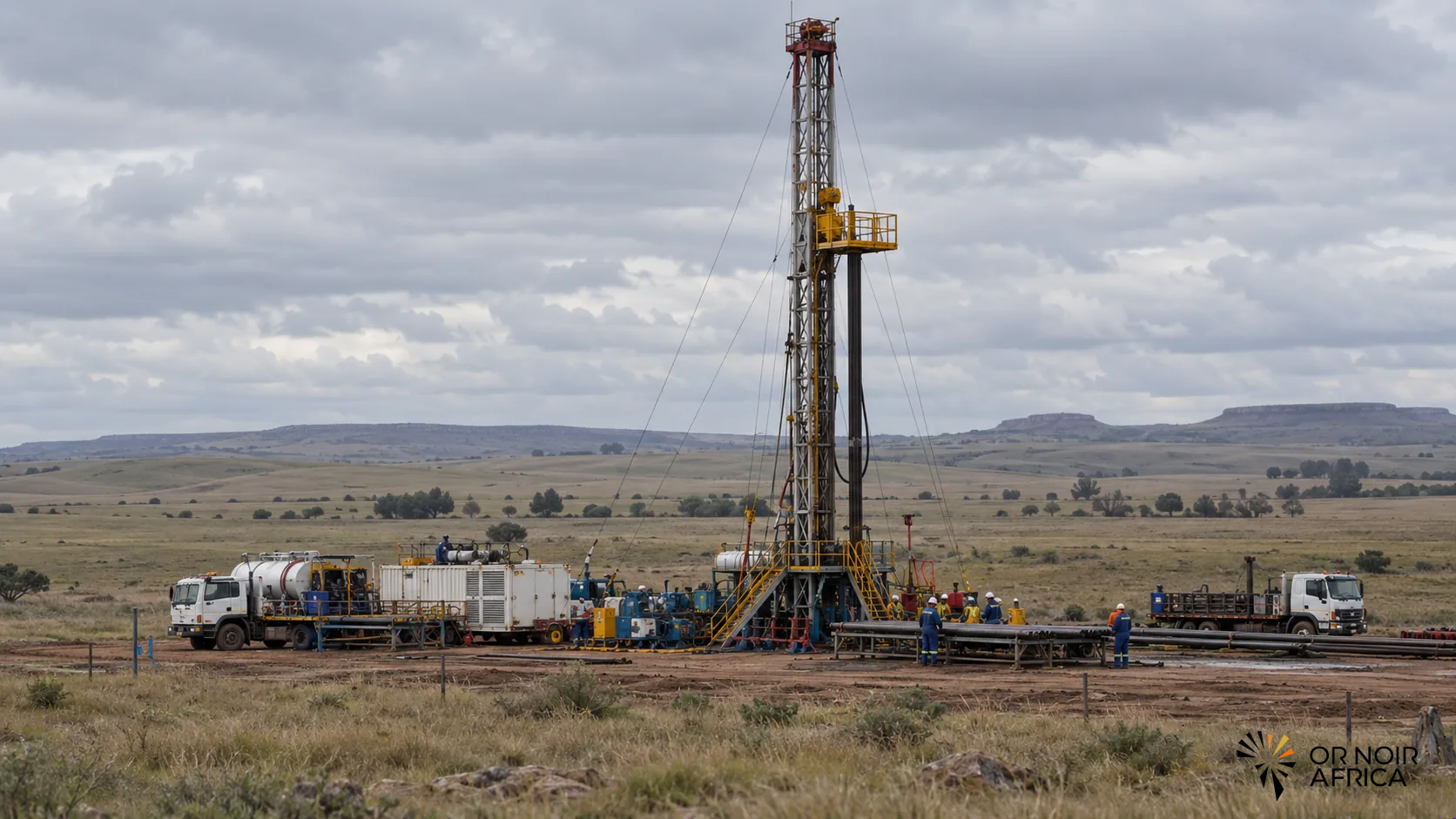
D3 Energy has identified gas-bearing zones in both wells drilled at Nooitgedacht in South Africa’s Free State province. The update published on 9 September nevertheless states that water from a deeper interval and very low reservoir pressure are restricting flow. The company was planning remedial cementing to isolate this water inflow and restore testing conditions.
The announcement therefore distinguishes two findings: gas indications are present in the wells, but their ability to produce stable, commercially viable flows has not yet been established. This matters in an exploration project, particularly as work concerns natural gas and helium in a region where subsurface characteristics can vary considerably between wells.
Gas-bearing zones, but disrupted flow
The Nooitgedacht programme concerns wells NGT245 D and NGT245 E, drilled within exploration licence ER315, wholly owned by D3 Energy. Logs and downhole observations enabled the company to confirm gas-bearing zones. In NGT245 E, a downhole camera notably showed gas rising through the water column.
However, the company attributes the restricted observed flow to water entering from a deeper zone. Low natural reservoir pressure makes it difficult to remove this water and allow gas to flow to the surface. D3 Energy said it intended to isolate the water-bearing interval through remedial cementing. Successful intervention is necessary to resume useful tests; it cannot be assumed before the work is performed and results obtained.
This illustrates why geological observations alone do not qualify a well as a commercial discovery. Tests must establish gas composition, recoverable volumes, pressure, flow consistency and the operations required for production. At Nooitgedacht, identified gas is a favourable exploration sign, but water creates a technical obstacle that must be resolved.
Two wells to test a targeted structure
D3 Energy began a two-well campaign in the Nooitgedacht area within ER315 in July. The wells target structures identified through previous geological work. The campaign aims to extend assessment of the company’s natural gas and helium potential in the Free State.
Drilling results must be considered within D3 Energy’s wider portfolio. The company holds exploration licences and assessed resources in other areas, particularly South Africa and Australia. Resources announced for other licences cannot automatically be attributed to Nooitgedacht: each area needs its own work and checks.
Natural gas, mainly methane, can serve industry, power generation and heating. Helium, when present in sufficient concentrations and volumes, is of interest particularly to medical, electronics and scientific sectors. However, potential markets do not replace technical demonstrations. Gas composition and flow must first be measured, followed by assessment of the infrastructure required to collect and sell it.
Remedial work becomes the next milestone
Following the September update, the programme must focus on managing water in the wells and new tests after cementing. Results will determine whether gas-bearing zones can be isolated and tested under conditions allowing their potential to be estimated. The public information reviewed does not yet confirm that remedial work has restored stable flow.
Monitoring points will therefore include completion of cementing, water levels after intervention, pressure measurements and production test results. If wells remain affected by excessively low pressure or difficult-to-control water inflow, the company will need to decide whether to change test configurations, undertake further work or redirect future drilling.
The outcome will also have operational significance. Onshore gas exploration in the Free State depends on managing shallow, low-pressure reservoirs and then delivering volumes to users. Even where gas is identified, processing, compression, storage and transport costs influence whether development proceeds.
Evidence of gas is not yet evidence of commercial viability
Nooitgedacht illustrates the gap between a promising geological indication and an asset ready to supply energy. D3 Energy has evidence of gas-bearing zones in both wells. Water inflow and low pressure have nevertheless prevented tests from providing a definitive answer on sustainable production.
For South African sector participants, the next announcements will need to clarify whether remedial work permits renewed testing of the targeted intervals, as well as measured composition and flow rates. Meanwhile, the project remains at the exploration and appraisal stage. Confirming subsurface gas is a milestone; only a successful testing campaign can establish whether viable production is possible.
Have any thoughts?
Share your reaction or leave a quick response — we’d love to hear what you think!
-
 0
-
0
-
0
-
0
-
0
-
0





