

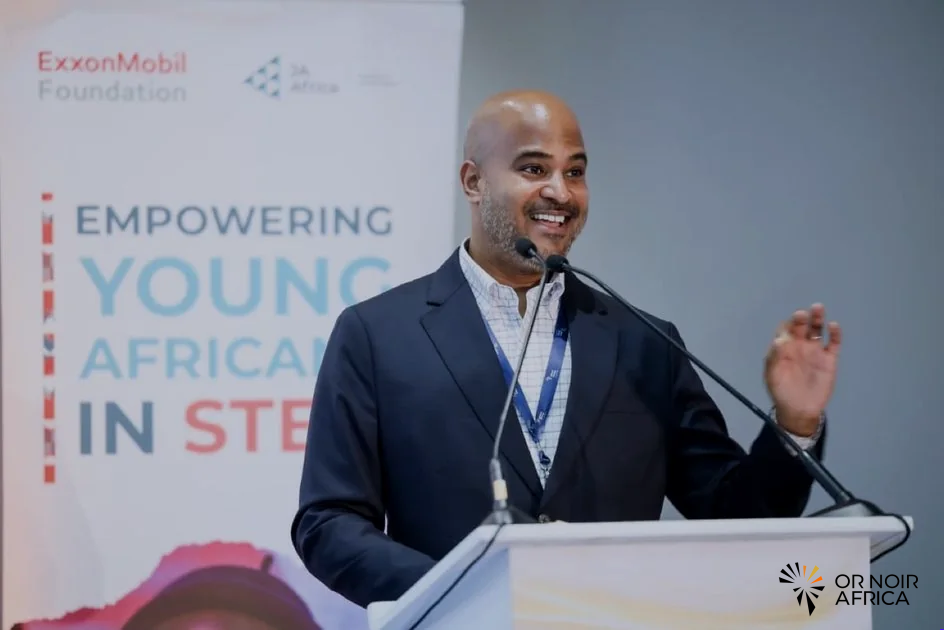
Sixteen secondary-school students from Angola, Mozambique, Namibia and Nigeria presented their science and technology projects at the regional final of the STEM Africa Challenge, held in Cape Town as part of African Energy Week (AEW) 2026. The teams were selected from nearly 10,000 students who took part in the programme's national stages. The competition highlights a central challenge for African economies: developing the skills needed to address communities' practical needs.
The prototypes presented cover areas ranging from agriculture to energy, including water management, recycling and artificial intelligence. Projects include an AI-assisted soil analysis tool, a system combining solar power and hydropower to supply a smart grid, and solutions for water recovery and the reuse of plastic waste or sawdust. The winners are due to be announced at the AEW gala dinner scheduled for 13 October.
Beyond the rankings, this final brings students closer to the professional world and gives visibility to initiatives developed locally. It also raises a practical question: how can a one-off competition become a lasting pathway for training, support and access to financing?
Everyday problems as a starting point
The selected projects go beyond technological demonstrations. They start with difficulties observed in the communities where the students live: soil quality, access to water, waste management, electricity reliability and the cost of basic solutions. This approach matters in settings where imported innovations may be too expensive, poorly suited to local uses or difficult to maintain.
Artificial intelligence for soil analysis illustrates this search for practical applications. If sufficiently accurate and accessible, such a solution could help farmers better understand their plots' characteristics and adapt their practices. But its usefulness will depend on data quality, equipment costs, ease of use and users' ability to understand the recommendations. The prototype opens up a possibility; its value will be measured through field testing.
Another project combines solar power and hydropower in a smart-grid approach. The aim is to bring together several sources to make electricity supply more consistent. Here too, the design must account for practical factors: water availability, storage, component costs and maintenance. These constraints do not diminish the idea's interest; they show the steps required between a competition presentation and an operational solution.
Water and waste initiatives address another priority. Water recovery can help strengthen the resilience of communities exposed to drought or irregular services. Turning plastics and sawdust into furniture combines material reuse with local production. To scale up, these projects will need to demonstrate their safety, durability and ability to find markets.
Nearly 10,000 students involved in the earlier stages
The sixteen finalists were selected after an initial phase involving around 10,000 secondary-school students. The process combined online STEM quizzes, in-person zonal competitions and national innovation camps. Teams then worked on their ideas and prepared prototypes before the regional final in Cape Town.
This progression gives the competition an educational dimension. Students are not simply assessed on a finished invention: they are required to identify a problem, formulate a hypothesis, design a response and present it to a jury. The exercise draws on science, mathematics, engineering, digital tools and communication skills.
The regional format also encourages exchanges among young people from several countries. Participants can compare their experiences and discover that similar challenges — access to energy, food security or resource management — sometimes require different responses depending on the location. These connections represent an initial form of scientific cooperation across the continent.
Sustaining support after the final
The competition can only deliver its benefits if support continues after the results are announced. A prototype can be promising without being ready for commercialisation or large-scale deployment. Teams need technical assistance, mentors, testing facilities, equipment and access to partners able to trial solutions under real conditions.
Companies attending AEW can contribute at this stage by offering internships, mentoring or data that help students better understand operational constraints. Schools and universities can help strengthen the scientific foundations and improve prototypes. Public authorities and financing organisations can support pilots, provided they evaluate results and distinguish mature initiatives from concepts that remain exploratory.
STEM education is also a matter of continuity. Competitions attract attention and can encourage students to pursue scientific studies. But impact develops over time: teaching quality, access to laboratories, guidance, professional role models and employment opportunities. Energy and industrial sectors will need these skills, as will agriculture, water and digital services.
A useful signal for productive sectors
By hosting the final among energy decision-makers and investors, AEW gives young innovators unusual visibility. This proximity can help connect business needs with education, while highlighting that innovation extends beyond major infrastructure projects. It can also emerge from modest solutions tested in communities and adapted to local realities.
The challenge will be to turn the attention generated by the competition into practical opportunities for the sixteen teams and the students who participated in the national stages. If the strongest projects receive technical follow-up and testing opportunities, the programme could help nurture a pool of African talent. The final marks a stage; success will be judged by these young people's ability to continue their work and turn their ideas into useful solutions.
Have any thoughts?
Share your reaction or leave a quick response — we’d love to hear what you think!
-
 0
-
0
-
0
-
0
-
0
-
0





