

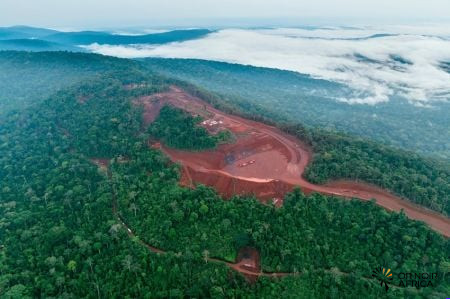
Three years after its mining permit was granted, the Bélinga iron ore project has still not entered production. Australia’s Fortescue continues exploration and evaluation of the deposit, discovered in 1955, while development remains conditional on feasibility studies, government approvals and the establishment of transport infrastructure.
The permit granted in February 2023 is valid for an initial twenty-year period. The mining agreement envisaged initial production of 2 million tonnes of ore per year. At this scale, the project remains smaller than the major iron ore complexes recently developed on the continent, but represents a potential source of diversification for a Gabonese economy in which hydrocarbons play a significant role.
A technical stage before investment
Fortescue has completed more than 230,000 meters of drilling at Bélinga, according to its report published in August 2026. The company says it is continuing studies and government approval procedures. It had previously targeted completion of a feasibility study in December 2026, but no new detailed timetable has been confirmed in the recent information available.
The group describes its work as an “intensive exploration and evaluation program.” This is a necessary stage to clarify the geology, ore characteristics, operating costs and required infrastructure. Until the feasibility study is published, assessing the project’s full cost, potential returns and the conditions needed for a final investment decision remains difficult.
The year 2030 has been put forward for commissioning an integrated development comprising the mine, railway and port, as well as for a first commercial shipment. The timetable therefore depends on components that must advance in a coordinated manner. A mine without a competitive logistics solution cannot sell its output; infrastructure built too early, without sufficient reserves and contracts, can increase project costs.
The logistics challenge shapes viability
African iron ore projects show that access to a port and railways is often as decisive as deposit quality. The development of Simandou in Guinea, which required decades of preparation and several partnerships, illustrates the complexity of these integrated developments. Bélinga is not on the same scale, but will also need a reliable logistics chain linking the mine site to markets.
Weak iron ore prices may also weigh on the financing timetable. Prices fluctuate with industrial demand, supply from major producers and conditions in China. In a less favorable environment, investors may require lower costs, secured volumes or long-term sales agreements before financing expensive infrastructure.
A diversification opportunity for Gabon
For Libreville, Bélinga could broaden the mining base beyond manganese and hydrocarbons. The Baniaka project, led by Genmin, is another iron ore initiative under development. Their realization will nevertheless depend on companies’ ability to raise capital, secure permits and align the projects with a national strategy for transport, energy and local benefits.
The next milestones to monitor are publication of the updated feasibility study, clarification of the timetable and infrastructure, and then investment decisions. The mining permit establishes a legal framework, but does not mean the project is financed or ready to produce. Bélinga remains a mining prospect of major importance to Gabon, whose realization will be measured by concrete commitments to the mine and logistics.
Have any thoughts?
Share your reaction or leave a quick response — we’d love to hear what you think!
-
 0
-
0
-
0
-
0
-
0
-
0





