

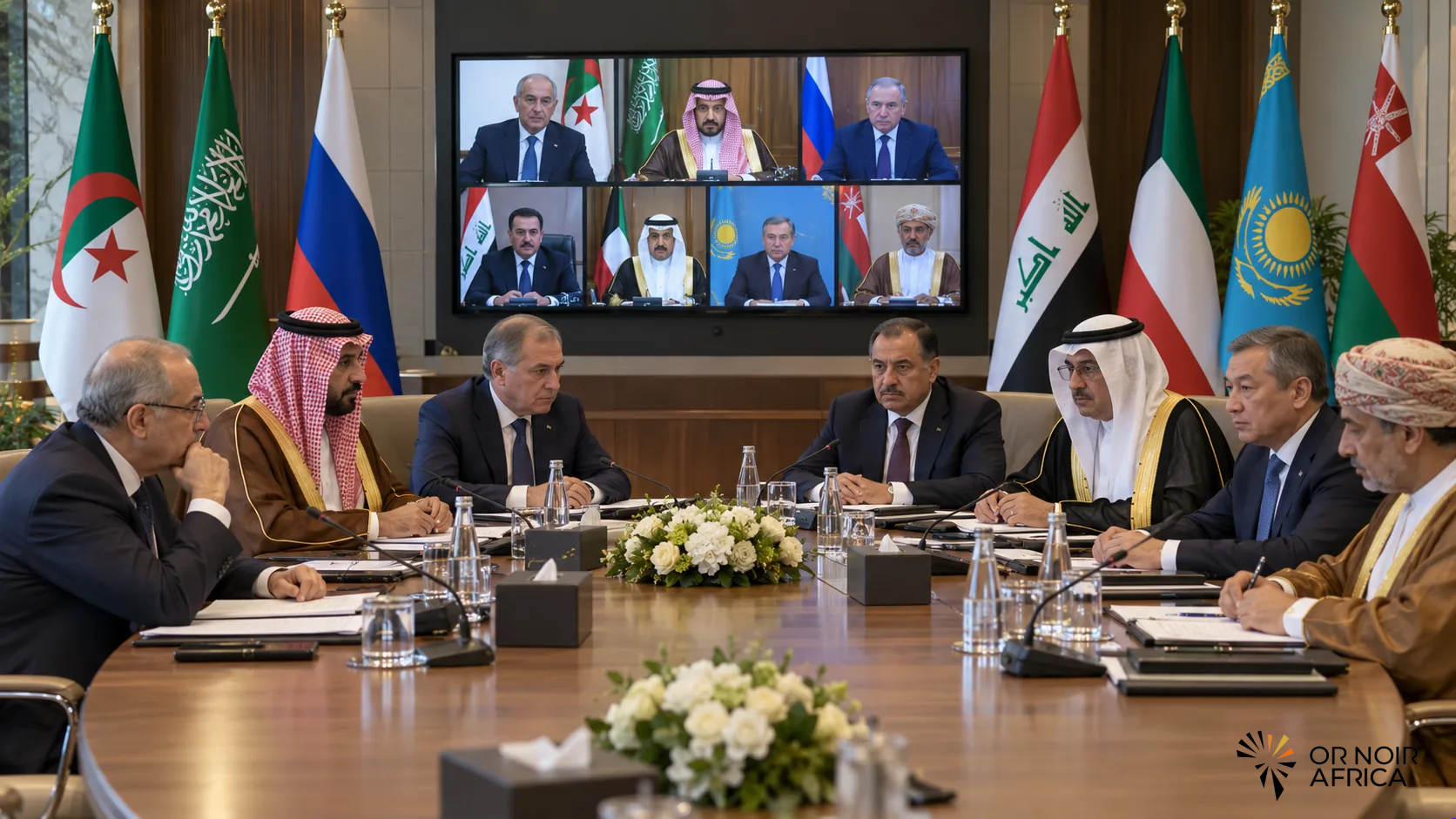
Algeria and six other OPEC+ alliance producers will maintain their required production levels in November unchanged from September. The October 4 decision comes as war with Iran disrupts supplies and Brent crude exceeds $100 a barrel. For Algeria, the production ceiling remains 1.007 million barrels per day. Maintaining the quota reflects a desire to preserve the collective framework as supply tensions make trade-offs particularly sensitive.
The seven countries concerned are Saudi Arabia, Russia, Iraq, Kuwait, Kazakhstan, Algeria and Oman. They met by videoconference to review market conditions. In its statement, OPEC says participants chose to maintain September’s required production levels for November. The group also reaffirmed its commitment to the Declaration of Cooperation and plans to meet again on November 1.
This formulation must be distinguished from a measurement of actual extracted volumes. A quota or required level establishes a production benchmark for each country; it guarantees neither the ability to increase deliveries nor actual production exactly matching the ceiling. Production data can also be affected by interruptions, technical constraints, compensation obligations and disrupted trade routes.
For Algeria, renewal at 1.007 million barrels per day extends the level already planned for October. Oil and gas remain central to export revenues, public finances and domestic supplies. Quota policy therefore requires reconciling several imperatives: benefiting from a potentially more profitable market, maintaining sustainable production capacity and preserving coordination with other group members.
The geopolitical environment makes this balancing act harder. Attacks and risks surrounding infrastructure and maritime routes can reduce available supply even if official ceilings do not change. War with Iran has supported prices and renewed concerns over regional oil flows. Internationally, G7 countries also announced a release of strategic and commercial stocks intended to cushion pressure on petroleum products, particularly diesel. These measures do not permanently replace interrupted flows: they provide temporary volumes to the market and address short-term needs.
The decision not to raise November’s required levels can be interpreted as a wait-and-see position. In an unstable market, a coordinated increase in ceilings would not alone ensure more barrels reach consumers. Producers must be able to transport crude, infrastructure must remain operational and refineries must be able to process available grades. If constraints are primarily logistical or security-related, changing quotas may have limited effect on immediately accessible supply.
Conversely, retaining ceilings can help avoid a rushed response that undermines producer cohesion. OPEC+ coordination rests on shared commitments and production monitoring. Countries’ compliance and compensation for previous overproduction therefore remain important to the mechanism’s credibility. Monthly decisions allow the group to adjust course if fundamentals change, but this flexibility depends on information quality and participants’ ability to actually adjust supply.
For importing countries, stable ceilings do not guarantee stable prices. Markets respond to expectations, interruption risks, available inventories, demand and major producers’ policies. An unchanged quota can coexist with rising prices if markets fear a shortage. It can also be followed by easing if transport routes remain open and stocks or deliveries from other producers offset losses.
The coming weeks will show whether the October 4 decision is simply a pause or the start of a prolonged period of caution. Indicators to monitor include actual production levels, exports, commercial and strategic inventories, developments in logistical disruptions and compensation volumes announced by members. Algeria’s challenge is maintaining its place in the agreement while protecting revenues and its ability to meet market needs. The 1.007-million-barrel-per-day ceiling provides November’s framework; actual delivered flows and the geopolitical situation will determine its economic impact.
The decision also has budget implications for producers. Algerian revenues depend on selling prices, exported volumes and the country’s import requirements, while public spending is sensitive to changes in hydrocarbon revenues. Higher prices can support short-term receipts, but do not remove constraints on exportable volumes or the need to prepare the economy for more volatile prices. Quota management therefore involves balancing immediate revenues, supply stability and resource preservation.
Have any thoughts?
Share your reaction or leave a quick response — we’d love to hear what you think!
-
 0
-
0
-
0
-
0
-
0
-
0





