

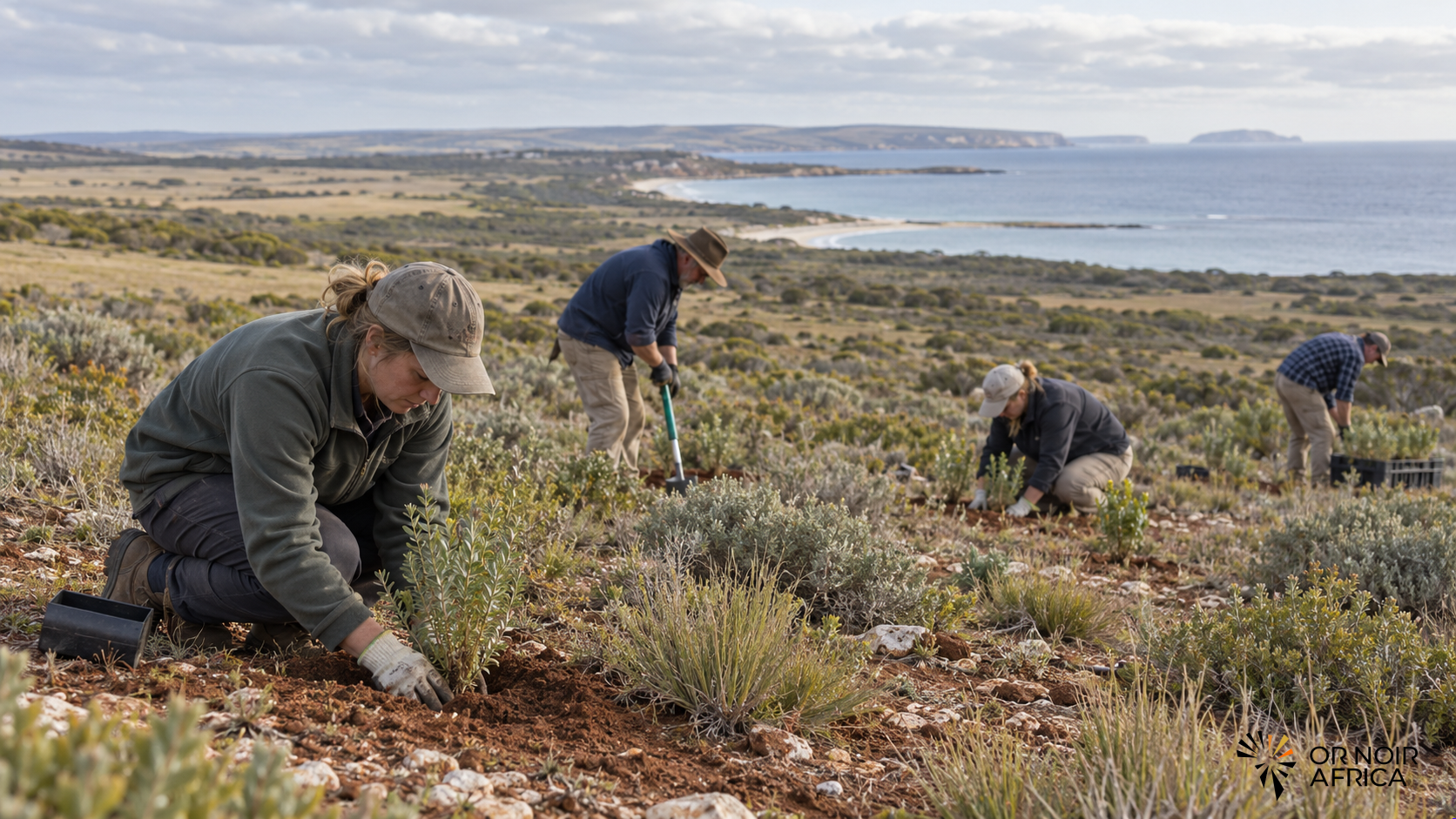
Airline Qantas has announced an A$30 million partnership with nonprofit Greening Australia and impact investment manager Conscious Investment Management. The first project is to restore nearly 800 hectares on Barngarla Country on South Australia’s Eyre Peninsula. The initiative aims to create carbon units from native vegetation plantings.
Presented on October 20 by Hayley Alchin, Qantas’s Head of Climate Strategy, Finance and Reporting, the transaction broadens the airline’s portfolio of nature projects. Alchin summarized the approach by noting that the carrier could not undertake this work alone: implementation brings together an ecological restoration organization and an investor specializing in impact projects.
A land project before a volume of credits
The partners plan to restore around 800 hectares, prioritizing local vegetation plantings. The project is intended to generate ACCUs, Australian carbon credit units, through an environmental planting and vegetation sequestration method. However, the announcement specifies neither a detailed schedule nor expected unit numbers or the partnership’s financial arrangements.
This absence of a projected volume is crucial. Under the Australian framework, a carbon unit corresponds to one tonne of CO₂ equivalent reduced, avoided or stored by an eligible project. Credits are not automatically generated when an announcement is made: the project must comply with the applicable method, measure results and satisfy monitoring requirements. Restoring 800 hectares therefore indicates a targeted land area, not a quantity of carbon already certified.
Caution is particularly necessary because ecological restoration outcomes develop over time. Vegetation growth depends on planted species, local conditions, maintenance and the project’s ability to protect land against disturbance. Monitoring must establish the progress of vegetation cover and permanence of stored carbon, as well as verify that the announced benefits are attributable to the intervention.
Three partners with complementary roles
Greening Australia brings field expertise in restoring landscapes and ecosystems. Conscious Investment Management acts as an impact investor, while Qantas provides the announced A$30 million and places the project within its climate strategy. The precise allocation of capital, responsibilities, risks and carbon revenues has not been published.
This type of arrangement can connect private resources and local ecological expertise. It can also help finance action whose benefits extend beyond carbon accounting alone: restoring degraded soils, wildlife habitat, greater landscape resilience and support for regional activities. However, these effects remain linked to project design and monitoring. They cannot be considered assured until indicators and results are made public.
The site is on Barngarla Country, making relationships with Traditional Owners and local communities essential to project governance. The available announcement does not detail participation agreements, jobs created or how benefits will be shared. These elements will matter when assessing the initiative’s quality beyond its funding and land area.
A carbon market that distinguishes projects
Credits from environmental plantings can trade at different levels from generic units. S&P Global assessed environmental planting ACCUs at A$54 per tonne of CO₂ equivalent on October 21, a premium of A$16.25 over its generic benchmark. This difference reflects buyer interest in certain project characteristics, but cannot be used to estimate revenues from Qantas’s initiative: future credit numbers and their selling price remain unknown.
Qantas had previously invested in nature-based sequestration projects, notably as a founding investor in the Silva Carbon Origination Fund in 2024. The new partnership reinforces this direction, but does not yet provide enough information to measure its contribution to the carrier’s total emissions. Land restoration and reductions in operational emissions are distinct measures: credits do not replace necessary efforts concerning aircraft, fuels, operations and the supply chain.
Credibility will depend on transparency
Several details will need clarification to assess the project: its schedule, chosen certification method, species used, maintenance practices, monitoring rules and benefit sharing. Publishing ecological outcomes and units actually issued will also distinguish the investment promise from verified carbon impact.
The A$30 million commitment provides a substantial financial base for restoration, while the partnership combines complementary expertise. Its reach will now depend on the quality of field execution and transparency of results. The nearly 800 hectares announced are a starting point; the outcome will be assessed over time through restored ecosystems, local benefits and credits actually certified.
Have any thoughts?
Share your reaction or leave a quick response — we’d love to hear what you think!
-
 0
-
0
-
0
-
0
-
0
-
0





