

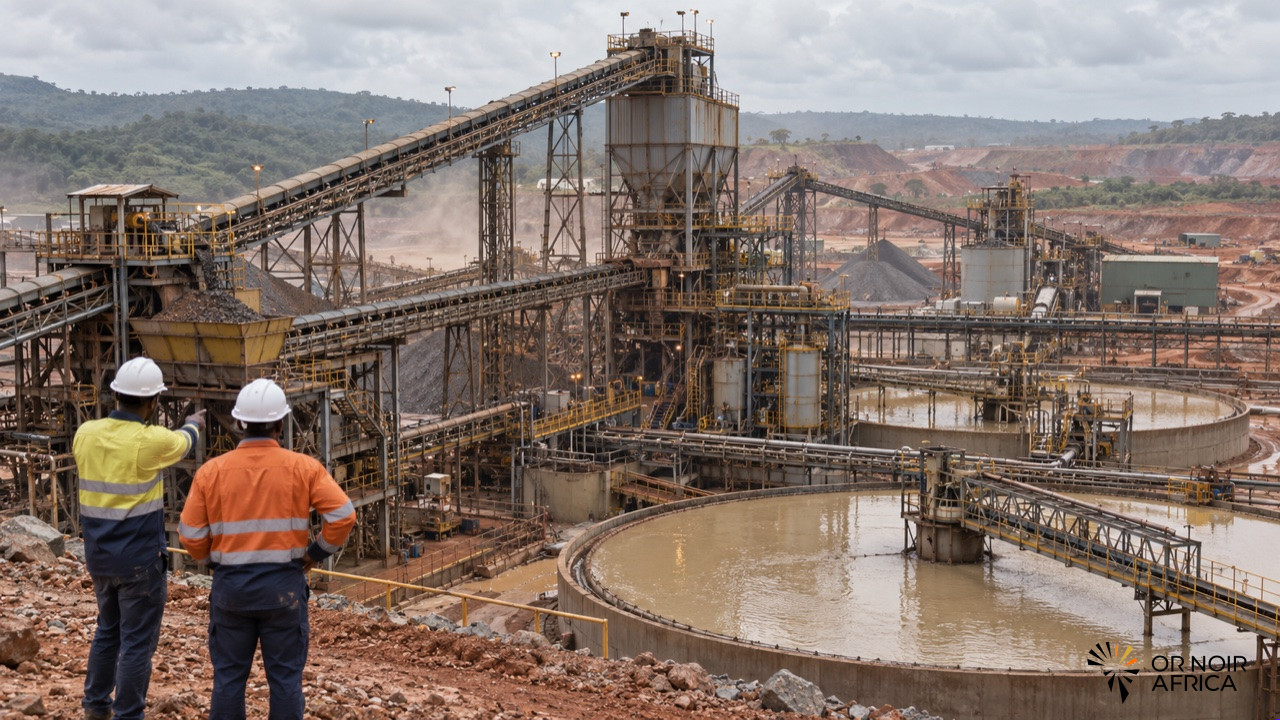
AI-generated illustration, for illustrative purposes.
Chemical processing capacity for critical materials represents a major strategic issue for global economies in 2026. At the heart of mineral supply chains, the midstream segment transforms raw concentrates from extraction into highly purified products essential to advanced technologies such as batteries, semiconductors, permanent magnets and renewable energy systems.
Chemical processing facilities require substantial investment, generally between $500 million and $2 billion per site, because of the complexity of infrastructure and the multistage processes needed for purification. Combining hydrometallurgy, pyrometallurgy and advanced separation techniques, these operations achieve purity levels above 99.9%, meeting the strict requirements of advanced sectors. They generate substantial margins, often 300% to 800% between raw concentrates and refined products, while creating an employment multiplier of 5 to 15 indirect positions per direct supply-chain job.
The geographic concentration of this capacity nevertheless represents a critical vulnerability for many countries’ economic and national security. China dominates the global landscape, controlling approximately 85% to 90% of rare-earth separation, 60% to 65% of lithium chemical conversion, 70% to 75% of cobalt refining and more than 90% of graphite purification. This dominant position provides considerable strategic leverage, reinforced by decades of investment in infrastructure and technical expertise.
International responses to this dependence are multiplying. In the United States, major initiatives aim to strengthen domestic production and processing, with substantial financing allocated—approximately $3.1 billion through various programs—and projects such as Project Vault, supported by major Export-Import Bank loans. The European Union’s Critical Raw Materials Act sets ambitious autonomy targets for 2030, while Australia is developing beneficiation hubs for its mineral resources. These efforts are accompanied by the promotion of “friend-shoring,” which redistributes capacity among allied countries to balance costs and supply security.
Technological advances play a decisive role in this shift. Automation improves consistency and reduces costs, while sustainability innovations—such as zero-liquid-discharge systems or heat integration to minimize energy consumption—strengthen new facilities’ competitiveness. Recycling, or “urban mining,” is emerging as a promising complementary source, particularly for lithium-ion batteries, where growing waste volumes are expected to unlock significant secondary flows of lithium, nickel, cobalt and graphite in the coming years.
Forecasts for 2026 and beyond indicate accelerating regional diversification of processing capacity. Specialized hubs and industrial clusters are expected to optimize shared infrastructure, while public-private partnerships mitigate financial and technological risks. Payback periods remain long—15 to 25 years for greenfield projects—and require long-term offtake agreements to secure demand.
Amid geopolitical tensions and an accelerating energy transition, strengthening chemical processing capacity for critical materials is becoming a strategic priority. Countries that succeed in developing resilient, diversified supply chains will gain a decisive advantage in mastering the technologies of the future.
Have any thoughts?
Share your reaction or leave a quick response — we’d love to hear what you think!
-
 0
-
0
-
0
-
0
-
0
-
0