

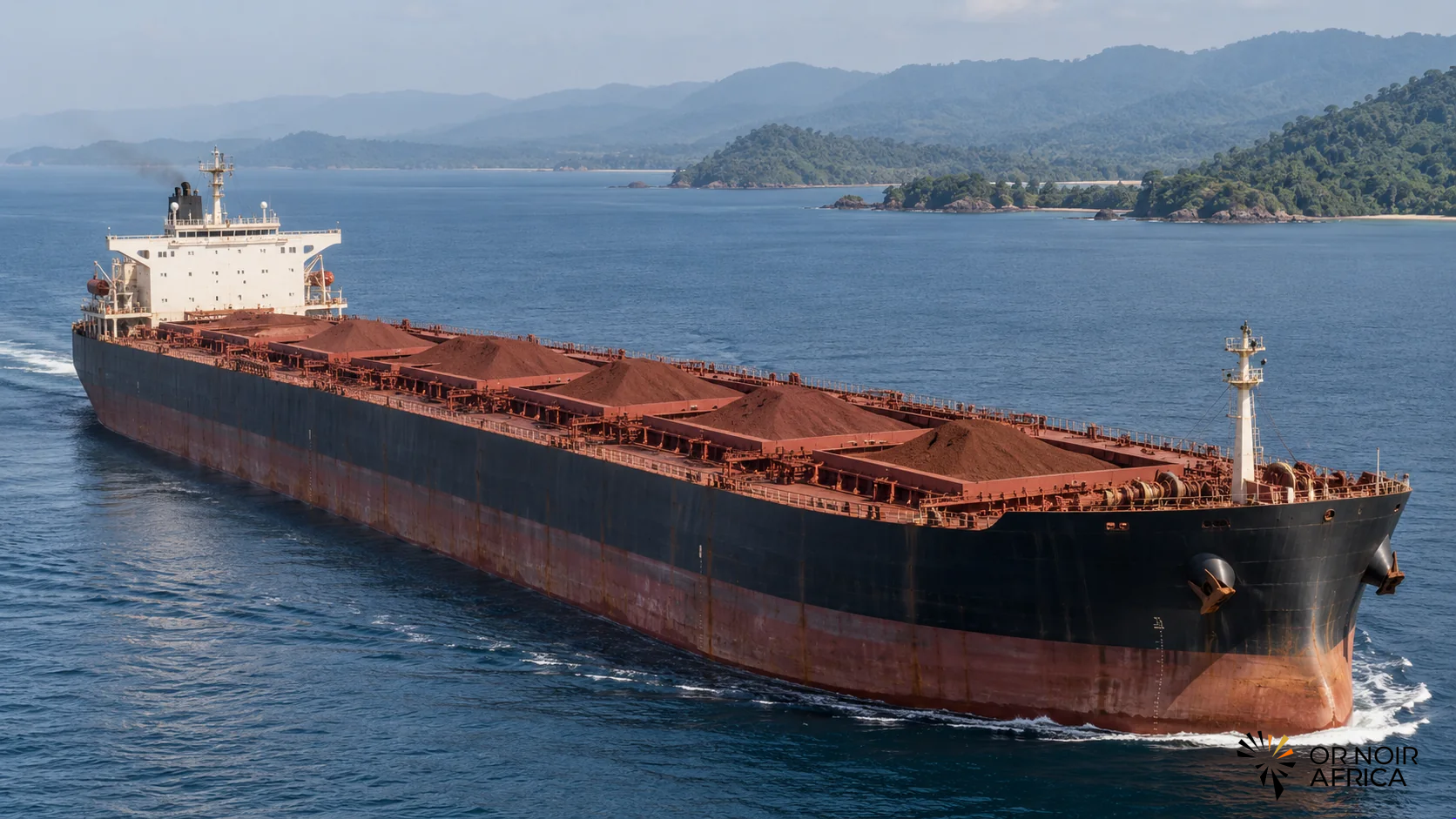
Development of the Simandou iron ore deposit is already creating needs that extend beyond the mines and railway. China Merchants Energy Shipping (CMES), through its shipping subsidiary Hong Kong Ming Wah, has entered into a 25-year agreement covering six very large ore carriers, or VLOCs, to transport the project's iron ore. The commitment represents an estimated minimum value of $2.8 billion and is intended to reserve long-term shipping capacity for Guinean exports.
The agreement illustrates the logistical dimension of a world-class mining project. Simandou ultimately aims to produce up to 120 million metric tons of high-quality iron ore annually, requiring a continuous chain connecting extraction sites in southeastern Guinea, railway facilities, ports and buyers in Asia. Vessel availability thus becomes a factor in export competitiveness and reliability.
Dedicated vessels for large-scale flows
VLOCs are designed to transport very large volumes of ore. By reserving six vessels over a 25-year horizon, CMES reduces uncertainty over part of the shipping capacity and establishes a long-term relationship with the project. The shipping subsidiary reportedly already transported approximately 600,000 metric tons of ore in initial cargoes associated with Simandou.
Remuneration under the contract is linked to shipping market benchmarks, with cost-adjustment mechanisms. This type of structure shares risks between operators and shippers: it offers dedicated capacity while allowing part of the rates to change with market conditions, notably fuel, port charges and vessel availability.
At the same time, CMES has ordered six new ore carriers with a capacity of approximately 343,000 deadweight metric tons. The vessels are to be built by China Merchants Shipbuilding and delivered between 2029 and 2030. The investment, valued at up to 4.93 billion yuan, or nearly $728 million, strengthens the physical resources mobilized around the project.
Logistics, an essential link in Simandou
The Simandou deposit is located in a mountainous region far from the coast. To make its ore exportable, the project relies on an integrated network of mines, railways and port infrastructure. Volumes must move according to a coordinated schedule: trains deliver ore to terminals, stocks are prepared to the required quality, and vessels then load cargoes for international markets.
A disruption in one of these links can slow the entire chain. Mines cannot export at the planned rate if the railway lacks capacity, ports cannot load quickly enough or vessels are unavailable. Conversely, a dedicated fleet delivers its full value only if extraction and land infrastructure reach the required level.
The shipping agreement therefore highlights that transportation contracts are as strategic as mining agreements. They secure the ability to move large quantities over long distances and can reduce exposure to freight market volatility. However, their profitability will depend on volumes actually produced, cargo quality, rotations between ports and operating costs.
A commercial and geopolitical dimension
Chinese participation in mining, rail, port and shipping infrastructure reveals the vertical integration accompanying Simandou. Companies involved at several stages can coordinate flows and reduce some logistics costs. For Guinea, this organization facilitates access to transportation capacity and buyers, but also raises questions about partner concentration and the distribution of value along the chain.
Guinean authorities must ensure that transportation contracts align with local obligations, shared-infrastructure commitments and public revenue objectives. Projects must also improve national capabilities in port, railway and logistics management so that the skills and experience acquired deliver benefits beyond a single mining operation.
The global transition toward low-carbon steel increases interest in high-grade iron ores because they can help reduce emissions at certain production stages. This does not automatically make Simandou sustainable: transportation emissions, infrastructure impacts and land management must be assessed as a whole.
The agreement does not remove commissioning challenges
The contract's long-term value rests on Simandou's ramp-up. Announced production targets must still be reached progressively as mines, trains and terminals enter service. The ordered vessels are not expected to be delivered until 2029 onward, tying their availability to a phase in which the project aims for substantial export growth.
The next milestones will therefore be the first regular cargoes, completion of land facilities and the port's ability to sustain the planned rotations. Stable commercial agreements and coordination between consortiums will be decisive. If the integrated system works as planned, CMES's VLOCs will help make Simandou's access to international markets more predictable. Otherwise, the committed shipping capacity could be underutilized or more expensive than expected.
The 25-year contract confirms logistics' central place in Simandou's future. It places Guinean ore in a large-scale transportation system, but the real test will be sustained delivery of promised volumes under economically viable conditions and with lasting benefits for Guinea.
Have any thoughts?
Share your reaction or leave a quick response — we’d love to hear what you think!
-
 0
-
0
-
0
-
0
-
0
-
0





