

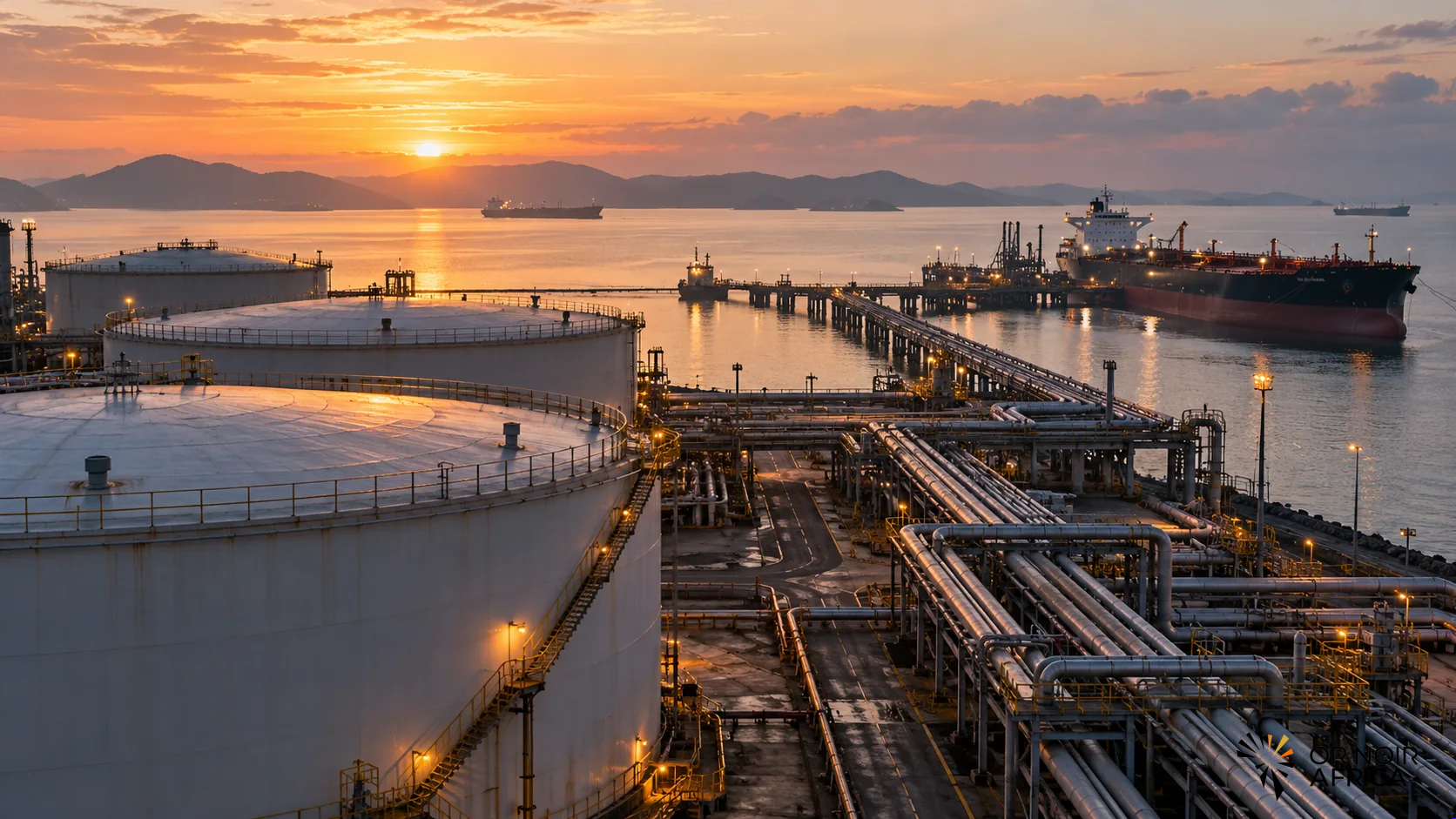
**Categories:** International **Tags:** oil, commercial inventories, strategic reserves, energy security, oil market **Excerpt:** Accessible oil stocks are contracting after months of disruptions and drawdowns. This pressure is a reminder that stored volume alone is not enough: availability, logistics and public decisions determine the actual ability to cushion a shock. **Slug:** marche-petrolier-stocks-accessibles-tensions-2026 **Image alt:** Oil storage tanks and a tanker at a marine terminal at sunset.
The global oil market is entering a period of increased vulnerability. Industry executives gathered in London believe that oil volumes actually available for use are becoming scarcer after this year's drawdowns to offset supply disruptions. The figure put forward by Saudi Aramco's chief executive—commercial inventories below six billion barrels—should be treated cautiously: it is an industry estimate, not an exhaustive count of immediately available global reserves.
The distinction is essential. Inventory data often add together barrels that cannot all reach the market within the same timeframe. Some are needed to operate refineries and networks; others are in pipelines or tanks whose operational contents cannot be fully withdrawn. Strategic reserves, meanwhile, are subject to national rules and political choices. Accounting inventories therefore do not correspond to stocks that can actually be mobilized.
A buffer used on a large scale
Inventories help smooth differences between supply and demand. They can support supplies when exports are interrupted, conflict disrupts shipping routes or important infrastructure is unavailable. More than one billion barrels have reportedly been drawn down since the start of the Middle East crisis, according to the estimate cited by industry executives. This withdrawal illustrates the scale of the role inventories have played this year.
But drawdowns cannot permanently replace interrupted production or transport. They shift part of the shock over time: they prevent an immediate break in supply while reducing the margin available if another disruption occurs. The market then becomes more sensitive to information about cargoes, ports, pipelines and producers' decisions. A limited change in supply can provoke a stronger price reaction when accessible reserves are low.
Commercial and public stocks serve similar functions but follow different rationales. Businesses hold volumes to ensure operational continuity and meet their obligations. Governments maintain emergency reserves that can be released under specific procedures. Their use requires a political decision, a timetable and logistical capacity to make them available. Their existence does not guarantee instantaneous delivery to areas where demand is most strained.
Availability matters as much as volume
Energy security is therefore also measured by stocks' quality and location. A barrel far from a suitable refinery, held in a congested logistics chain or assigned to technical needs cannot respond to the same market signal as a barrel ready for shipment. Inventory composition also matters: crude oil does not automatically substitute for refined products, and not all oil grades are suitable for every facility.
This reality explains why announcements of reserve releases must be assessed using several indicators: announced quantities, delivery rates, storage locations, product types and the period over which volumes can be supplied. Political announcements can calm expectations, but their effect depends on execution and the response of commercial supply.
For African importing countries, the situation is transmitted through several channels. Higher crude prices can increase import bills, while reduced availability of refined products raises freight costs and regional premiums. Public budgets are exposed when authorities maintain regulated prices or support importers. Transport businesses, agriculture and power generation also face higher fuel costs.
Exposure nevertheless varies with each economy's structure. A producing country can earn additional revenue from crude exports without having sufficient refining or storage capacity for products consumed locally. Export revenue and domestic supply security therefore do not necessarily advance at the same pace.
Rebuilding reserves and reducing vulnerability
Rebuilding stocks will take time and depend on supply availability, prices and businesses' decisions. Rapid purchases of large volumes can support prices and compete with refineries' current needs. Governments must also decide the level at which to maintain their reserves, how to finance replenishment and which products to prioritize.
The episode invites a broader understanding of energy security. Reserves remain a crucial tool, but replace neither diversification of sources and suppliers nor reliable storage and transport infrastructure. Energy efficiency, interconnections and the development of local sources can reduce the amount of oil needed to sustain economic activity.
Industry executives' warning does not mean that a general shortage is certain. Rather, it indicates that the system's ability to absorb another incident may have diminished. The difference between temporary pressure and a lasting crisis will depend on the duration of disruptions, the return of flows and the speed at which stocks can be replenished. These concrete factors, more than the global total of barrels in reserve alone, will shape the next assessment of oil market risk.
Have any thoughts?
Share your reaction or leave a quick response — we’d love to hear what you think!
-
 0
-
0
-
0
-
0
-
0
-
0





