

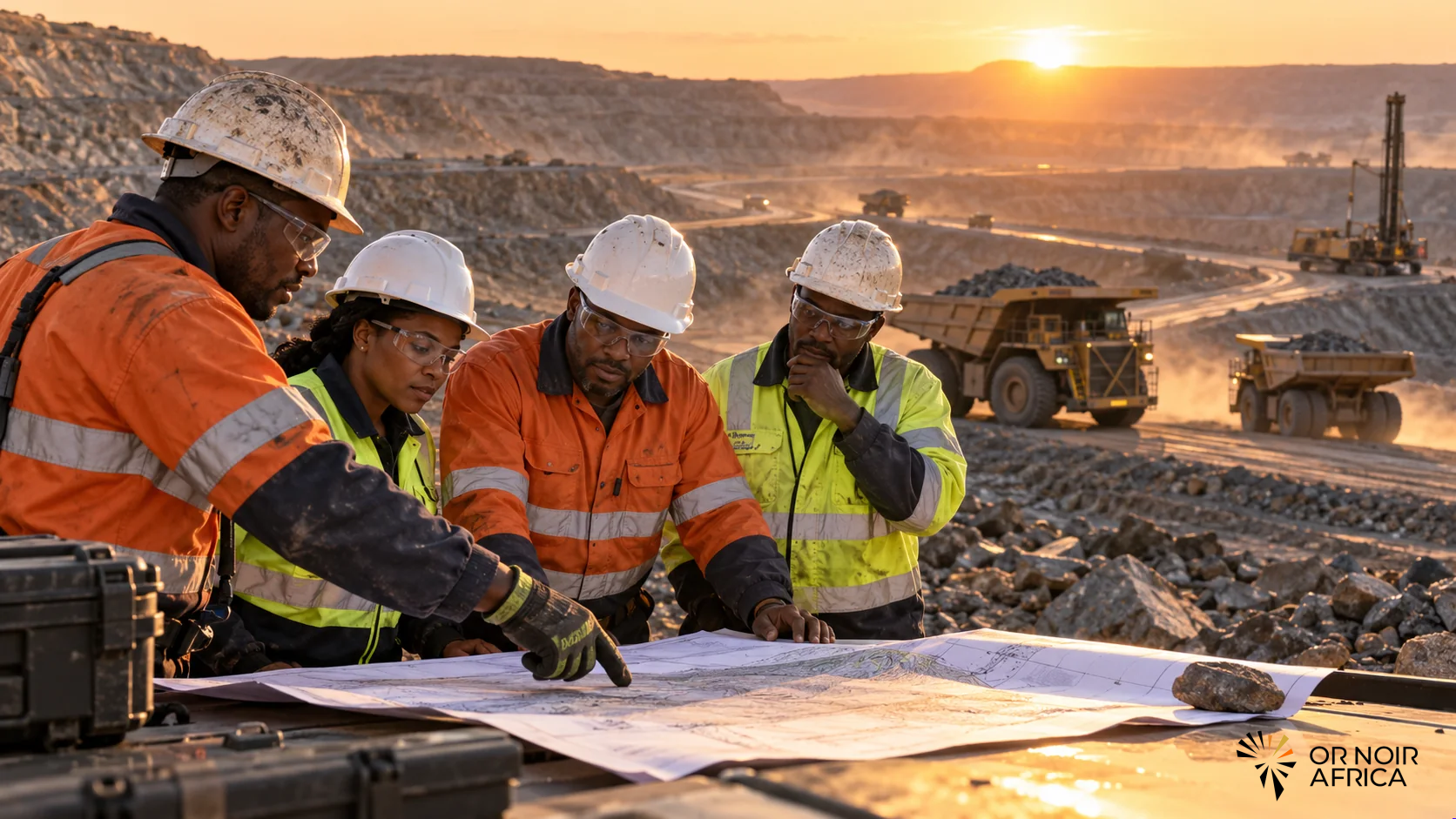
**Categories:** News, Mining **Tags:** South Africa, mining industry, resilience, infrastructure, investment **Excerpt:** At the Mining Indaba in Johannesburg, industry professionals emphasize companies’ ability to withstand cost shocks, infrastructure constraints and regulatory uncertainty. For South Africa, announced reforms will need to translate into concrete improvements. **Slug:** afrique-du-sud-mines-resilience-infrastructures-investissement **Image alt:** South African mining team studying plans for an open-pit operation.
Resilience has become a watchword for South African mining companies facing a volatile environment. Price fluctuations, energy costs, logistics disruptions and regulatory uncertainties weigh on investment decisions. Gathering in Johannesburg for the Mining Indaba, industry participants emphasize the need to strengthen operations’ ability to absorb these shocks without compromising production or safety.
The message extends beyond crisis management alone. In an industry where projects require substantial capital and horizons spanning several decades, resilience also rests on predictable rules, reliable infrastructure and closer cooperation between mines, public authorities and suppliers. The challenge is to ensure geological resources translate into investments actually delivered.
Stable rules as a condition for investment
Investors assess geological potential, but also a country’s ability to provide a clear regulatory framework. Policy changes, permitting delays and difficulties accessing mining rights can delay decisions or increase the cost of capital. Clear regulation does not eliminate commercial risks, but it enables companies to quantify them more accurately.
In South Africa, operators are monitoring several signs of reform, including the mineral resources development bill, the critical minerals strategy and announced efforts to modernize the mining cadastre. Their impact will depend on implementation: accessible procedures, well-defined institutional responsibilities and predictable timelines will be decisive.
Transparency in the permitting system is particularly important. A reliable cadastre can reduce disputes over rights, improve planning and facilitate new investment. Conversely, incomplete or hard-to-verify information complicates transactions and can discourage exploration projects, which are essential to replenishing the mining project pipeline.
Energy, rail and ports: operational constraints
Resilience also depends on infrastructure beyond a mine’s boundaries. Electricity, rail and ports determine operational continuity and export competitiveness. An outage, delayed maintenance or insufficient capacity can reduce delivered volumes even when demand and prices are favorable.
Companies are seeking to adapt their operations: securing energy supplies, improving maintenance, diversifying logistics routes and planning inventories more effectively. These measures can reduce exposure to disruptions, but sometimes entail additional expenditure and do not replace the network investments needed nationally.
More structured coordination between mines and infrastructure operators can help prioritize work. Producers need visibility on maintenance schedules, available capacity and cost-sharing arrangements. Public authorities, meanwhile, must balance the mining sector’s needs with those of other industries and households’ access to essential services.
Technology must address an operational need
Digitalization, automation and artificial intelligence are often presented as drivers of productivity. They can improve planning, predictive maintenance, safety and energy consumption. But their value depends on data quality, team training and integration into working processes.
Benefits are not identical across all mines. Technology suited to a large operation cannot necessarily be deployed in the same way at a smaller or older site. Companies must compare expected benefits with equipment, cybersecurity and training expenditure. In labor-intensive operations, supporting change is essential for tools to improve working conditions and performance in practice.
Collaboration throughout the value chain matters as much as innovation. Equipment manufacturers, local suppliers, universities and mining companies can share expertise and design solutions suited to conditions on the ground. Developing South African suppliers can also strengthen operational continuity and retain more value in the local economy.
Resilience to be assessed through results
Resilience cannot be established simply through a conference or strategy. It is measured through production stability, fewer incidents, permit issuance times, transported volumes, electricity reliability and investments’ ability to create jobs and skills.
Companies can improve internal practices, but cannot resolve network constraints or guarantee a stable public framework alone. Governments, for their part, need private investment but must ensure projects meet social, environmental and tax obligations. Regular dialogue, published data and clearly allocated responsibilities can make this relationship more effective.
South Africa’s mining potential remains substantial, but realizing it depends on very concrete factors: operational infrastructure, predictably applied rules and cooperation throughout the chain. Resilience then becomes a competitive advantage. It can help the sector navigate market cycles while maintaining activity, attracting capital and delivering stronger benefits for the national economy.
Have any thoughts?
Share your reaction or leave a quick response — we’d love to hear what you think!
-
 0
-
0
-
0
-
0
-
0
-
0





