

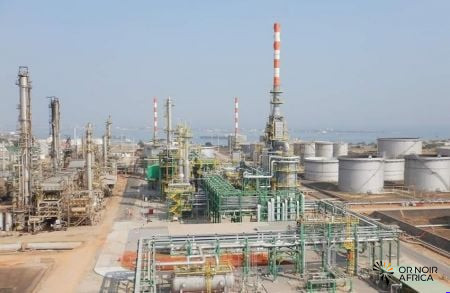
Angola is seeking to broaden the group of partners around its future Lobito refinery, one of the country’s largest industrial projects. Petroleum Minister Diamantino Azevedo renewed his invitation to Namibia on October 20, proposing that Windhoek join the project as a strategic partner.
Designed to process up to 200,000 barrels of crude per day, the facility is under construction in Benguela on the Atlantic coast. According to the minister, progress is close to 30%. The aim is to process part of Angola’s output domestically and supply fuels to Southern African markets, in a region where several countries remain exposed to imports of refined products.
Financing remains the hurdle
The project’s cost is estimated at $6.2 billion. In April, Joaquim Kiteculo, Sonangol’s head of refining, said approximately $4.8 billion still needed to be raised. Angola is therefore seeking additional capital while stating that it intends to retain a majority interest. This constraint complicates negotiations: partners must contribute sufficient resources without shifting the center of decision-making outside the country.
Luanda has already sounded out several states in the region. Zambia has expressed interest, Botswana has discussed possible participation, and talks have also taken place with China. Namibia has been approached since 2023. At the time, Namibian authorities had not decided between taking an equity stake in Lobito and developing a domestic refinery.
This hesitation is understandable. Namibia is preparing to become an oil producer following discoveries by Shell and TotalEnergies in the Orange Basin, but it still needs to assess recoverable volumes, production timelines and domestic processing requirements. Participating in Lobito could provide exposure to regional infrastructure; it would not replace analysis of Namibia’s own resources and supply needs.
Reducing costly dependence
Despite its crude exports, Angola imports a large share of the fuels used in its economy. In the first half of 2026, these purchases reached approximately $1.96 billion for 1.8 million tonnes of refined products, according to figures released by Sonangol. The gap between abundant crude and reliance on imports illustrates the weakness of domestic refining capacity.
The future refinery could reduce this dependence and diversify oil sector revenue. But its size requires sufficient demand, regular feedstock supplies and suitable storage and transport facilities. Exports to neighboring countries will also depend on trade agreements, fuel standards and available logistics networks.
A timetable dependent on capital
Commissioning is expected around 2027, but construction remains exposed to financing risk. A regional partner’s participation could share costs and strengthen outlets, provided governance and return arrangements are clear. At this stage, no firm Namibian decision has been announced.
Lobito’s ability to become a regional hub will therefore depend on more than the planned 200,000 barrels per day. It will hinge on financial close, adherence to schedules and integration with distribution networks. For Angola, attracting partners while retaining control of the project is a central balancing act; for Namibia, the challenge is to distinguish an investment opportunity from a long-term commitment that still needs evaluation.
Have any thoughts?
Share your reaction or leave a quick response — we’d love to hear what you think!
-
 0
-
0
-
0
-
0
-
0
-
0





