

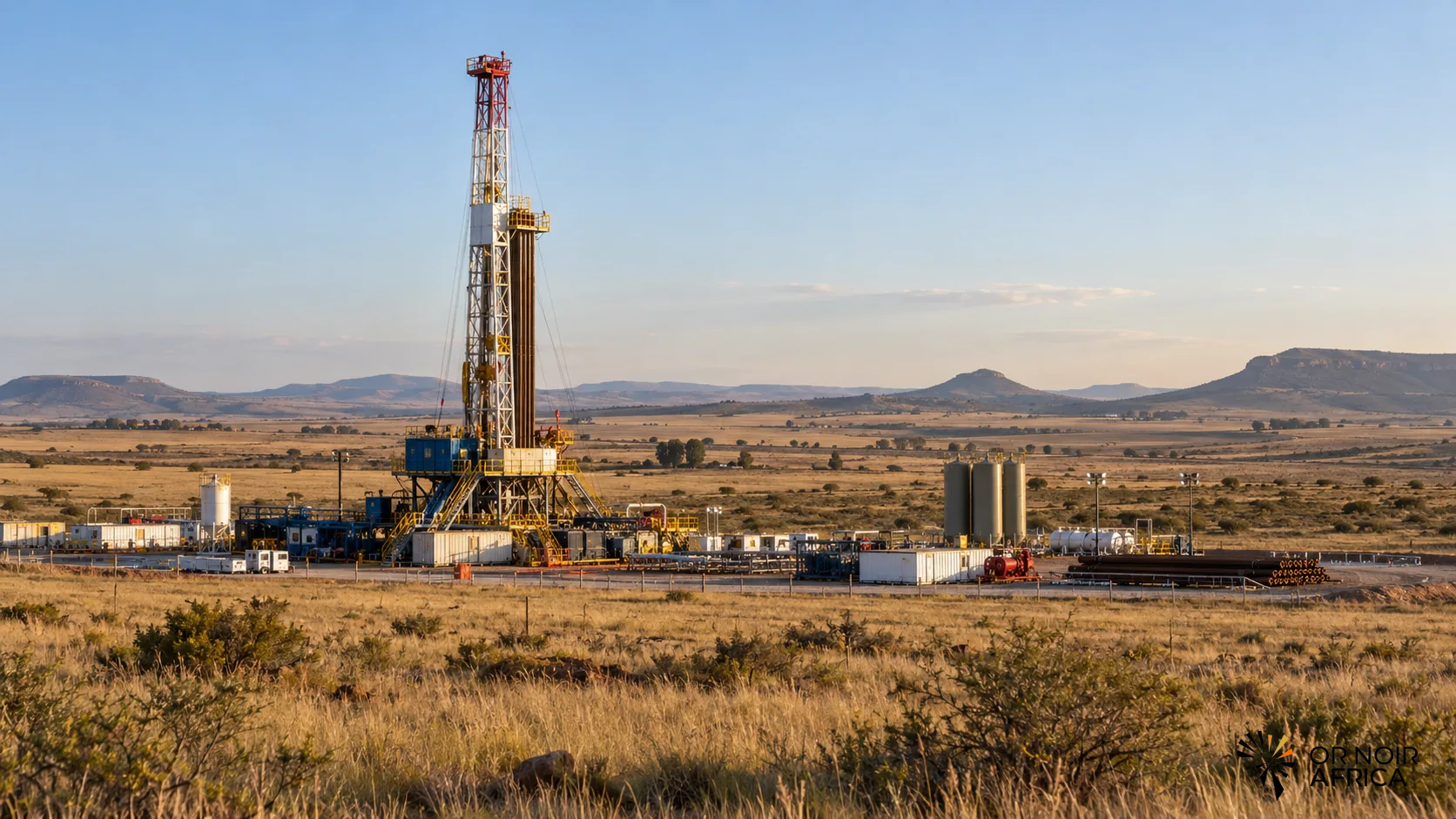
D3 Energy has secured Strategic Integrated Project status for its gas assets in South Africa's Free State. The designation covers exploration right ER315 and production right application PR016. It places the project within the national infrastructure development framework and may facilitate coordination between government departments and stakeholders as the company seeks to move its resources closer to the commercial phase.
This recognition comes as Pretoria seeks to strengthen security of supply and give energy projects greater visibility. D3 Energy presents its asset as a potential natural gas and helium resource. Strategic status is a useful regulatory step, but it does not mean that gas will be produced in the short term: studies, project-specific approvals, financing, infrastructure and proof of commercial viability remain decisive.
An institutional signal for ER315 and PR016
The status granted under South Africa's Infrastructure Development Act covers two related areas. ER315 is the exploration right held by D3 Energy in Free State province. PR016 concerns the area for which the company is pursuing a production right application. This distinction reflects two different phases: exploration serves to improve knowledge of the subsurface and evaluate resources; a production right governs the possibility of extracting hydrocarbons, subject to the necessary approvals.
Recognition as a Strategic Integrated Project aims to improve coordination and visibility for a project considered important to national priorities. It can help organize discussions with the relevant public bodies and stakeholders. For a medium-sized company that must advance a project through several administrative and technical stages, this visibility can support discussions with potential partners.
However, it does not replace the regulatory decisions required at each stage. The status is neither a production authorization, nor a guarantee of grid access, nor a financial commitment by the state. Its practical value will depend on its ability to accelerate procedures, clarify responsibilities between institutions and advance preparatory work.
Gas and helium: two markets to assess
Interest in the project rests on the reported presence of natural gas and helium in the Free State basin. Gas could help diversify supply in a country seeking to secure its energy system and ease some of the constraints affecting industry and electricity generation. Helium is used in specialized sectors, including healthcare, research, electronics and certain industrial applications. Its value depends on concentration, the ability to separate it from the gas mixture and the existence of reliable buyers.
The coexistence of these two resources offers a potential development opportunity, but also makes project evaluation more demanding. Investors will need to know the quality and recoverable volume of the gas, processing costs, transport requirements and sales terms. For helium, resource certification and the establishment of a separation, storage and export chain will be essential. A resource identified underground becomes an economically extractable reserve only when the technical and economic conditions are sufficiently established.
The priority will therefore be to consolidate data from exploration work and demonstrate that both products can be developed within a coherent model. Gas could potentially provide the foundation for revenues and infrastructure, while helium could add value if commercial specifications are met. This combination should not be taken for granted before testing and feasibility studies.
An opportunity in an energy system under strain
South Africa faces substantial supply needs and structural constraints in its electricity system. Developing new domestic gas resources is regularly presented as a way to complement the energy mix, support certain industrial activities and provide a dispatchable source to back up renewable energy. However, a project's actual contribution depends on its size, cost and commissioning date.
In this context, a domestic gas project may attract interest from public authorities and potential buyers, but it will have to compete with alternative solutions: imports, renewables, storage, energy efficiency and other forms of generation. Infrastructure choices are particularly important. Without connections, processing facilities, offtake contracts or market access, strategic recognition is not enough to turn resources into available energy.
The Free State location may offer opportunities for integration with existing or planned infrastructure, but these will need to be confirmed as studies progress. Transport to industrial consumers and power generation facilities will be among the issues to examine before any final investment decision.
The milestones that will show whether the project scales up
The status secured by D3 Energy marks institutional progress, but the next phase must provide operational evidence. The most useful indicators will be progress in processing PR016, publication of a work schedule, flow test results, more precise resource estimates and the identification of industrial or financial partners.
The designation's practical effect on administrative timelines will also need to be assessed. If it enables more effective coordination between public services, it could reduce uncertainty over schedules and improve project preparation. If it is accompanied by neither dated milestones nor development commitments, it will remain primarily institutional recognition.
For South Africa, the stakes extend beyond the progress of a single company. The country seeks to attract investment while advancing projects capable of meeting its energy and industrial needs. For D3 Energy, SIP 20f status increases the visibility of its assets and places the project within a broader national framework. However, the next proof of progress will not be the label itself, but the ability to convert exploration into demonstrated resources, then into contracts, infrastructure and commercially viable supply.
Have any thoughts?
Share your reaction or leave a quick response — we’d love to hear what you think!
-
 0
-
0
-
0
-
0
-
0
-
0





