

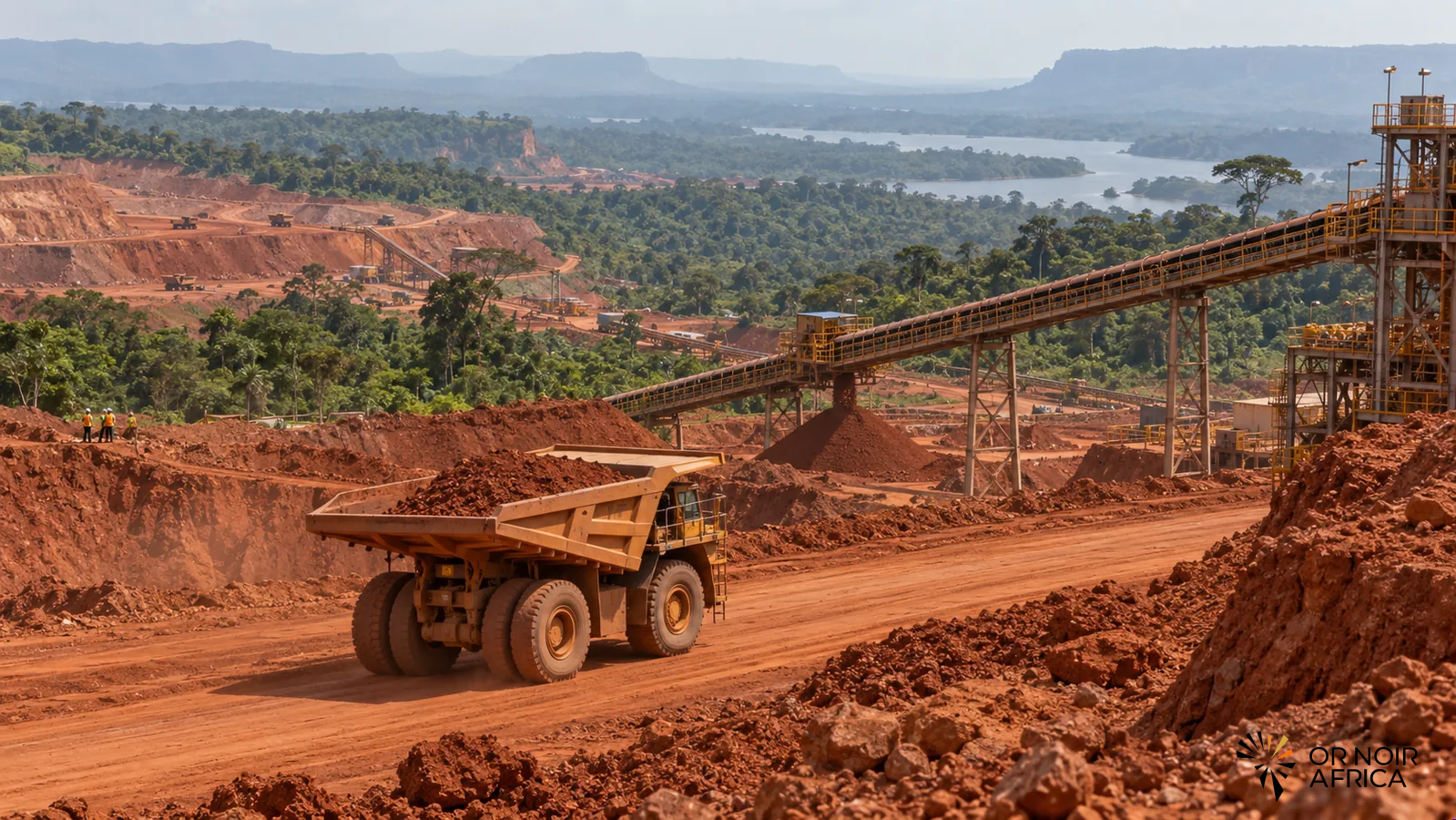
Nimba Mining Company (NMC), a mining company owned by Guinean interests, has concluded a five-year prefinancing and marketing agreement with Glencore. The Swiss trader is to provide more than $300 million in advance financing. In return, NMC commits to supplying it with between 10 and 12 million metric tons of bauxite per year, for a total volume of 50 to 60 million metric tons over the term of the agreement.
The transaction comes as global demand for aluminum continues to be supported by the automotive, packaging and construction sectors, as well as power generation equipment. For NMC, which is developing operations at Tinguilinta and seeking to increase its shipments, access to a global buyer and advance financing may reduce barriers to starting up and ramping up operations. For Glencore, the agreement secures a long-term source of supply in one of the world's leading bauxite regions.
A contract combining financing and a sales outlet
Mining prefinancing involves advancing capital to a producer, generally in exchange for future deliveries of raw materials. The financing may cover operating needs, equipment, logistics or expansion. For a company in the development stage, access to this liquidity may be faster than conventional bank financing, especially if it does not yet have a long production and sales track record.
However, this structure ties the company's commercial strategy to that of its buyer. Pricing, quality, delivery and repayment terms determine the agreement's actual value. A guaranteed volume can support planning and persuade other partners to commit, but it can also reduce the producer's flexibility if market conditions change significantly. The contract details will therefore be crucial to assessing how risk is shared between Glencore and NMC.
NMC has already demonstrated an ability to produce and ship bauxite since restarting its activities at Tinguilinta. The company reported shipping more than one million metric tons during its first year of operations. The new commercial commitment represents a major increase in scale: consistently reaching 10 to 12 million metric tons annually requires investment, reliable port logistics and close coordination between extraction, rail transport and ship loading.
Logistics as a prerequisite for scaling up
Guinea has significant bauxite resources and several export corridors. Production growth has nevertheless increased pressure on roads, railways, ports and communities near mining areas. A rapid increase in NMC's volumes must therefore be assessed against actual transport capacity and infrastructure needs.
Shipping tens of millions of metric tons over five years requires trains and loading facilities to handle the flows without creating bottlenecks. Expansion projects can engage Guinean subcontractors, provide jobs and support tax revenues, but their impact depends on how activities are organized. Communities often expect improvements in roads, water, electricity and public services. These benefits are not automatic and require careful monitoring of commitments.
Glencore's financing may thus facilitate operational progress, but it does not replace public investment in shared infrastructure. The authorities will need to ensure that growth in bauxite transport remains compatible with safety, corridor maintenance and coexistence with other users. Increased export volumes may also heighten dependence on a limited number of access routes if no additional development is planned.
From mining sovereignty to local processing
The involvement of a Guinean-owned company in the exploitation of the country's resources is often presented as a means of strengthening sovereignty. The central question is how to turn this presence into lasting industrial capabilities. Bauxite extraction and exports generate income and logistics activity, but processing it into alumina and aluminum adds higher-value stages and can broaden the economic benefits.
These stages require much greater investment, competitively priced electricity, water availability, technical expertise and markets. Guinean bauxite is exported to refining facilities in Asia and elsewhere, where it is converted into alumina before aluminum production. Developing a local industry cannot be reduced to a regulatory decision: power supply contracts, infrastructure, environmental regulation and a market strategy must be established.
The NMC–Glencore agreement may be a first step toward strengthening a national company and ensuring predictable revenues. It may also illustrate the continuing role of global traders in financing producers, including those with local ownership. The partnership does not mean that Guinea is losing control of its resource; rather, it shows that access to markets and capital still depends on international trading networks.
The agreement's performance will be measured over time: volumes actually delivered, fulfillment of commitments, public revenues, jobs and the development of local capabilities. NMC's challenge is to turn prefinancing into reliable operations and ensure that increased exports amount to more than a rise in raw tonnage. For Guinea, the next step will be to connect these supply contracts to an industrial policy capable of gradually increasing the share of value retained within the country.
Have any thoughts?
Share your reaction or leave a quick response — we’d love to hear what you think!
-
 0
-
0
-
0
-
0
-
0
-
0





