

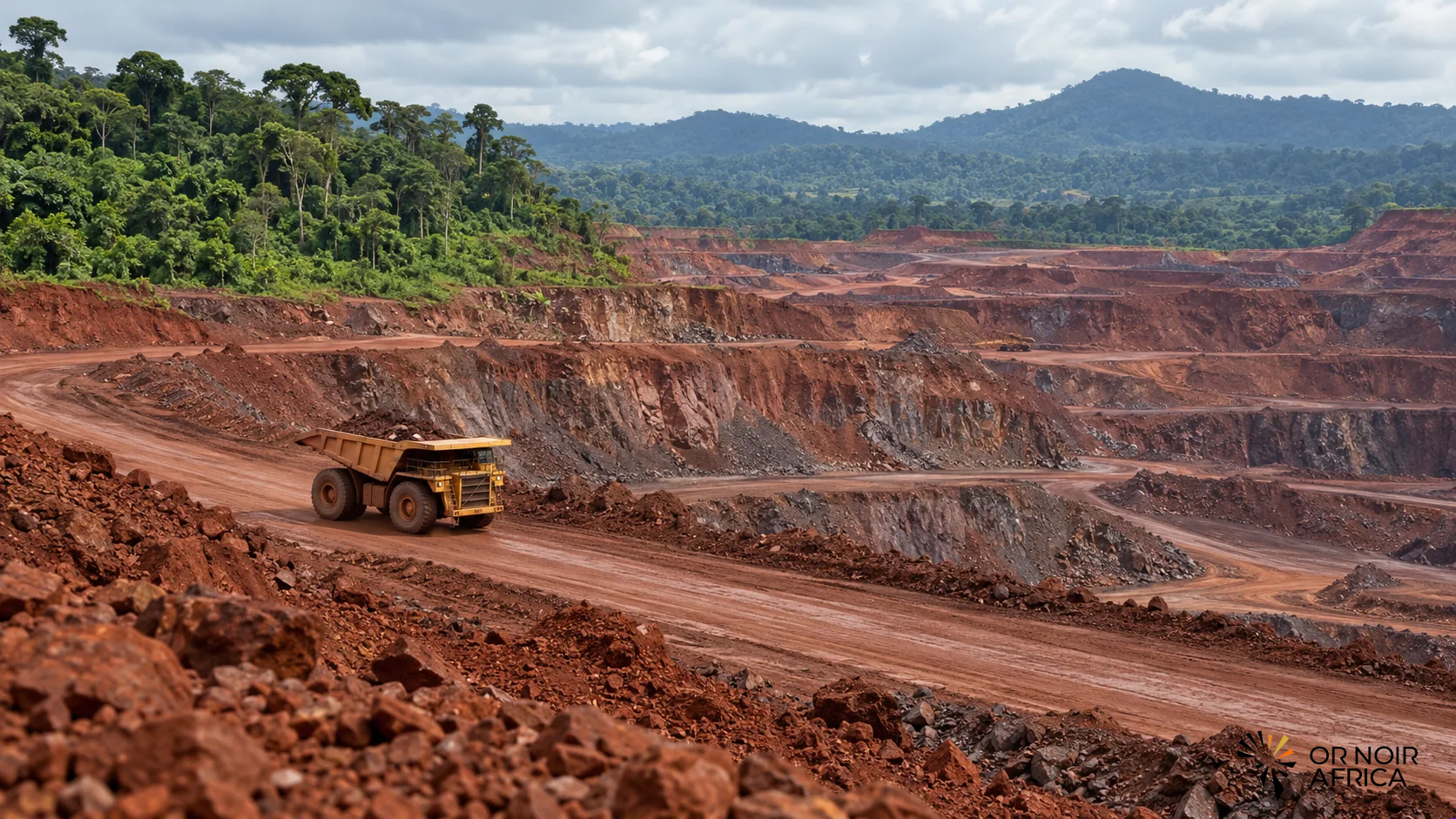
Gabon seeks to expand its role in strategic mineral supply chains. Already a major global manganese player, the country also holds iron ore, gold, niobium, tantalum and rare earths. The challenge is now to turn geological diversity into investment, local processing and lasting revenues beyond extraction and raw ore exports.
The priority is particularly visible in manganese. In 2024, Gabon ranked among the two largest global producers, accounting for approximately a quarter of world output according to US data. Production nevertheless remains concentrated among a few operators and dependent on rail, port and energy infrastructure. This position provides commercial influence but also exposes the country to price cycles and international groups’ investment decisions.
From exported ore to an industrial chain
Manganese has long been used in steel production. It is also taking on a new dimension through demand for certain battery materials and other technologies. What qualifies as ‘critical’ varies by country and use, but international competition to secure supplies now places African producers at the center of industrial resilience discussions.
In July 2026, Gabon’s government and Eramet signed a memorandum of understanding to study scenarios for increased manganese processing in Gabon. The roadmap envisages local processing of up to 700,000 metric tons of ore annually by the end of 2031, subject to economic viability and implementation conditions such as energy access. Partners also mentioned a biochar industry using forestry coproducts and a ‘Made in Gabon’ industrial start-up fund.
This memorandum establishes a direction, not yet operational industrial capacity. Scenarios must be studied, financed and implemented; profitability will depend on energy costs, global demand, logistics and targeted processed products. Success will also require technician training, local firms’ access to contracts and clear risk allocation between the state and operator.
Mabounié: another mineral opportunity
The Mabounié polymetallic deposit in Moyen-Ogooué province is regularly presented as a diversification opportunity. It contains niobium, tantalum, phosphates, scandium and rare earths. Work and studies have already been undertaken, but development remains demanding: confirming resources, adapting processing to complex ore, designing infrastructure and demonstrating overall profitability.
Dusk Gabon, a New Energy Metals subsidiary, says it concluded an agreement with the state in 2024 to restart development and feasibility studies. This polymetallic project requires an integrated value strategy: extracting one metal may not cover costs if other components cannot be competitively separated and sold.
Local processing therefore means more than building a plant near a mine. It requires reliable metallurgical knowledge, energy and reagent supplies, tailings management, transport solutions and outlets for every product. Resource projections and investor announcements must be distinguished from proven reserves and funded installations.
Conditions for attracting capital without losing value
Investors examine mining framework stability, permits, taxation and infrastructure access. Gabon’s 2019 mining code provides the general framework, but strategic projects also require clear agreements and precise obligations. Recent decisions on local processing and national content show the state wants greater participation in resource-generated value.
This ambition can improve benefits if accompanied by realistic contracts, credible schedules and coordination with electricity, rail and ports. Processing obligations poorly aligned with costs or outlets can delay projects, while a model without local requirements risks maintaining an economy exporting minimally processed products. Decisions must focus on actual added value, lasting jobs and skills, public revenues and finished-product competitiveness.
Gabon must also preserve environmental and social operating conditions. Mining can affect forests, water, land and communities. Environmental assessment, consultation, watershed monitoring and tailings management must begin at design rather than be treated as late formalities.
A market opportunity, not a guarantee of success
Global critical mineral demand offers Gabon negotiating opportunities, but a mineral’s strategic status guarantees neither high prices nor lasting markets. Technologies evolve, buyers diversify suppliers and processing plants require substantial financing. Shared infrastructure, regional chains and affordable energy access will be decisive.
The country has strengths: established manganese production, mining-related rail infrastructure and several underdeveloped resources. The priority is connecting these strengths to a measurable industrial strategy with feasibility, investment, construction and capacity-expansion milestones. Gabon will truly capitalize on its potential when commitments become operational installations, local suppliers and competitive processed products.
Have any thoughts?
Share your reaction or leave a quick response — we’d love to hear what you think!
-
 0
-
0
-
0
-
0
-
0
-
0





